
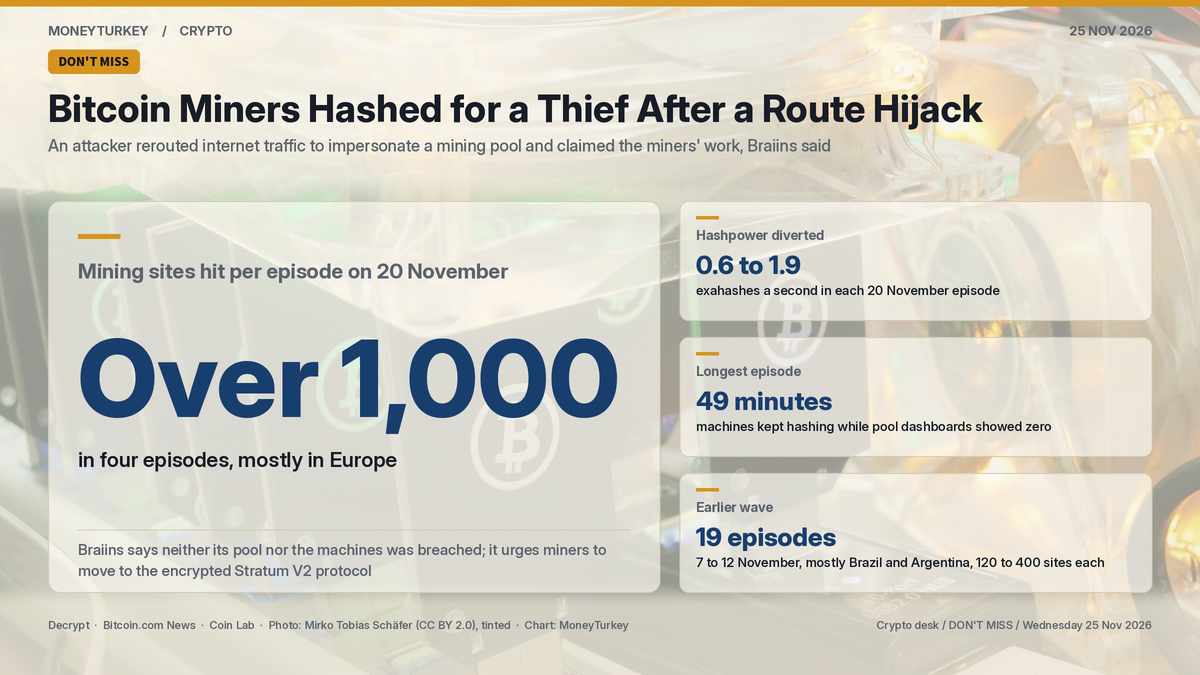
For up to 49 minutes at a time, more than 1,000 bitcoin mining sites kept burning electricity for someone else. Mining software firm Braiins said on Wednesday that an attacker rerouted internet traffic to impersonate a mining pool and claimed the miners’ work under its own account, according to Decrypt and Bitcoin.com News.
A fake pool, real work
Braiins said neither its pool nor the affected machines was breached, Decrypt and Bitcoin.com News reported. The attacker exploited Stratum V1, the unencrypted protocol that carries work between miners and pools and gives a miner no way to check that the server on the other end is the real pool, according to the same reports.
The trick was a hijack of the Border Gateway Protocol, the trust-based system that tells networks where to send internet traffic. The attacker announced a narrower block of addresses that contained a pool’s endpoint, so networks that did not validate the route sent miners’ connections to an impostor, Decrypt and Coin Lab reported. The fake pool handed out genuine jobs and pocketed the resulting shares, while the hijacked machines kept hashing at full power and their real pool dashboards showed zero, according to Decrypt and Bitcoin.com News.
From Brazil to Europe
Braiins traced 19 earlier episodes between 7 and 12 November, mostly in Brazil and Argentina, each hitting 120 to 400 sites, according to Bitcoin.com News and Coin Lab. On 20 November four larger episodes, mostly in Europe, each struck more than 1,000 sites and diverted between 0.6 and 1.9 exahashes per second, the same outlets and Decrypt reported.
It is the second warning of its kind in weeks. Mining-services firm Luxor reported last week that hackers had redirected its miners’ rewards, an incident it tied to AI-assisted attacks, Decrypt reported.
What everyone’s missing
The weakness is old. Dell SecureWorks documented the same routing trick stealing about $83,000 in mining rewards in 2014, according to Decrypt and Bitcoin.com News. The fix exists too: Braiins is urging miners to move to the encrypted Stratum V2 protocol, or to Stratum V1 over TLS with certificate checks, and has released a free proxy for those who cannot upgrade, Decrypt and Coin Lab reported. Bitcoin itself is not at risk, because the attack steals rewards from individual miners rather than changing the blockchain, Coin Lab noted. The bill lands on the miners who never upgraded.
For information only. Not investment advice.
Related on MoneyTurkey
- Luxor Blames AI-Enabled Hack for Diverted Miner Rewards
- Bitcoin Trades Far Below Its Mining Cost, JPMorgan Says
- A Coldcard Flaw Hid From 15 Security Reviews for Five Years
Sources
- Decrypt: Another Bitcoin Mining Firm Flags ‘Hashrate Hijacking’ Attacks That Reroute Rewards
- Bitcoin.com News: Braiins Warns of Widespread Bitcoin Hashrate Hijacking Attacks
- Coin Lab: Braiins: Stratum V1 attack hijacked hashrate of 1,000+ mining sites
- The Block: Bitcoin miners hit by hashrate hijacking attack exploiting unencrypted connections