
By Andrew, Editor-in-Chief, and MoneyTurkey editors | Andrew’s Corner | 11 November 2026, London
Yesterday I said October’s inflation report would be the first test of the stock market’s peace trade. The report came in hot, and Asia bought anyway. Within a few hours, the AI trade got good news about demand and bad news about money. Seoul and Taipei chose to price the first. I think the second will matter more.
Washington made money dearer
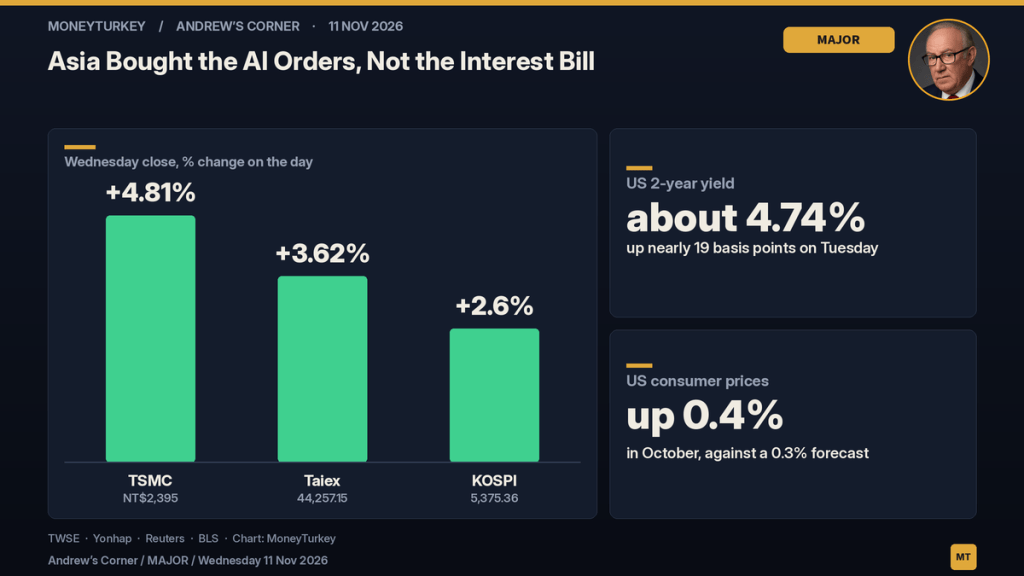
US consumer prices rose 0.4% in October against a 0.3% forecast, and core prices, which strip out food and energy, rose 0.3% against 0.2%, the Bureau of Labor Statistics said. It was the third straight monthly gain of 0.4% or more in the headline index, Reuters reported. Hours earlier in London, Fed Governor Christopher Waller had set his own bar: if core came in around 0.3%, “a 50 basis point hike in the policy rate should be considered at the December meeting.” It did.
By the close, a December hike of at least a quarter point was fully priced, up from 84% on Monday, Reuters reported, citing CME FedWatch, with about a 12% chance of a half point. The 2-year Treasury yield jumped nearly 19 basis points to about 4.74%, its biggest daily rise since April 2025, Reuters reported. The 10-year yield topped 5% during the session and was just under 5% late in the US session, Yahoo Finance and Reuters data show. Wall Street slipped rather than broke: the S&P 500 fell 0.38% to 7,520.93 and the Nasdaq Composite 0.74% to 25,065.87. Nvidia was at the centre of the decline, CNBC said, falling 5.47% to $168.89 as its board hired lawyers to investigate chief executive Jensen Huang.
Asia bought the orders
Then CoreWeave, which rents out AI computing power, reported third-quarter revenue up 168% and raised its 2026 guidance after the US close, CNBC reported. Asia took that as evidence that the demand is real. Taiwan’s Taiex rose 3.62% to 44,257.15, back above 44,000 for the first time since 2 November, as TSMC climbed 4.81% to NT$2,395 (about $73), according to Economic Daily News. Seoul’s KOSPI turned a weaker open into a 2.6% gain at 5,375.36, and the smaller Kosdaq jumped 5.62% to 705.10, setting off a buy sidecar, a five-minute pause on program buying, for the second day running, Yonhap reported. Maeil Business Newspaper put the chip rally down to CoreWeave’s results, hopes around Anthropic’s planned listing and strong exports. Nasdaq 100 futures were up about 1.3% at 07:40 London time on Yahoo Finance data.
The bill comes through the lenders
Here is why I would not celebrate yet. The AI build-out is not paid for out of petty change. It is financed, and CNBC noted that companies like CoreWeave have been under growing pressure from rising interest rates. CoreWeave’s shares had lost about 40% in a month before these results, and some of its bonds recently yielded more than 16%, CNBC reported. One portfolio manager put it neatly in an email to CNBC: “The business can execute well and still face a tougher financing environment.” That sentence is the whole story of this week.
Seoul and Taipei sell the hardware. Their revenue depends on customers who keep ordering chips, and those customers increasingly borrow to do it. When the 10-year Treasury yield sits near 5% and the Fed is debating a bigger hike, every data centre that needs outside money gets more expensive to build. Demand can stay strong while the willingness to fund it shrinks. Strong orders this quarter do not settle that.
My read
This was a fair rally on a fair piece of news. CoreWeave answered the question the market had been asking for a month, which was whether anyone still wants this much computing power. The answer was yes. But the question has moved on. It is now what that computing power costs to finance, and on Tuesday Washington raised the answer. Asia priced the orders. It has not yet priced the interest bill.
There is also a gap at the top. The world’s most important AI chipmaker has lost nearly 10% in two sessions over a governance problem, not a demand problem, and reports earnings a week from today. Asia rallied around Nvidia, not with it. That can last for a day or two, but not for long.
What I’m watching: whether the 10-year yield settles above or below 5%; Fed speakers on the size of a December move ahead of the 8 and 9 December meeting; Nvidia’s results next Wednesday; and whether foreign investors, net buyers of the KOSPI but sellers of the Kosdaq on Wednesday, keep buying Seoul.
The AI trade has its demand back. What it needs now is cheaper money, and Washington just signalled the opposite.
For information only. Not investment advice. FX conversion at about NT$32.8 per dollar (around 07:50 London, 11 November).
Sources
CNBC: October CPI report
Reuters: US consumer prices rise for a third straight month
Reuters via StreetInsider: Wall Street close, FedWatch odds and the 2-year yield
Business Insider: Waller’s half-point remarks
CNBC: Nvidia’s second day of losses
CNBC: CoreWeave third-quarter results
Reuters via Investing.com: Nvidia earnings date and AI-sector selling
Yahoo Finance market data: index closes, 10-year yield, futures and FX, about 07:40 to 07:50 London
MoneyTurkey desks: Seoul close (Yonhap, Maeil Business Newspaper), Taipei close (Economic Daily News), Waller and the US close

