
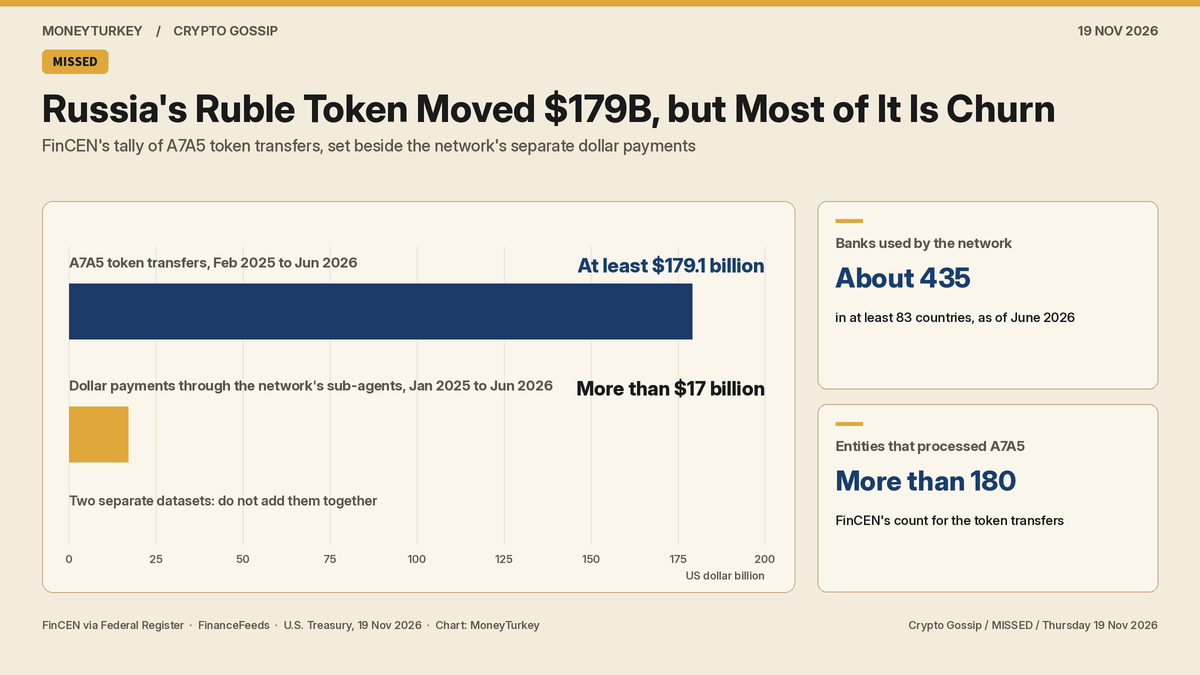
A stablecoin most crypto traders have never heard of has moved more money than many of the coins they watch every day. US regulators say more than 180 entities processed at least $179.1 billion in transactions in A7A5, a token backed by Russian rubles, between February 2025 and June 2026. The figure has been doing the rounds again this week. It is big, but it is also misleading: much of it is the same money moving in circles inside a sanctions-evasion network.
MoneyTurkey | Crypto Gossip | 19 November 2026
Key points
- The Treasury’s Financial Crimes Enforcement Network traced at least $179.1 billion in A7A5 transactions from February 2025 to June 2026
- A7A5 runs on the Tron and Ethereum blockchains and is backed by ruble deposits at Promsvyazbank, a sanctioned Russian defence bank
- The wider A7 Network’s companies held accounts at about 435 banks in at least 83 countries as of June 2026
- Its intermediaries processed a separate $17 billion or more in dollar payments, a figure that should not be added to the token total
What the number means
The token works as an internal ledger. Transfers between wallets the network controls stand in for real payments in dollars, euros, yuan or dirhams that its intermediaries make through ordinary bank accounts abroad. Because the same tokens can be passed back and forth to balance the books, gross blockchain volume overstates the new economic activity behind it, FinanceFeeds noted. The $179.1 billion measures turnover, not money laundered or capital that left Russia.
Why it is back
The figure comes from an alert FinCEN issued on 1 October alongside a proposal to cut off the network’s foreign intermediaries from US banks. Comments on that proposal closed on 4 November, and fresh analysis of the record this week has put the token back in front of crypto readers. FinCEN says the network has served Iranian state bodies, sanctioned companies and cybercriminals, and that after an alleged hack of the Grinex exchange in April the token has moved into self-held wallets, away from sanctioned exchanges.
Why traders should care
A7A5 is often swapped into Tether, the biggest dollar stablecoin, before it is turned into dollars or other currencies. That puts pressure on exchanges, over-the-counter brokers and stablecoin issuers that touch those flows, and it is the kind of exposure regulators are now asking banks to flag in suspicious activity reports.
What to watch
- Whether FinCEN finalises its rule against the network’s intermediaries
- Freezes by stablecoin issuers of wallets linked to A7A5 swaps
- Russia’s own crypto rules for savers and firms
Related on MoneyTurkey
- Russia Opens Crypto to Savers, but Firms Fear the List
- Binance Wins a $6.5B Court Freeze to Chase Its Stolen Crypto
For information only. Not investment advice.
References
- Federal Register (FinCEN): Proposal of Special Measure Regarding the A7 Network’s Sub-Agents
- FinanceFeeds: FinCEN Says Russia’s A7 Network Used 435 Banks Across 83 Countries
- DaveFinances: FinCEN Details $179.1B in A7A5 Stablecoin Transfers
- GOV.HOUSE: Comments close on FinCEN’s plan to cut off A7 Network sub-agents