
By Andrew, Editor-in-Chief, and MoneyTurkey editors | Andrew’s Corner | 17 November 2026, London
For years Jensen Huang was one of the loudest voices for a simple argument: cut China off from American chips and you don’t stop China, you build its rival. He resigned as Nvidia’s chief executive last week, and with him went much of the industry’s weight in that debate. On Tuesday, Hong Kong’s stock market made his case for him.
Washington moved first
On Monday the US Commerce Department issued an interim rule that closes the route Chinese companies have used to reach top AI chips without buying them: renting computing power from data centres abroad. Data centres that supply significant computing power to companies headquartered in China now need a licence, and so does any shipment of advanced AI chips to Indonesia, Malaysia, Singapore, Thailand and Brazil, according to the rule text and Fortune. Chips bound for companies headquartered in the US, or owned by one, are exempt from the five-country licence if they meet reporting rules. The rule also tightens the terms for chip factories and packagers that make advanced chips for designers in restricted countries, the Bureau of Industry and Security said, a point Citi flagged in a note reported by AASTOCKS.
Fortune noted that the rule was the first change to export controls since the scandal around Huang broke. It also recalled that Huang had long warned such measures would encourage a competing Chinese chip industry.
Asia sorted itself
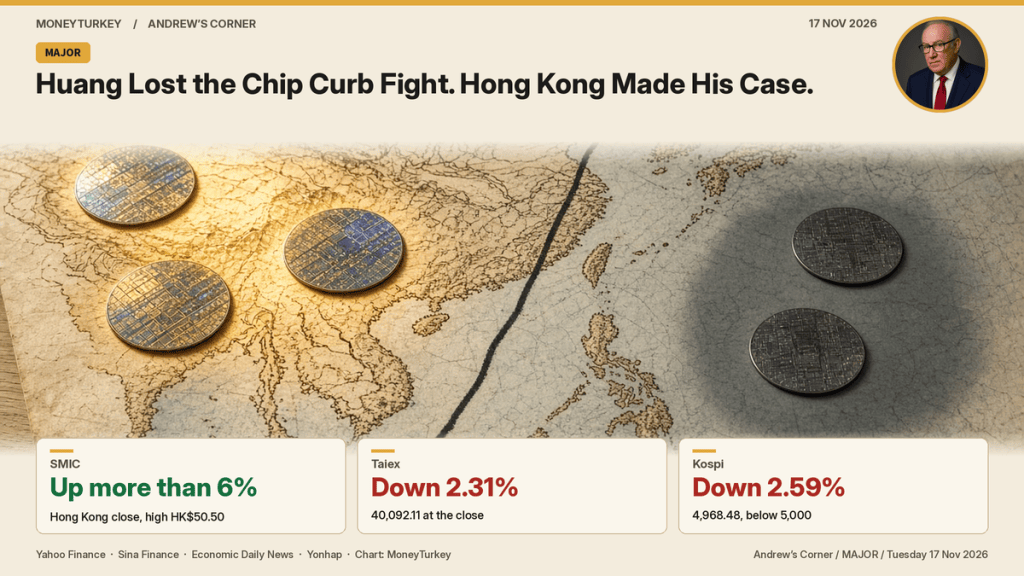
Asia’s markets read the rule the way the rule reads the world: by side. Taiwan’s Taiex fell another 2.31% to 40,092.11, leaving it 8.2% below Friday’s close after two sessions, and TSMC lost 2.03% to NT$2,170 (about $66), the Economic Daily News and the Central News Agency reported. Seoul’s Kospi dropped 2.59% to 4,968.48, its first close below 5,000 since early February, as foreign investors sold a net 1.44 trillion won (about $1.08 billion) of shares, Yonhap and Hankyung reported. Kang Jin-hyuk of Shinhan Securities told Yonhap the pressure came from the fallout around Nvidia, “U.S. restrictions on remote access to Nvidia’s AI chips” and doubts over how long AI demand lasts.
Hong Kong went the other way where it counted. SMIC, China’s biggest chipmaker, rose as much as 9.6% to HK$50.50 and closed more than 6% higher at just over HK$49 (about $6.30), according to Yahoo Finance and Sina Finance data. Investing.com and Business Insider tied the jump to bets that the curbs will speed up China’s push for home-grown chips, and Hua Hong Semiconductor rallied with it. Alibaba and Tencent, which need the computing power rather than make the chips, fell, Business Insider reported. The Hang Seng ended about 0.9% lower.
Not every move was about the rule; Nvidia nerves had already hit Asia on Monday. But the split is the story. A chipmaker that sells to China rose. The companies that build, rent or rely on American AI chips in Asia fell. Investors were not dumping AI. They were asking who sits on which side of Washington’s line.
Tonight answers a different question
The obvious event of the week comes at about 21:20 London time, when Nvidia reports third-quarter results with interim chief executive Colette Kress, the company said. Options imply a move of about 8% to 9% in the shares either way, TipRanks and Benzinga calculated. The stock fell 4.1% on Monday to $156.14, Yahoo Finance data show, as the Nasdaq Composite closed more than 10% below its October record, Reuters reported. Investopedia and CNBC also had Nvidia down more than 4%.
A strong quarter would settle whether the orders were real. It would not change the rule. Commerce gave data centres already serving Chinese companies 90 days to get a licence, according to Fortune and the rule text, so the effect on who can buy and rent Nvidia chips in Southeast Asia will show up in coming quarters, not in tonight’s numbers. “For Malaysia, the controls could be disastrous,” Joshua Kurlantzick of the Council on Foreign Relations told Fortune, because Malaysia sees serving Chinese AI companies from its data centres as a big future industry.
My read
Markets have spent two days treating this as one AI sell-off. I think it is two. One is a question of confidence in Nvidia and in the spending forecast behind it, and Kress can go some way to answering it tonight. The other is a question of maps, and no earnings call settles that. Every new rule that splits the chip world into two camps makes China’s own chipmakers more valuable to China, and makes the American supply chain a little less of a sure thing for the countries in between.
That is the argument our Blindspot essay The Commoditisation of High Tech makes about past booms: a scarce, premium technology rarely stays scarce. New capacity arrives, prices fall and the margin moves. A China pushed to build its own chips is new capacity in the making, and Tuesday’s tape in Hong Kong was a small, early sign that investors see it.
The next test is political, not financial. President Trump is due to meet Xi Jinping and Vladimir Putin in Shenzhen on Thursday and says trade is on his list, The Guardian and AP reported. If chips come up, that meeting may move Asia’s chip stocks more than tonight’s quarter.
What I’m watching: what Kress says about orders from China and Southeast Asia, not just total revenue; whether Malaysia and Singapore push back on the rule; whether SMIC holds Tuesday’s gain; and whether chips make Thursday’s agenda in Shenzhen.
Huang may have lost the argument in Washington. On Tuesday, investors in Hong Kong were still pricing it.
Related on MoneyTurkey
- SMIC rises 6.6% as chip shares diverge
- Taiex Loses 8% in Two Days as Kospi Slips Below 5,000
- Nasdaq Enters Correction as Wall Street Dumps Chipmakers
For information only. Not investment advice. FX conversions at about NT$32.9, 1,338 won and HK$7.85 per dollar (Tuesday Asian session).
Sources
Bureau of Industry and Security: interim final rule on remote access to advanced semiconductors
Fortune: the Commerce rule, Huang and Southeast Asia
NBC News: US closes the remote-access loophole
BigGo Finance, citing AASTOCKS and Citi: Hong Kong chipmakers
Investing.com: why SMIC surged
Business Insider: Asian tech stocks and the new US rule
Economic Daily News: Taiex close (Chinese)
Yonhap: Seoul stocks fall for a fourth day
Nvidia: third-quarter results timing
Yahoo Finance market data: Asian closes, Hong Kong shares, Nvidia and FX, about 07:45 to 08:05 London
MoneyTurkey desks: Seoul close, Nvidia options, Shenzhen meeting

