
Saudi Arabia has found enough ways round the Strait of Hormuz to make its war slump look smaller. It is still borrowing its way through it.
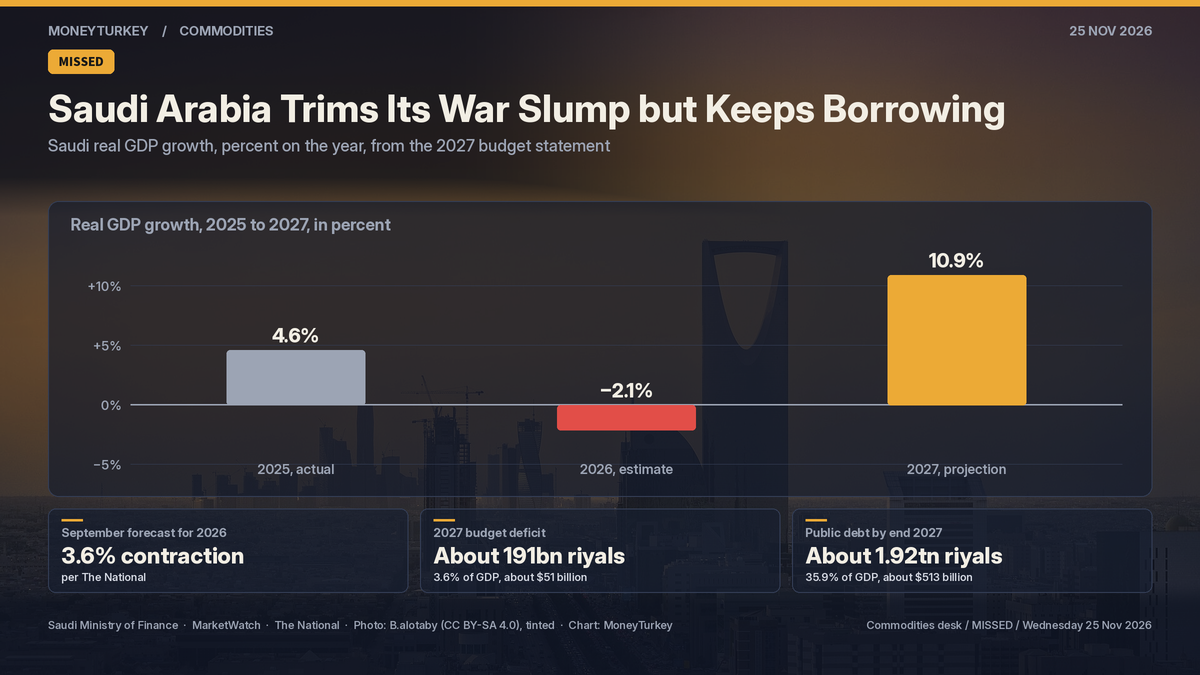
The kingdom now expects its economy to shrink 2.1% this year, the Finance Ministry said on Tuesday as it set out its 2027 budget, according to the ministry and MarketWatch. That follows growth of 4.6% in 2025, according to the ministry’s budget statement and Argaam. In September the ministry had pencilled in a 3.6% contraction, according to OilPrice and The National.
It expects growth of 10.9% next year as oil output recovers, the ministry and MarketWatch said.
The road around Hormuz
Crown Prince Mohammed bin Salman pointed to the East-West oil pipeline and the ports on the Red Sea coast as the routes that kept exports flowing while the Gulf was disrupted, according to The National and MarketWatch, both citing the Saudi Press Agency.
The rest of the economy is cooling, though. Official estimates for non-oil growth this year range from 2.3%, in the finance minister’s statement, to 2.5%, in the budget document and in the crown prince’s remarks, according to the ministry, OilPrice and The National.
Still in the red
The 2027 budget plans spending of about 1.392 trillion riyals ($371 billion) against revenue of about 1.202 trillion riyals ($321 billion), the ministry said, figures also reported by MarketWatch and The National. That leaves a deficit of about 191 billion riyals ($51 billion), or 3.6% of GDP, all three said.
This year’s gap is far wider. The ministry now estimates the 2026 deficit at about 245 billion riyals ($65 billion), or 4.9% of GDP, against the 165 billion riyals ($44 billion) it budgeted a year ago, according to the budget statement and The National.
What everyone’s missing
A narrower deficit does not mean less debt. Public debt is set to rise from about 1.73 trillion riyals ($462 billion), or 34.5% of GDP, at the end of this year to about 1.92 trillion riyals ($513 billion), or 35.9% of GDP, by the end of 2027, according to the ministry and MarketWatch. That is roughly 190 billion riyals of new borrowing in a year the kingdom expects to grow by double digits.
For information only. Not investment advice.
Related on MoneyTurkey
- Baghdad Moves to Take Back Oilfields Held by Kurdistan
- Iran Says Three Tankers Hit Mines, and Oil Barely Moves
- Russia’s Record Oil Year in Asia Looks Like a One-Off
Sources
- Saudi Ministry of Finance: Final Budget Statement for FY2027
- Saudi Ministry of Finance: Budget Statement 2027
- MarketWatch: Saudi Arabia Approves $371 Billion Budget for 2027
- The National: Saudi Arabia approves $371bn budget as non-oil growth slows
- Argaam: Saudi Arabia sees 10.9% real GDP growth in 2027
- OilPrice: Saudi Arabia Sees Smaller Economic Slump as More Oil Reaches Market