
For two years, money chasing artificial intelligence flowed to Seoul and Taipei and left India behind. Goldman Sachs now argues that is the reason to go back, turning overweight on Indian stocks just as investors start asking what happens when the AI trade cools.
MoneyTurkey Research Desk | 18 November 2026
Key points
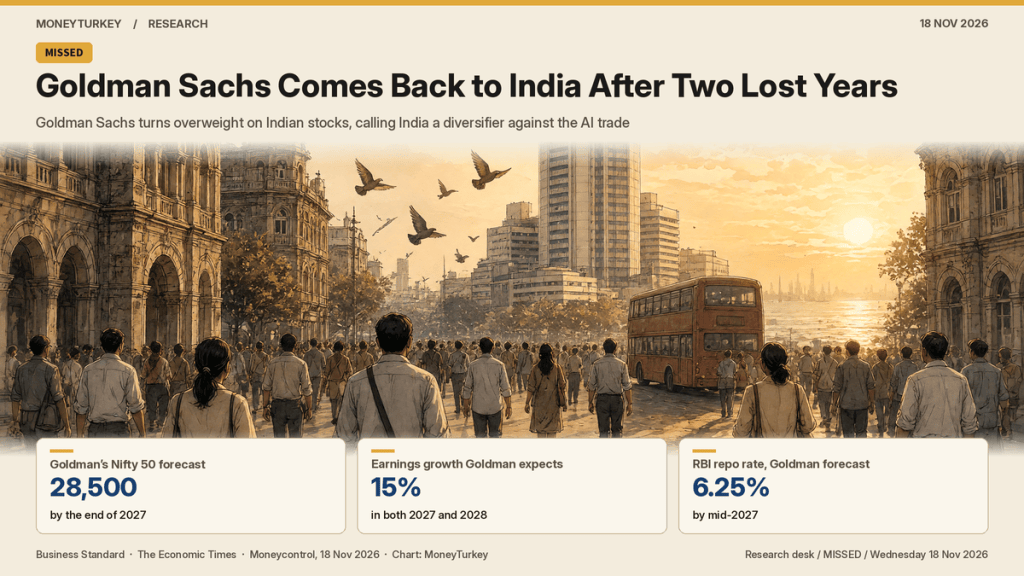
- Goldman Sachs upgraded India to overweight with a Nifty 50 target of 28,500 by the end of 2027, the bank said in a note
- The call rests on expected earnings growth of 15% in both 2027 and 2028
- Goldman called India an attractive diversifier against the AI trade
- Its economists expect the Reserve Bank of India to raise its repo rate to 6.25% by mid-2027
The call
Goldman Sachs said in a note that strong domestic demand, robust earnings and foreign positioning at a decade-plus low make India worth owning again. The bank described India as a “clear AI diversification contender”. The 28,500 target implies upside in the low teens from current levels. Goldman managing director Sunil Koul discussed the target on a call with clients, The Economic Times reported.
Koul said the gains would come from earnings alone, with no rise in valuations built into the target.
Why now
Foreign investors pulled $64 billion from Indian stocks from peak to trough between 2024 and 2026, Goldman said. Since the so-called anti-AI rotation began in October, India has taken the largest share of foreign inflows into emerging markets. Goldman thinks global funds remain heavily underexposed, leaving room for that to reverse further.
Valuations have also come down. The market’s forward price-to-earnings ratio has fallen from a peak of 25 times to close to its 10-year average, Goldman said. It expects MSCI India profits to grow 11%, 15% and 15% in 2026, 2027 and 2028, slightly below consensus.
Where Goldman is leaning
The bank is overweight banks, which it expects to benefit from rate hikes, low valuations and light positioning, and it has upgraded industrials to overweight. It is also overweight defence, utilities, telecoms and internet companies, and underweight IT services, healthcare, cement and chemicals.
The rate backdrop
Goldman’s India economists expect a quarter-point rate rise in December and another half point in the first half of 2027. They forecast inflation averaging 5.7% in 2027, up from 4.6% this year, and growth slowing to 7.2% from 7.9%.
Risks
Goldman sees valuations rising 7% to 8% in its bull case and falling 10% to 12% in its bear case. Oil is the swing factor, because of what it does to inflation, the rupee and foreign sentiment, the bank said.
What to watch
- Whether foreign inflows into India keep building as the AI trade cools
- The Reserve Bank of India’s December decision
- Oil prices, which Goldman names as the main risk to the call
Related on MoneyTurkey
- The Commoditisation of High Tech
- HSBC Lifts India to Overweight, Cuts China to Neutral
- Record Stock Inflows Carry the Rupee Past Asian Rivals
For information only. Not investment advice.
References
- Business Standard: Goldman Sachs upgrades India to overweight; Dec.’27 Nifty target at 28,500
- The Economic Times: Nifty target 28,500: Why Goldman Sachs is betting on India’s mean reversion
- Business Today: Nifty at 28,500 by 2027? Sunil Koul of Goldman Sachs on India overweight stance
- Moneycontrol: Goldman Sachs sees RBI raising repo rate to 6.25% by mid-2027, India growth slowing to 7.2%
- NewsBytes: Goldman Sachs predicts RBI rate rise to 6.25% by mid-2027
- Zee Business: RBI repo rate outlook: HSBC, Goldman Sachs and BofA

