
By Andrew, Editor-in-Chief, and MoneyTurkey editors | Andrew’s Corner | 16 November 2026, London
Last Wednesday I wrote that Asia had bought the AI orders and ignored the interest bill. Demand was no longer the question, I argued; the cost of funding it was. Three sessions later, both are questions, and on Monday Asia’s chip markets answered them the only way a market can before the facts arrive: they sold.
Asia went first
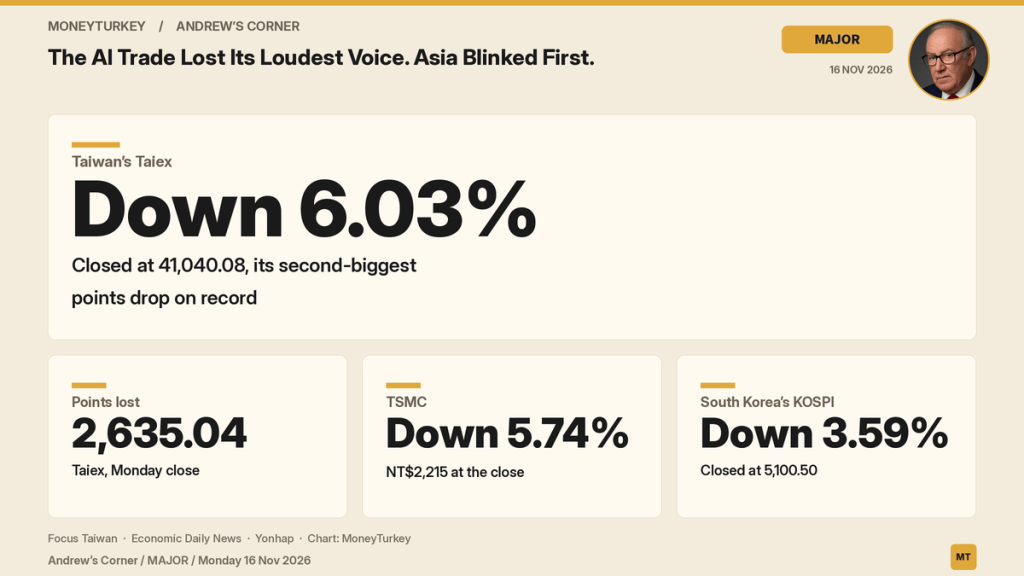
Taiwan’s Taiex fell 2,635.04 points, or 6.03%, to 41,040.08, its second-biggest points drop on record, according to Focus Taiwan and the Economic Daily News. TSMC, which makes most of Nvidia’s AI chips, lost 5.74% to NT$2,215 (about $67). The selling ran the length of the supply chain, from server assemblers to cooling, circuit-board and chip-substrate makers, the United Daily News reported. Traders who expected Taiwan’s National Financial Stabilization Fund to cushion the fall saw no sign of it, the Economic Daily News said.
Seoul’s KOSPI fell 3.59% to 5,100.50, with SK hynix down 7.89% and Samsung Electronics down 4.47%, Yonhap reported. Foreign investors sold a net 1.38 trillion won (about $1 billion) of shares. Tokyo’s Nikkei 225 dropped 2.42% to 59,662.02. Before London opened, Nasdaq 100 futures were down about 0.8% on Yahoo Finance data.
Two shocks, one bill
The obvious story is Jensen Huang. He resigned as Nvidia’s chief executive on 12 November after an extramarital affair raised US national security concerns, AP reported, and finance chief Colette Kress is running the company on an interim basis while the board looks for a successor. Nvidia shares fell 2% on Friday to $162.85, down nearly 13% on the week and about a third below their October peak, Business Insider reported. Taiwan’s central bank governor, Yang Chin-long, told legislators on Monday that the departure had caused significant short-term turbulence and that its effect on the AI sector would stay unclear until Nvidia names a successor, TaiwanPlus reported.
But a leadership change alone does not knock 6% off a market. The second shock is the one I flagged last week. The 10-year Treasury yield rose about 29 basis points last week to 5.15%, its biggest weekly gain since April 2025 and its highest close since mid-October, Dow Jones data show. Futures markets now treat a Fed rate rise on 9 December as close to a certainty, according to CME FedWatch data cited by CNBC and Reuters. The United Daily News, explaining Monday’s rout to Taiwanese readers, put both blows on its list: doubt over Nvidia’s strategy and spending, and worry that dearer money will squeeze AI data-centre investment and tech valuations.
Put them together and the problem is plain. Asia’s chip rally was priced on a forecast of AI spending. The person most associated with that forecast has gone, and the money that pays for the spending got more expensive in the same week.
What Tuesday can and cannot answer
Nvidia reports third-quarter results after the US close on Tuesday, at about 21:20 London time, with Kress’s written commentary posted alongside, the company said. That quarter ended on 25 October, so the numbers will describe orders booked under Huang. A strong set would show the demand was real. It would not tell us who sets Nvidia’s course next year, how hard Washington will now push on chip exports, or what a 5% 10-year yield does to customers borrowing to build data centres.
Washington is part of this too. House Speaker Mike Johnson has spoken of a “developing consensus in Congress” on limiting chip exports to China, and lawmakers want to attach chip bills to the annual defence bill, as our politics desk reported on Sunday. A scandal that began as a governance story is becoming a policy one.
My read
Monday was not a verdict that AI demand has gone. Individual investors in Seoul bought about 1.34 trillion won (about $1 billion) of shares, Hong Kong edged higher, and Korean brokers described a rotation into financials and consumer staples rather than a rush for the exit. What Asia sold was certainty: the assumption that someone at the top of the chain would keep promising more spending, and that the money for it would stay cheap.
That is why I would not read too much into whichever way Asia jumps on Wednesday morning. Good numbers from Nvidia could spark a relief rally in Taipei and Seoul. If the 10-year keeps climbing towards its 5.31% high of early October, the rally would be answering last quarter’s question, not this one.
What I’m watching: what Kress says about next year’s orders, not just last quarter’s revenue; Fed Chair Kevin Warsh and other Fed speakers this week; whether foreign investors keep selling Seoul; and whether the chip bills make it into the defence bill.
The AI trade can get through a quarter without its loudest voice. It will find a 5% 10-year yield harder to live with.
For information only. Not investment advice. FX conversions at about NT$32.9 and 1,335 won per dollar (Monday Asian session).
Sources
Focus Taiwan (CNA): Taiex close
United Daily News: Taiex, TSMC and the AI supply chain (Chinese)
TaiwanPlus: central bank governor Yang Chin-long
Yonhap: KOSPI close and foreign selling
Business Insider: Nvidia shares and Asia’s AI trade
AP: Asian markets and Huang’s resignation
Nvidia: third-quarter results timing
Dow Jones via Morningstar: 10-year yield week
Yahoo Finance market data: index closes, futures and FX, about 07:55 to 08:05 London
MoneyTurkey desks: Taipei close, Treasury week, Congress and chip curbs

