
By Andrew, Editor-in-Chief, and MoneyTurkey editors | Andrew’s Corner | 10 November 2026, London
Yesterday I wrote that Asia’s rebound was rented from Taipei. Overnight the landlord changed. Monday’s rally did not come from a stabilisation fund or from Nvidia, which fell. It came from the price of a barrel of oil, and behind that from a bet that the US-Iran war is ending. Equities have priced that peace. The people who set and trade interest rates have not.
The barrel did the buying
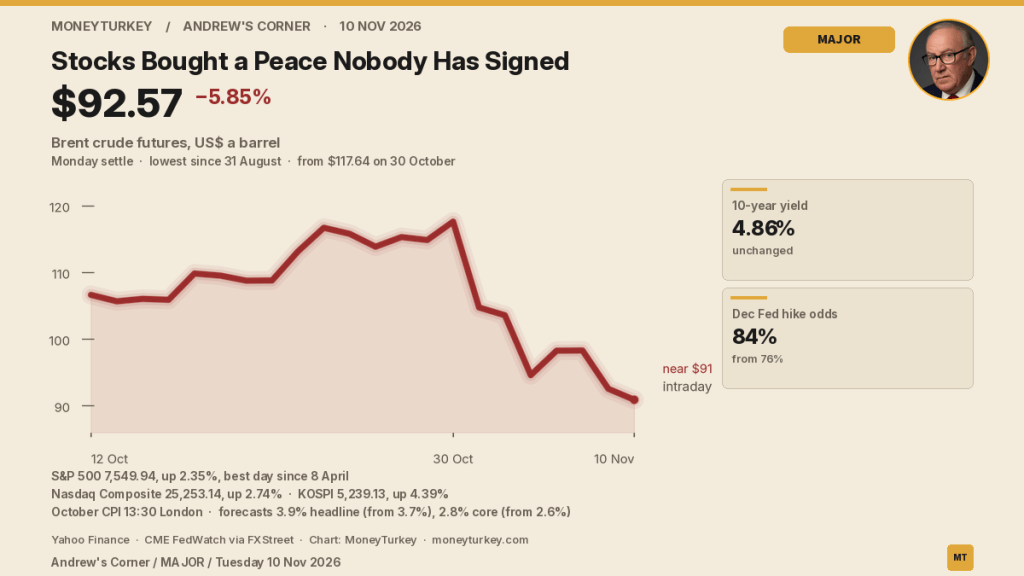
Brent crude fell 5.85% on Monday to settle at $92.57 a barrel, its lowest since 31 August, after President Donald Trump said fresh strikes on Iran were highly unlikely while talks progressed. It was trading near $91 this morning. Brent ended October at $117.64 on Yahoo Finance data, so more than a fifth of the price has gone in six sessions.
Wall Street took that as an inflation cut. The S&P 500 rose 2.35% to 7,549.94, its best day since 8 April, and the Nasdaq Composite gained 2.74% to 25,253.14. The Philadelphia chip index jumped 6.85%, and Nvidia was the only stock in it to fall, Reuters reported. Nvidia closed 4.27% lower at $178.67, Yahoo Finance data show, as its board investigates Jensen Huang. Advanced Micro Devices rose 13.26%. When a market buys every chipmaker except the biggest one, it is not making a fresh call on AI. It is covering shorts, as one New York fund manager told Reuters, and pricing cheaper energy.
Asia took the same trade
Seoul made the logic plain. The KOSPI closed up 4.39% at 5,239.13, tripping a buy-side sidecar within minutes of the open, and foreign investors were net buyers of ₩365.9 billion (about $274 million), Yonhap reported, after a seventh straight day of selling on Monday. SK Hynix rose 6.69%. But so did the oil-sensitive names: Korean Air jumped 11.51%. Tokyo’s Nikkei 225 closed up 2.87% at 60,459.58, back above 60,000 for the first time in three sessions, and Taiwan’s Taiex added another 2.52% to 42,711.92.
Nobody has signed anything
Here is the problem with pricing a peace: there isn’t one yet. Trump said on Monday the war could end “fairly soon” and that Iran “militarily is effectively over”, but he plans to keep the naval blockade in place for now and has left the door open to new strikes. Iran has sent a proposal through Qatari mediators demanding sanctions relief, Reuters reported, while Mohsen Rezaei, secretary of Iran’s Supreme National Security Council, told Washington to stop “manufacturing fake news about imaginary talks”. Secretary of State Marco Rubio on Sunday called Tehran’s demands “outrageous and ridiculous”. Attacks on shipping around the Strait of Hormuz are still occurring, CNBC reported, and Houthi fire struck Saudi Arabia’s East-West pipeline on Monday.
The bond market didn’t take the trade
The more telling signal is what did not move. The 10-year Treasury yield ended Monday at 4.86%, where it closed on Friday, on a day when oil fell almost 6%. And the odds of a Federal Reserve rate hike at the December meeting rose to 84% from 76% a day earlier, according to the CME FedWatch tool as cited by FXStreet, after hawkish remarks from the Fed’s Thomas Barkin and Austan Goolsbee. If cheaper oil were going to rescue the Fed, rate futures would have said so. They said the opposite.
That is because the Fed sets policy on inflation it has measured, not on the inflation equity traders expect. Today’s US consumer price report, at 13:30 London time, covers October, when Brent futures settled at an average of about $108 a barrel on our count of Yahoo Finance daily data. Forecasts call for headline inflation to rise to 3.9% from 3.7% and core to 2.8% from 2.6%, FXStreet reported. Stocks are trading November’s barrel. The Fed will be reading October’s.
My read
Monday was a real relief rally, and cheaper oil is good news for everyone who buys fuel, from Korean Air to American households. But the equity market has jumped two steps ahead: from “strikes are unlikely” to “the war is over”, and from “oil is lower” to “the Fed can stand down”. Neither step has been confirmed by the people who would have to take it. The bond market is the one asking for evidence.
So I would treat this afternoon’s CPI as the first test of the peace trade, not a footnote to it. A hot October number will not undo a lower oil price, but it can keep a December hike in play, and a hike is exactly what Monday’s buyers have assumed away.
What I’m watching: October CPI at 13:30 London against the 3.9% and 2.8% forecasts; whether the 10-year yield finally moves, and in which direction; Brent near $91 and any confirmed talks, or any new strike, around Hormuz; and whether foreign buyers stay in Seoul for a second day.
Stocks have bought a peace nobody has signed, paid for with an inflation report nobody has seen. One of those arrives this afternoon.
For information only. Not investment advice. FX conversion at about ₩1,335 per dollar (around 08:05 London, 10 November). October Brent average is MoneyTurkey’s calculation from Yahoo Finance front-month daily settlements.
Sources
Reuters via Euronext: Monday’s US close, oil settlement and Nvidia
CNBC: Monday’s market and Rubio comments
CNBC/Reuters: oil and Rezaei comments
CNBC: Trump on the Iran war
AGBI: East-West pipeline strike
Yonhap: Seoul close and foreign buying
Newsworks: Nikkei close
FXStreet: CPI forecasts and CME FedWatch odds
BLS: CPI release schedule
Yahoo Finance market data: index closes, Brent, 10-year yield and FX, about 08:05 London
MoneyTurkey desks: Nvidia and Advanced Micro Devices, ASX 200

