
Nobody knows quite how much power America’s data centres will need, or when the next heat wave or cold snap will squeeze the grid. That uncertainty has become a business of its own. Power producers, utilities and traders are hedging it on Intercontinental Exchange in record amounts, and the fastest growth is in Texas.
MoneyTurkey Derivatives Desk | 20 November 2026
Key points
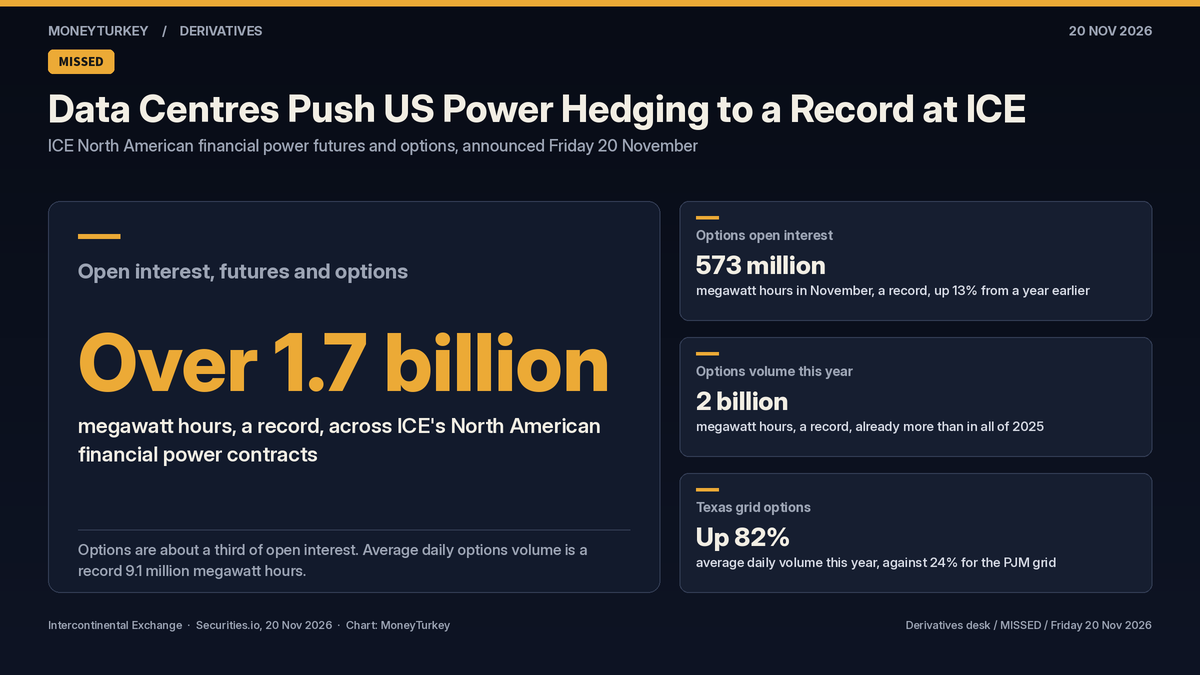
- Open interest across ICE’s North American financial power futures and options reached a record of more than 1.7 billion megawatt hours
- Options made up about a third of that, at a record 573 million megawatt hours in November, up 13% from a year earlier
- Options volume has hit a record 2 billion megawatt hours so far this year, already more than in all of 2025, and average daily volume is a record 9.1 million megawatt hours, up 25%
- Average daily options volume is up 82% this year in Texas grid contracts and 24% in contracts covering the PJM grid in the Mid-Atlantic and Midwest
What happened
The exchange announced the records on Friday. Open interest measures how many contracts are still outstanding, so a record means more positions are being held open, not just traded in and out. The options figures show the sharpest change. Options let a buyer pay for protection against a price spike without committing to a fixed amount of power, which suits a market where demand is hard to predict.
“Managing extreme weather, data center growth and tighter supply is now central to how participants approach North American power,” said Brian Lewis, who runs North American natural gas and power at ICE. He said options had grown in importance as a way to hedge exposure that is hard to size or time.
Why it matters
Texas is where that pressure shows most. Its grid, run by ERCOT, is largely cut off from its neighbours, so it has little room to borrow power when demand jumps. The PJM grid covers 13 states and Washington DC. When the people closest to those grids pay up for protection, they are telling you how uncertain they think next year’s power prices are.
It is also a reminder that the AI boom has a physical bill. Even on a day when chip stocks are being sold hard, the demand for electricity that the build-out has already created is not going away.
What to watch
- Whether ERCOT options keep outgrowing other regions into the winter
- Power prices in Texas and PJM during the first cold snap of the season
- Whether rival exchanges report similar growth in power hedging
Related on MoneyTurkey
- The Commoditisation of High Tech
- German Wind Gets Its First Exchange Hedge at CME
- Cboe Lets Traders Bet on the Earnings Number, Not the Stock
For information only. Not investment advice.
References
- Intercontinental Exchange: Open interest across ICE’s North American financial power futures and options reaches a record 1.7 billion megawatt hours
- Securities.io: ICE power options trading rises 25% as open interest sets record
- Yahoo Finance (Business Wire): Open interest across ICE North American financial power futures and options reaches a record