
American brewers pay far more for the aluminum in their cans than the world benchmark suggests. The top US derivatives regulator now says the extra charge behind that gap should be reformed.
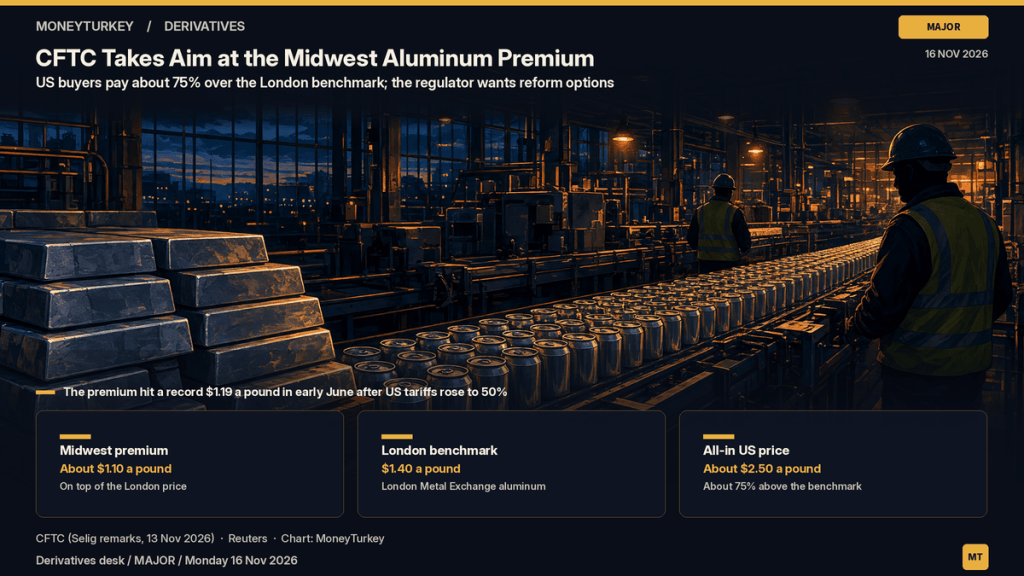
• Midwest premium about $1.10 a pound on top of a $1.40 benchmark
• CFTC weighs new US-based aluminum contracts
Commodity Futures Trading Commission Chairman Michael Selig has ordered staff to draw up reform options for how US aluminum is priced, and to study new US-based contracts that could challenge the London benchmark.
MoneyTurkey Derivatives Desk | 16 November 2026
Key points
- Selig told the Beer Institute’s annual meeting in Washington on Friday that he had directed the CFTC’s global markets team to develop “concrete reform options” for aluminum pricing.
- He put the Midwest premium at about $1.10 a pound on top of a London Metal Exchange benchmark of $1.40, taking the all-in US price to roughly $2.50, about 75% above the benchmark.
- The premium hit a record $1.19 a pound in early June, more than double a year earlier, after US tariffs on aluminum imports rose to 50%.
- Selig also floated a derivatives market built specifically for recycled aluminum.
What happened
US buyers of physical aluminum typically pay the London Metal Exchange price plus the Midwest premium, an assessment published by Platts, part of S&P Global, that reflects the cost of delivering metal into the United States. Selig said the London contract’s “cheapest-to-deliver” structure means its price can reflect metal in the lowest-cost delivery location rather than the cost of securing aluminum in the US.
“The concern is that American manufacturers, including our beer producers, can face prices incorporating costs that do not reflect their actual supply chains,” Selig said, according to the CFTC’s published text. “This is one of my top priorities as Chairman,” he added. “If we are successful, you’ll never have to hear the words ‘Midwest premium’ ever again.”
He said the commission would examine whether additional US-based aluminum contracts could “improve local price discovery and give commercial end users more effective hedging options,” but warned that a contract only works if producers and consumers actually trade it. The CFTC does not set aluminum prices, he noted. The plan is a review, not a new rule.
The pushback
A Platts spokesperson told Reuters the Midwest premium is an independent and transparent reference, that its use is entirely voluntary and that its methodology is rigorously tested. “Our daily price assessment is grounded in actual activity in the open market, reflecting bids, offers and transactions from buyers and sellers in the physical spot market,” the spokesperson said.
Beer Institute President Brian Crawford welcomed the remarks. “We support continued action by the administration and Congress to alleviate cost pressures caused by the Midwest premium,” he said, according to Reuters.
Why it matters
A manufacturer can hedge the London price, but if the regional premium jumps it still faces a sharp rise in the cost of the metal it actually receives, Selig said. That is the gap a US contract would aim to close. Alcoa has said the premium is likely to stay high even if tariffs on Canadian metal are cut, because the US still needs to import about 4 million tons of aluminum a year, Reuters reported via Investing.com.
Any US benchmark would also be a direct challenge to London’s long grip on metals pricing. Selig said in March that he wanted to bring base metals and critical minerals markets back to the United States.
What to watch
- Reform options from the CFTC’s global markets team
- Whether US exchanges propose new aluminum or recycled-aluminum contracts
- Any change to US tariffs on Canadian aluminum
Related on MoneyTurkey
- Marshall Islands Onchain Bond Joins Membrane Repo Collateral
- Webull Opens US Options to Italian Traders
For information only. Not investment advice.
Sources
- CFTC, Chairman Selig’s remarks: https://www.cftc.gov/PressRoom/SpeechesTestimony/opaselig15
- Reuters via Mining.com: https://www.mining.com/web/cftc-plans-to-overhaul-aluminum-pricing-in-us/
- Bloomberg: https://www.bloomberg.com/news/articles/2026-11-13/cftc-chief-calls-for-aluminum-pricing-reforms-after-costs-soar
- CRU Aluminum Market Update: https://www.aluminummarketupdate.crugroup.com/global-trade/aluminum-pricing-review-targets-midwest-premium/
- WWC One Media: https://wwconemedia.com/us-aluminum-pricing-faces-cftc-review-but-will-reform-lower-factory-costs/
- Reuters via Investing.com (Alcoa): https://www.investing.com/news/stock-market-news/alcoa-says-us-aluminum-premium-to-stay-high-despite-tariff-cut-93CH-4896685

