
Germany’s recovery came closer to stalling over the summer than first thought, and the reason is the part of the economy that is supposed to carry the rebound: investment.
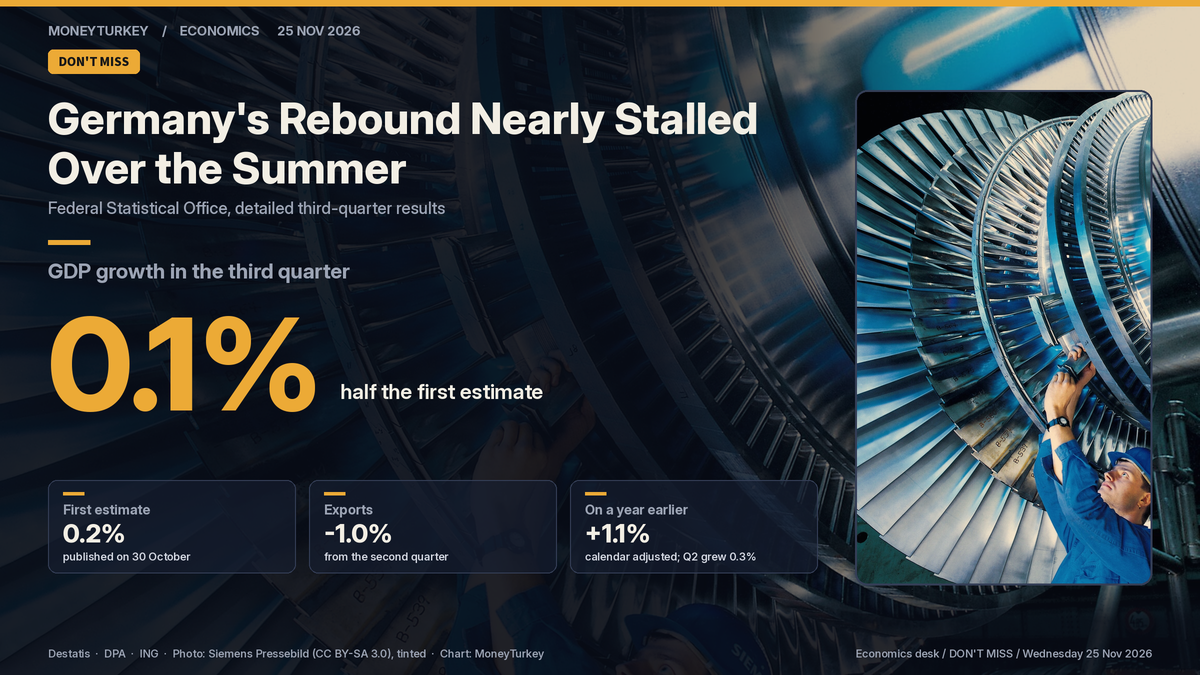
Gross domestic product rose 0.1% in the third quarter from the second, half the 0.2% the Federal Statistical Office first estimated on 30 October, the office said on Wednesday. Exports and retail sales in September were weaker than first assumed, the office said, according to its release and a DPA report carried by Yahoo Finance. Il Sole 24 Ore and ING also reported the 0.1% reading.
“After Germany’s economic performance was robust in the first six months of the year in the face of geopolitical crises, economic growth slowed in the 3rd quarter of 2026,” said Ruth Brand, president of the statistics office, according to the release and DPA.
Where the summer went wrong
Exports fell 1.0% from the second quarter, with cars and car parts, chemical products and metals all lower, the statistics office and DPA reported. Households cut back on food and fuel, both said, while low river levels over the summer weighed on chemical makers.
Investment did the most damage. Spending on machinery and equipment fell markedly, the statistics office said, deepening a slide that ran through the first half of the year, and only higher government buying, including for defence, stopped it being worse. ING said investment, which had shown strong signs of life in the second quarter, disappointed in the third.
Compared with a year earlier, the economy was 1.1% larger after adjusting for calendar effects, according to the statistics office and Il Sole 24 Ore. Growth in the second quarter was 0.3%, the office and ING said.
What everyone’s missing
The headline still counts as growth, the fourth quarter in a row by the statistics office’s figures, as ING noted. But the mix matters more than the decimal. Germany’s turnaround story rests on companies spending again, and private firms are still buying fewer machines while the state does the heavy lifting. ING called the data a strong warning that optimism should not turn into complacency, with high gas prices and new US tariffs among the risks it listed.
For information only. Not investment advice.
Related on MoneyTurkey
- Trump Readies New Tariffs, With China Set to Pay the Most
- Fitch Sees Sovereign Debt Trouble in the West, Not the South
- Turkey Pays for China’s Hybrid Surge With an EU Car Cap
Sources
- Federal Statistical Office (Destatis): Gross domestic product: detailed results on economic performance in the 3rd quarter of 2026
- Yahoo Finance (DPA): German economy grows 0.1% in third quarter, below first estimate
- Il Sole 24 Ore: Germany: Q3 GDP revised down to +0.1 per cent
- ING Think: German economic rebound lost steam in the third quarter