
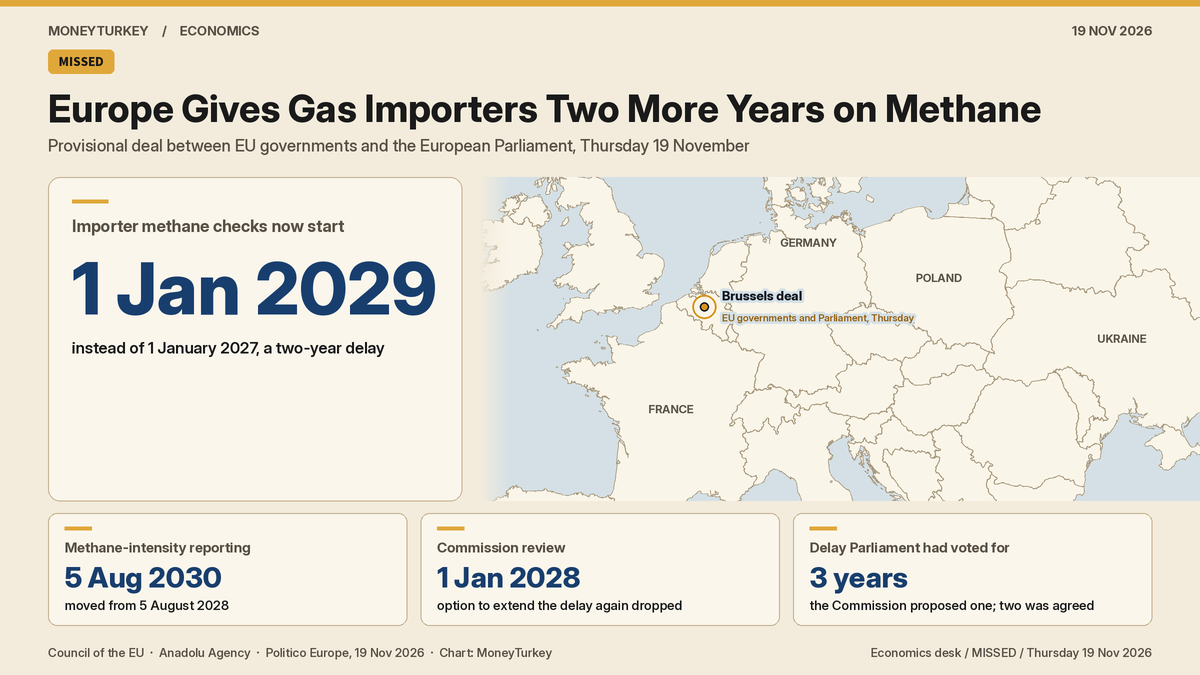
Europe has decided that keeping the gas flowing matters more, for now, than counting the methane that leaks on the way. In talks that ran into the early hours of Thursday, EU governments and the European Parliament agreed to delay the bloc’s methane checks on imported oil, gas and coal by two years, double the delay the European Commission had asked for.
MoneyTurkey Economics Desk | 19 November 2026
Key points
- Monitoring, reporting and verification rules for importers of crude oil, natural gas and coal now apply from 1 January 2029, instead of 1 January 2027
- Reporting on the methane intensity of supplies, for importers and EU producers, moves to 5 August 2030 from 5 August 2028
- The Commission will review how the rules are working by 1 January 2028, but an option to extend the delay again was dropped
How the deal was struck
The Commission proposed a one-year delay in October, after the war in Iran disrupted Gulf oil and gas and pushed up fuel prices. A group of governments backed by France wanted to stick to one year, while Parliament had voted for three. Two years was the split down the middle, the Council of the EU said in announcing the provisional agreement.
Campaigners got one thing back. A clause that would have let countries extend the delay again if they were still not ready was removed, Politico Europe reported. Any further postponement would now need a new law.
Why it matters
Methane traps around 80 times more heat than carbon dioxide over 20 years, and much of it escapes from wells, pipelines and coal mines long before the fuel reaches Europe. The 2024 regulation was meant to make foreign suppliers measure and report those leaks or lose access to the EU market.
The United States, Europe’s biggest supplier of liquefied natural gas, had warned that its cargoes could go elsewhere if the rules stayed as written, and energy companies said they risked supply shortfalls. With Gulf supply still unsettled, Brussels chose not to test that threat. For European gas buyers, the delay removes a compliance risk from contracts for the next two winters. For the climate goal, it means two more years of imported fuel with no methane accounting attached.
What to watch
- Formal approval by the Council and Parliament, which is due before the end of the year
- The Commission’s review by 1 January 2028, including whether there are enough independent verifiers
- Whether US exporters start offering methane data on their own to win European buyers
Related on MoneyTurkey
- The IEA Says the Iran War Has Changed Oil for Good
- Germany Cuts Its Power Tax to the EU Minimum, for a Year
- Bahrain’s Bombed Sitra Refinery Is Weeks From Full Output
For information only. Not investment advice.
References
- Council of the EU: Methane regulation: EU agrees targeted amendment to safeguard security of supply
- Anadolu Agency: EU reaches provisional deal to delay methane rules for fossil fuel importers by 2 years
- Politico Europe: EU extends delay of key methane rules to two years after US pressure
- EUobserver: EU gives oil and gas importers until 2029 on methane checks
- Eunews: EU methane obligations for fossil fuel importers delayed by two years