
By Andrew, Editor-in-Chief, and MoneyTurkey editors | Andrew’s Corner | 9 November 2026, London
Last week I argued that the AI bill was landing in Asia first. On Friday Wall Street bought some of it back: the Nasdaq Composite rose 1.09% to 24,579.42 and the S&P 500 added 0.31% to 7,376.86, a day after the Nasdaq’s 5.5% fall put it in correction. This morning Asia joined the rebound. Look at who did the buying, though, and Monday’s bounce is less a verdict on AI than a policy decision.
Taipei wrote the put
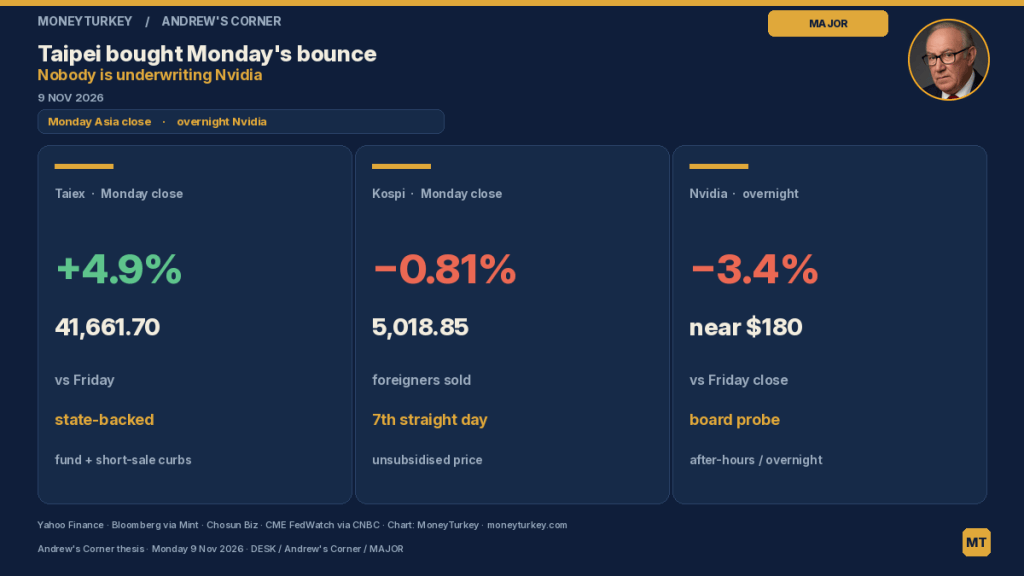
Taiwan’s Taiex closed up 4.9% at 41,661.70, ending a seven-session slide that had taken the market into bear territory. It did not get there alone. After Friday’s close the Financial Supervisory Commission cut the cap on intraday short sales of borrowed shares to 3% of average volume from 30% and lifted the short-selling margin requirement to 130% from 90%, and the government readied its NT$500 billion (about $15.2 billion) National Stabilisation Fund. TSMC closed 4.7% higher.
That is a put, and puts are worth having. But the history is worth having too. In a note reported by Bloomberg, Goldman Sachs’ trading desk said the fund actually deployed between NT$0.76 billion and NT$122.7 billion (about $23 million to $3.7 billion) in its nine previous activations. The market rallied 6% on average the following week and 22% over a year, yet six of those nine episodes saw further drawdowns of 5% to 28% within six months. The announcement does the work on day one. The bill comes later.
Seoul is the control group
If you want to see the AI trade with the policy stripped out, look at Seoul. Korean chipmakers had the same tailwind from Friday’s US rebound, and Samsung Electronics and SK Hynix were up nearly 4% at one point. They finished up 0.64% and 0.35%. The KOSPI closed down 0.81% at 5,018.85, barely holding 5,000, as foreign investors sold a net ₩692.7 billion (about $513 million), their seventh straight day of selling, Chosun Biz reported. That is what an unsubsidised bounce looked like this morning: bargain-hunters in, foreign money still out.
Tokyo’s rally runs on a weak yen
The Nikkei 225 closed up 2.33% at 58,775.50, led by banks and exporters. Exporters like a cheap yen, and the yen is cheap again: the dollar was buying about 157.9 yen around 08:10 London time. Data released on Monday show Tokyo spent a record ¥7.98 trillion (about $50.4 billion) buying yen on 30 July alone, Kyodo reported, and the dollar has been trading around 158 yen again since. Tokyo’s defence of the yen was real. It bought time, not a new trend.
Nobody is underwriting Nvidia
Here is the asymmetry. Taipei is leaning against the sell-off. America’s central bank is not. San Francisco Fed President Mary Daly told CNBC on Friday, after a 165,000 October payrolls gain against a 59,000 consensus: “My expectation is we’re going to have to tighten policy further.” She called the tech repricing “painful” but orderly, Reuters reported. On Friday, fed funds futures put the chance of a quarter-point hike on 9 December at more than 77%, according to CME FedWatch as cited by CNBC. China’s producer prices rose 5.7% in October from a year earlier, the fastest since June 2022, which is another reason for central banks to keep fighting inflation rather than protecting share prices.
Then the weekend added a risk no stabilisation fund can buy. Nvidia’s board said on Sunday it has opened an independent investigation into reports that chief executive Jensen Huang was the target of a foreign intelligence effort. The board said it has no reason to believe national security or company secrets were compromised and that it has confidence in Huang; no charges have been announced, and Beijing called the spying claims “baseless”. The shares traded about 3.4% lower overnight, near $180, against Friday’s close of $186.64, according to Yahoo Finance, which wipes out Friday’s rebound. Nvidia reports quarterly results on 17 November, and House committee chairs have asked Huang for a closed-door briefing on 18 November.
My read
Last week the market priced a slower American AI buildout. This week it has to price something harder: a key-person and national-security question at the company the whole trade leans on, while a Fed policymaker says plainly that more rate hikes are likely. Taipei can cap short sales on Taiwanese stocks. It cannot cap the discount on Nvidia’s governance, and neither can Tokyo’s yen.
So I would read Monday’s Asian rebound as rented, not owned. The put is local and temporary. The risk is American and, for now, growing. Europe was indicated to open little changed, Reuters reported, after Friday’s 1% fall in the Stoxx 600. That seems about right: nobody has yet been given a reason to pay up.
What I’m watching: whether the Taiex holds above 40,000 once the announcement effect fades and any purchase figures emerge; whether foreign selling in Seoul runs to an eighth day; Nvidia at Monday’s US open, and any update from its board before the 17 November results; and how close the dollar gets to 160 yen before Tokyo speaks up.
Taipei bought Monday’s bounce. Nobody is underwriting Nvidia. Until someone does, Asia’s rally is borrowed.
For information only. Not investment advice. FX conversions at about NT$32.81, ₩1,349 and ¥157.9 per dollar (around 08:10 London, 9 November).
Sources
CNBC: Friday’s US closes
Bloomberg via Mint: Taiwan short-selling curbs, stabilisation fund and Goldman Sachs note
Chosun Biz: KOSPI close and foreign selling
Kyodo: Japan’s record intervention data
CNBC: Daly interview and Reuters via Investing.com
CNBC: jobs report and CME FedWatch odds
National Bureau of Statistics: China October PPI and CNBC
Nvidia board statement, The Guardian and Yahoo Finance
Reuters via Boursorama: Europe’s expected open
Yahoo Finance market data: index closes and FX, about 08:10 London
MoneyTurkey desks: Taiwan rally, Japan intervention data

