
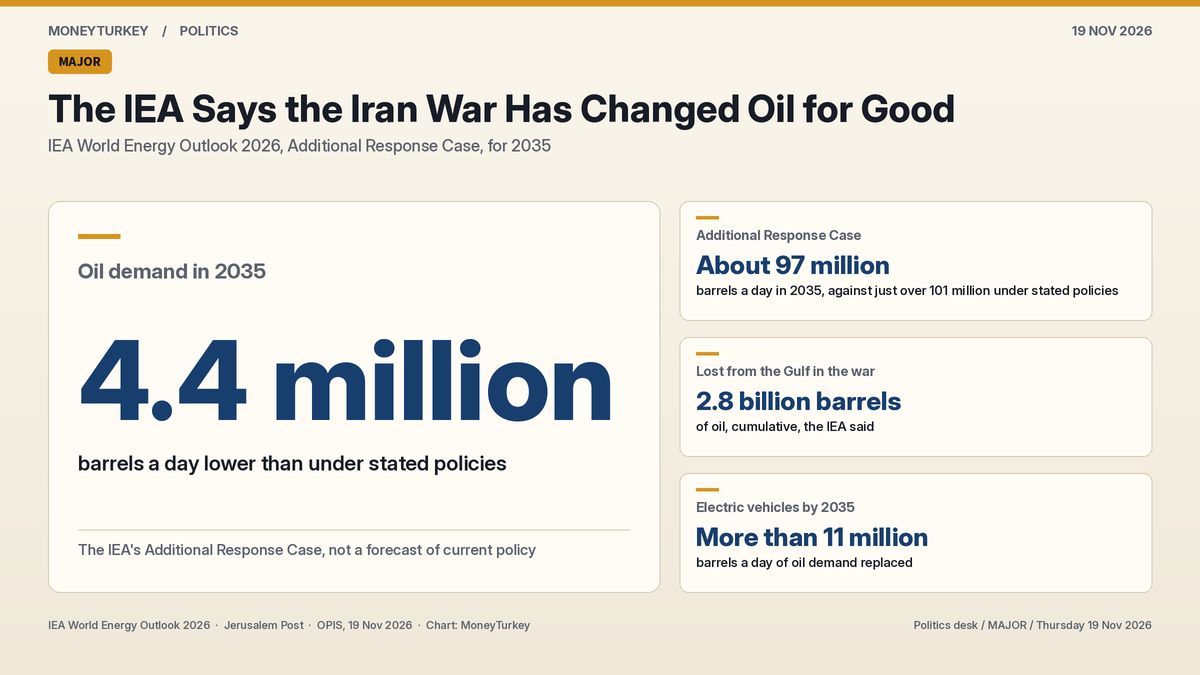
For half a century, the oil market’s worst fear was a closed Strait of Hormuz. This year it happened, and the International Energy Agency now says the world will not go back. Its annual outlook, published on Thursday, argues that the Iran war could do what decades of climate policy struggled to do: pull forward the day oil demand stops growing.
MoneyTurkey Politics Desk | 19 November 2026
Key points
- The war has cost the world 2.8 billion barrels of oil and 60 billion cubic metres of gas from the Gulf, the IEA said, the biggest disruption to oil and gas trade on record
- If governments respond with faster electrification and efficiency, world oil demand in 2035 would be about 4.4 million barrels a day lower than under today’s policies, or roughly 97 million barrels a day instead of just over 101 million
- In a case where the risks to Hormuz drag on, the need to ship oil through the strait could fall from 20 million barrels a day before the crisis to under 2 million by 2035
What the IEA said
The World Energy Outlook is the agency’s big yearly look at where energy is heading, and this edition is built around the war. The strait normally carries about a fifth of the world’s oil and liquefied natural gas, and shipping through it has been curbed for much of the year.
“In my view, the energy world will never be the same again as it was before the Iran war,” the IEA’s executive director, Fatih Birol, said in an interview released with the report, NBC News reported.
The report adds a new scenario, the Additional Response Case, for a world that has lost confidence in Gulf supply. In it, importers diversify routes, use more of their own resources and electrify faster. Electric vehicles alone would replace more than 11 million barrels a day of oil demand by 2035, and gas demand would be more than 300 billion cubic metres lower than under current policies.
The other side of the trade
The IEA is careful not to call the end of the Gulf. Even in its most extreme Hormuz case, the Middle East stays the world’s largest oil exporter. And if the conflict ends cleanly, the agency warns, supply could rebound strongly just as a delayed wave of new LNG capacity arrives, giving buyers the upper hand and pushing prices down while inventories are rebuilt.
Electricity is the quiet winner in every version. Its share of the energy the world uses is set to approach 30% under current policies, up from about 23% today, as transport, heating and parts of industry move away from oil and gas.
Why it matters for markets
Oil producers have spent the year being paid for scarcity. The IEA’s message is that scarcity is also changing the customers. Every importer that builds a pipeline around the strait, a solar farm or a charging network is a barrel it may never buy again, and that is a slower, longer story than this month’s price swings.
What to watch
- Whether Asian importers turn emergency energy-saving steps into permanent policy
- Progress on pipelines that bypass the Strait of Hormuz
- How oil prices react if talks on ending the conflict make progress
Related on MoneyTurkey
- Iran Turns Its Drones on Kuwait After the Qeshm Strike
- Bahrain’s Bombed Sitra Refinery Is Weeks From Full Output
For information only. Not investment advice.
References
- International Energy Agency: World Energy Outlook 2026 press release
- International Energy Agency: WEO 2026, potential additional responses
- NBC News: Middle East conflict triggers biggest disruption ever to global oil trade, IEA warns
- The Jerusalem Post: Iran war could slash global oil demand by over 4% by 2035, IEA says
- Reuters: Energy security response to Iran war could cut oil demand by 4% by 2035