
Three weeks after the biggest crypto theft on record, Binance has moved the fight from the blockchain to the courtroom. An Abu Dhabi judge has given it a worldwide freezing order, and the exchange is betting that paper can do what code could not: get frozen tokens handed back.
MoneyTurkey Crypto Desk | 18 November 2026
Key points
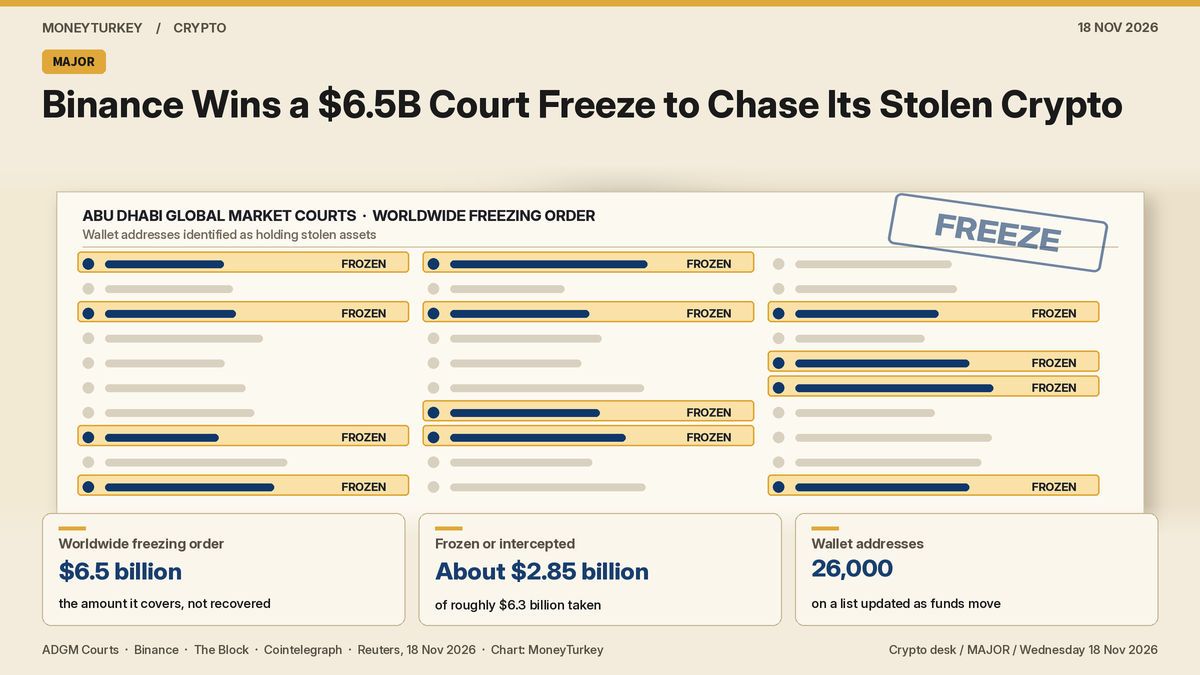
- The Abu Dhabi Global Market Courts issued a $6.5 billion worldwide freezing order against the unidentified attackers behind the 29 October hack
- About $2.85 billion of the roughly $6.3 billion taken has already been frozen or intercepted by third parties, Binance has said
- Binance’s lawyers have identified 26,000 wallet addresses holding stolen assets, a list they will keep updating as the funds move
What happened
Binance said on Wednesday that it had obtained the order from the courts of Abu Dhabi Global Market, the financial centre that hosts its global hub. The $6.5 billion is the amount the injunction covers, not a tally of what has been recovered. Alongside it, the court granted interim orders over specific stolen assets and orders requiring assets to be handed over.
Some of those interim orders name companies that have already frozen stolen tokens, including the stablecoin issuer Circle and World Liberty Financial, the crypto venture run by President Donald Trump’s family. Binance does not accuse them of wrongdoing. The point is practical: some issuers and exchanges want a court order before they release funds they have locked.
Why it matters
Stablecoins have a kill switch that Bitcoin and Ether lack. Issuers can freeze a dollar token at a wallet address, which is why a large slice of the loot was stopped within hours. Tether alone has said it froze more than $1.5 billion of its tokens, although it was not named in the order and says it is working with Binance directly on reissuing them.
The rest is harder. The attackers swapped freezable tokens for coins with no central issuer, and no court order can lock those at source. The orders can, however, be served on the blockchain itself, delivered straight to wallet addresses, which Gibson Dunn, the firm acting for Binance, presented as a way to keep the market on notice as the stolen funds move.
What to watch
- How much frozen stablecoin is actually returned to Binance under the orders
- Updates to the list of 26,000 wallet addresses as the attackers move funds
- Whether exchanges outside the Gulf honour an order served on chain
Related on MoneyTurkey
- Binance Thieves Stir $137M of Ether After Two Silent Weeks
- BlackRock’s Bitcoin Fund Stems an 11-Day, $2.35B Exodus
- Evernorth Writes Its Pre-Listing XRP Down by 60%
For information only. Not investment advice.
References
- Reuters via Investing.com: UAE court orders freeze on crypto tokens stolen from Binance wallets
- The Block: Binance obtains $6.5 billion freezing order from Abu Dhabi court in bid to recover stolen crypto
- Cointelegraph: Binance says it won $6.5B worldwide freezing order after hack
- Bitcoin Magazine: Binance says it won Abu Dhabi order for frozen funds