
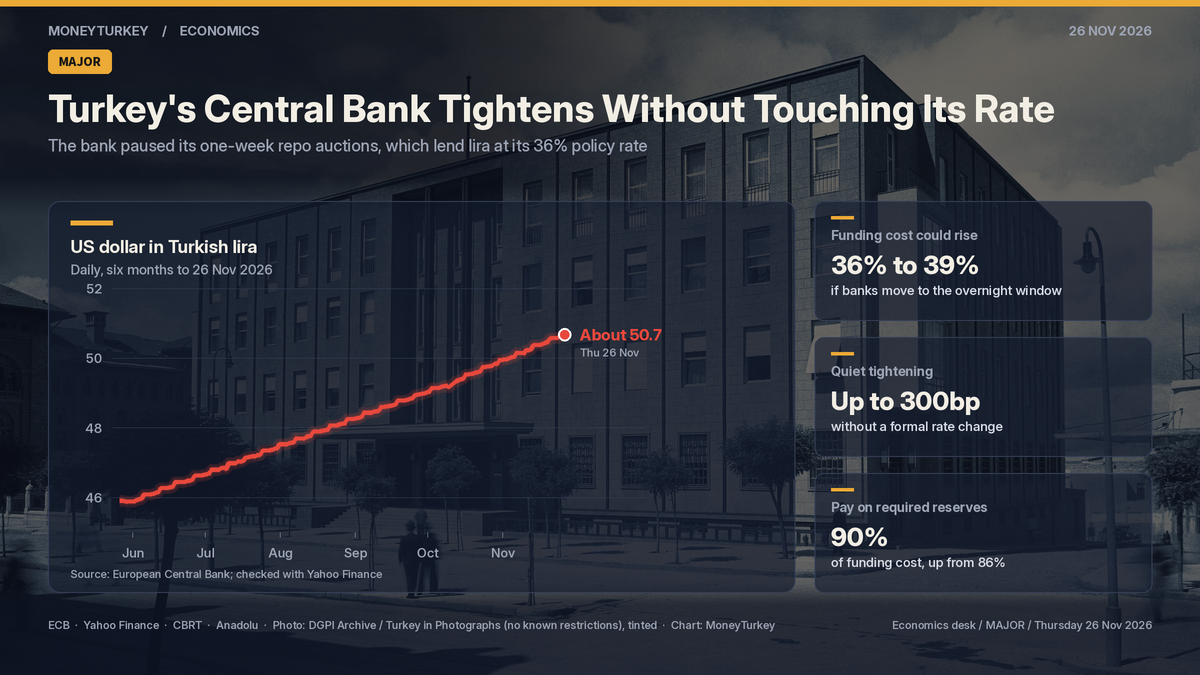
Turkey’s central bank left its policy rate alone on Thursday and still made borrowing dearer for the country’s banks. It did it by switching off the auction that sets that rate.
The Central Bank of the Republic of Türkiye said it had temporarily suspended its one-week repo auctions, the open market operation through which it lends lira to banks at the 36% policy rate, according to the bank’s statement and Anadolu. It gave no date for restarting them, Karar and EkoTürk reported.
The lira ended Thursday at about 50.7 per US dollar, according to European Central Bank reference rates and Yahoo Finance.
Up to 300 basis points of quiet tightening
With the weekly auctions paused, banks that need lira from the central bank are expected to turn to its overnight lending window, which charges 39%, according to Bloomberg, Karar and EkoTürk. If funding shifts there, banks’ borrowing cost could rise from 36% to 39%, a tightening of up to 300 basis points without a formal rate change, according to Karar and EkoTürk. The bank cut the policy rate to 36% from 37% and the overnight lending rate to 39% at its 22 October meeting, according to its own statement.
The move comes after a sharp fall in the central bank’s foreign-exchange reserves, according to Bloomberg and Karar.
Banks paid more to park lira
In a separate statement, the bank raised the pay on banks’ required reserves for lira deposits to 90% of its weighted average funding cost from 86%, according to Anadolu and Karar. It said the change aims to support macrofinancial stability and strengthen the transmission of monetary policy, Anadolu reported.
The two steps pull in the same direction: lira gets harder to borrow from the central bank and more rewarding to leave with it.
Related on MoneyTurkey
- Turkey Weighs a Lira Deposit Tax Cut as Reserves Drain
- Turkey Cuts Its Card Rate Cap for the First Time Since 2023
- Everyone Is Hiking at Once, and Bonds Have Noticed
Sources
- Central Bank of the Republic of Türkiye: Press Release on Turkish Lira Liquidity Management (2026-51)
- Central Bank of the Republic of Türkiye: Press Release on Interest Rates (2026-45)
- Anadolu: Türkiye’s central bank suspends 1-week repo auctions, hikes lira reserve remuneration
- Bloomberg: Turkey Central Bank Sidelines Policy Rate as Reserves Shrink
- Karar: Merkez Bankası’ndan gece yarısı iki kritik hamle
- EkoTürk: TCMB, bir hafta vadeli repo ihalelerine ara verdi
For information only. Not investment advice.