
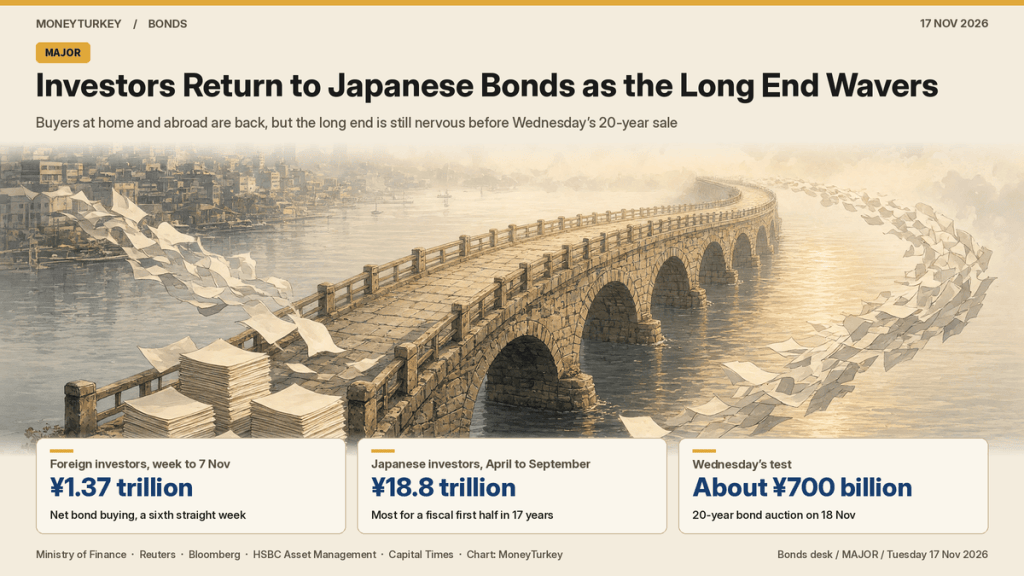
After months of betting that Japanese yields could only go up, money is flowing back into the country’s government bonds from home and abroad. The test comes on Wednesday, when Tokyo sells 20-year debt to a market that is still nervous about the long end.
MoneyTurkey Bonds Desk | 17 November 2026
Key points
- Foreign investors bought a net ¥1.37 trillion (about $8.6 billion) of Japanese medium- and long-term bonds in the week to 7 November, their sixth straight week of buying, Ministry of Finance data and Reuters show.
- Japanese investors bought a net ¥18.8 trillion (about $118 billion) of government bonds from April to September, the most for a fiscal first half in 17 years, according to Japan Securities Dealers Association data reported by Bloomberg and HSBC Asset Management.
- Superlong yields still climbed to about one-month highs on Tuesday as buyers held back before the 20-year auction, Reuters and ETMarkets reported.
“We may be at a major turning point”
Keita Matsumoto, head of financial markets at SMBC Nikko Securities, told Bloomberg in an interview last week that investors are adjusting positions to prepare for potentially lower yields, after months of bets on ever-higher rates. “We may be at a major turning point,” he said, according to Bloomberg, as reported by the Japan Times and Livemint.
Domestic banks are among the main Japanese buyers, gradually adding bonds in the five- to 10-year range, Matsumoto said. In the superlong sector, overseas investors remain key buyers, and participation is no longer limited to hedge funds as longer-term foreign asset managers step in, he said. He added that worries about the sustainability of artificial-intelligence spending, and how it will be financed, are pushing investors towards safer assets.
The money behind the shift
The flows back him up. Ministry of Finance figures released on 12 November show foreigners bought ¥1.37 trillion of Japanese medium- and long-term debt in the first week of November, extending their run to six weeks, even as they sold ¥1.5 trillion (about $9.4 billion) of short-term bills, Reuters reported.
At home, the buying has been heavier still. Japanese investors’ net purchases of ¥18.8 trillion in the six months to September were the most for that half of the fiscal year since 2009, Bloomberg and insigtX reported from dealers’ association data. HSBC Asset Management said credit trusts backed by pension funds accounted for nearly half of those purchases.
Why the long end is not convinced
The market itself is less sure. On Tuesday the 20- and 30-year yields climbed to their highest in about a month, while the benchmark 10-year yield slipped to about 2.88%, Reuters and Kyodo reported. Last week’s 30-year auction drew weaker demand than October’s, Reuters and Capital Times reported, and the Ministry of Finance sells about ¥700 billion (about $4.4 billion) of 20-year bonds on 18 November.
“With the Bank of Japan seen staying on course for further rate hikes and uncertainty lingering over inflation and the terminal rate, investors are unlikely to aggressively buy longer-dated and superlong JGBs,” Takayuki Miyajima, senior economist at Sony Financial Group, said in a note cited by Reuters.
Rate-hike bets are the main reason. Overnight index swaps price a more than 80% chance that the Bank of Japan raises rates by its 17-18 December meeting, according to Bloomberg and BlueGamma swap data. Board member Hajime Takata has said the bank needs to raise rates “nimbly”, Reuters reported, in comments MoneyTurkey also covered.
Matsumoto’s case for a turn rests on the yen. A narrowing gap between US and Japanese rates could strengthen the currency and ease pressure on the Bank of Japan to hike quickly, which would help steady long-term yields and draw more money into bonds, he said.
What to watch
- Demand at Wednesday’s 20-year auction, after last week’s soft 30-year sale.
- Thursday’s Ministry of Finance flow data, and whether foreign bond buying reaches a seventh week.
- Swap pricing for a December Bank of Japan hike, and the 40-year auction on 25 November.
Related on MoneyTurkey
- Bank of Japan Hawk Takata Urges Faster Rate Rises
- Morgan Stanley Outbids Nomura With a 4,800 TOPIX Target
- Nasdaq Enters Correction as Wall Street Dumps Chipmakers
For information only. Not investment advice.
Sources
- Japan Times (Bloomberg): https://www.japantimes.co.jp/business/2026/11/17/markets/investors-return-to-jgbs/
- Livemint (Bloomberg): https://www.livemint.com/market/investors-return-to-jgbs-as-rate-outlook-shifts-smbc-nikko-says-11794801634286.html
- Ministry of Finance, weekly securities flows: https://www.mof.go.jp/english/policy/international_policy/reference/itn_transactions_in_securities/week.pdf
- Reuters via Zawya: https://www.daily8.com/en/article/d8_8796de93fe65140940a55e98f1cb8d33de88975b1a21179d970dcbf113433ce7
- Bloomberg via TBS Cross Dig: https://newsdig.tbs.co.jp/articles/withbloomberg/3025884
- insigtX: https://www.insigtx.com/en/news/japan-investors-purchases-of-domestic-government-bonds-hit-033601/
- Adalytica (HSBC Asset Management): https://adalytica.com/news/japan-investors-return-jgbs-yields-rise-59812b61
- Reuters via Economic Times: https://m.economictimes.com/markets/bonds/jgb-yields-climb-as-buyers-hold-back-on-long-dated-debt/amp_articleshow/135910809.cms
- ETMarkets: https://economictimes.indiatimes.com/markets/us-stocks/news/japan-bond-yields-rise-as-investors-shun-longer-dated-debt/articleshow/135911356.cms
- Kyodo via Fukushima Minpo: https://www.minpo.jp/articles/-/276909
- Capital Times: https://capitaltimes.asia/markets/bonds/japan-bonds-gdp-contraction-20-year-auction-boj/
- Ministry of Finance, 20-year auction: https://www.mof.go.jp/english/policy/jgbs/auction/calendar/announcement/auct20261111e.htm
- BlueGamma: https://www.bluegamma.io/central-banks/central-bank-interest-rate-forecasts/the-bank-of-japan-interest-rate-forecast
- Reuters via Business Recorder: https://www.brecorder.com/news/40449139

