
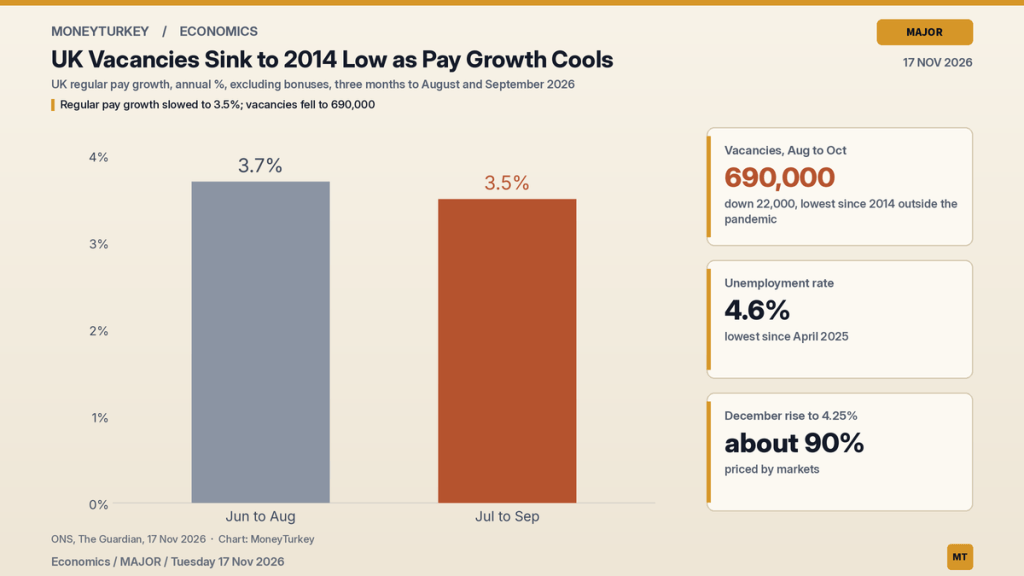
British employers are advertising fewer jobs than at any time since 2014 outside the pandemic, and pay growth is easing. Markets still expect the Bank of England to raise rates again next month.
MoneyTurkey Economics Desk | 17 November 2026
Key points
- Vacancies fell by 22,000 to 690,000 in August to October, the lowest outside the pandemic since 2014
- Regular pay growth slowed to 3.5% in the three months to September, from 3.7%
- The unemployment rate fell to 4.6%, its lowest since the three months to April 2025
- Markets put the chance of a December rate rise to 4.25% at about 90%
Fewer openings, slower pay
Job vacancies dropped by 22,000 to 690,000 in the three months to October, the Office for National Statistics (ONS) said on Tuesday. Outside the pandemic, that is the lowest count since 2014, the ONS and the Guardian reported. The ONS said the fall was again concentrated in smaller businesses, which report that higher labour and operating costs are affecting their hiring decisions.
Regular pay, excluding bonuses, was 3.5% higher than a year earlier in July to September, down from 3.7% in the previous three months and just below the 3.6% economists expected in a Reuters poll, according to the ONS and Reuters. The ONS said the slowdown was driven by public sector pay, as the effect of the timing of this year’s pay awards starts to drop out of the figures. The number of workers on company payrolls also fell, the ONS said.
A jobless rate that flatters
Unemployment fell to 4.6% from 4.7%, below the 4.7% that markets expected and the lowest since the three months to April 2025, Investing.com reported, in line with the ONS release. The number of unemployed people fell by 88,000 on the quarter to 1.684 million.
The ONS warned that the better headline partly reflects the rotation of its Labour Force Survey sample: people leaving the survey in June had lower employment than those joining in September. “The latest figures provide a mixed picture overall,” said Liz McKeown, the ONS director of economic statistics.
The Bank still leans towards a hike
The Bank of England raised Bank Rate to 4% on 5 November, its first rise since 2023, as higher energy prices from the Middle East conflict push up inflation. After the data, financial markets still saw a roughly 90% chance of another quarter-point rise to 4.25% in December, Reuters and the Guardian reported.
Not everyone sees a wage threat. “Crucially, for the Bank of England, the risk of a damaging wage-price spiral still looks to be minimal,” Zara Nokes, global market analyst at J.P. Morgan Asset Management, said, according to the Guardian. Last week, MPC member Megan Greene said surveys pointed to pay growth of at least 3.5% next year, higher than most policymakers see as consistent with the 2% inflation target, Reuters reported.
What to watch
- UK inflation figures for October, due on Wednesday
- The Bank of England’s next rate decision on 17 December
- The next ONS labour market release on 15 December
Related on MoneyTurkey
- BoE’s Lombardelli Flags Another Rate Rise
- BoE’s Lombardelli: Young Hit Hardest by Hiring Freeze
- ECB’s Vujcic Signals Tightening May Outlast December
For information only. Not investment advice.
Sources
- Office for National Statistics: Labour market overview, UK: November 2026
- Office for National Statistics: Average weekly earnings in Great Britain: November 2026
- Reuters via US News: UK Wage Growth Slows to 3.5% in Three Months to September
- Investing.com: UK unemployment falls to 4.6%, beats forecast; payrolls, vacancies drop
- The Guardian: UK jobs market is a ‘mixed picture’ as wage growth slows and unemployment falls
- Bank of England: Interest rates and Bank Rate: our latest decision
- FXStreet: British Pound declines ahead of UK jobs data

