
Southeast Asia has sold itself as the place to build the AI age. On Tuesday, as President Donald Trump flew in for the regional summit in Manila, investors in Kuala Lumpur and Singapore were asking how much of that boom Washington’s new chip licences will let through.
MoneyTurkey Politics Desk | 17 November 2026
Key points
- A US Commerce Department rule issued on Monday requires a licence to ship advanced AI chips to Singapore, Malaysia, Thailand, Indonesia and Brazil, Singapore’s government and The Business Times reported. Chips bound for companies headquartered in the US are exempt if they meet reporting rules.
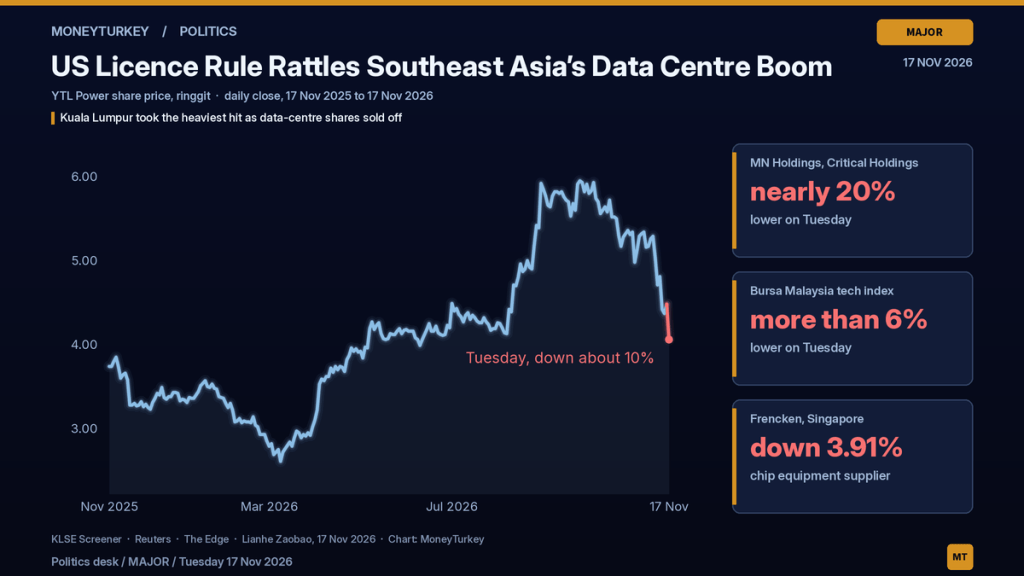
- Malaysian data-centre contractors MN Holdings and Critical Holdings fell nearly 20%, and YTL Power, an Nvidia partner, lost about 10%, Reuters and The Edge reported.
- Singapore said it is talking to US officials to secure “trusted access” to advanced chips for legitimate companies, according to its ministries and AFP.
What Washington changed
The rule targets a loophole: Chinese companies that cannot buy the most advanced American chips have been renting the computing power instead, from data centres abroad. Data centres that supply large volumes of computing power to companies headquartered in China now need a US licence, and those already doing so have 90 days to get one, Lianhe Zaobao and AFP reported. Some of the region’s demand has come remotely from Chinese groups such as Alibaba and ByteDance, Bloomberg reported in The Japan Times.
The timing has a political edge. The rule landed just before Trump arrived for meetings around the summit of the 11-member Association of Southeast Asian Nations, starting with the Quad leaders of India, Japan and Australia, AFP reported. He sees Philippine President Ferdinand Marcos on Wednesday and meets Chinese President Xi Jinping in Shenzhen on Thursday, according to AFP and The Business Times. Our story on that meeting is Kremlin Hails First Putin-Xi-Trump Meeting in Shenzhen.
It also follows the scandal that cost Jensen Huang his job as Nvidia’s chief executive, amid questions over whether Singapore-based Megaspeed helped Chinese firms reach advanced chips, AFP reported. Those claims remain allegations.
How markets took it
Kuala Lumpur took the heaviest hit. MN Holdings, which builds substations for data centres, and Critical Holdings both fell almost 20%, enough to trigger automatic curbs on short selling, The Edge and Reuters reported. YTL Power, which runs an AI data centre in Johor on Nvidia chips, fell about 10%, according to Reuters and The Edge. The Bursa Malaysia Technology Index dropped more than 6%, The Edge and KLSE Screener reported, while the main FBM KLCI index was down less than 1%.
In Singapore, Frencken, a supplier to the Dutch chip equipment maker ASML, fell 3.91% and chip tester AEM about 3%, Reuters and Lianhe Zaobao reported. The selling spread to data-centre suppliers in Japan and Taiwan, Nikkei Asia and Reuters reported. China’s own chipmaker SMIC went the other way, as we reported in SMIC rises 6.6% as chip shares diverge.
“Chinese AI developers can no longer bypass physical hardware embargoes by renting advanced US compute power … from overseas data centres,” Neil Shah of Counterpoint told Reuters. Charu Chanana of Saxo told Reuters that operators reliant on Chinese customers could face “weaker utilisation, pricing pressure and delayed expansion”.
A licence is not a ban
Not everyone thinks the sell-off fits the rule. MBSB Investment Bank said the measures “should not be interpreted as a blanket prohibition on US AI chip deployment in Malaysia”, Malay Mail and Bernama reported. It expects cloud and colocation demand from customers outside China to hold up better, though long licensing delays could hold back some AI projects. An analyst quoted by The Edge said the previous US AI chip rule had delayed data-centre project awards by six to seven months.
Singapore’s digital and trade ministries said they were studying the rule carefully and engaging affected companies. “We take our international reputation seriously and do not condone companies using their association with Singapore to circumvent or violate the laws of other countries,” they said in a joint statement. Digital minister Josephine Teo said legitimate businesses must keep “trusted access” to the infrastructure they need, CNA reported.
Why it matters
Data centres have become one of the region’s biggest investment stories, with governments counting on them for jobs and higher-value industry. The rule does not stop American cloud companies building there. What it threatens is the Chinese-linked demand that filled some of those halls, and the speed at which new projects can be approved. The sell-off came on the second day of a global rout in AI stocks, the scenario our Blindspot essay The Commoditisation of High Tech set out to test.
What to watch
- Whether Trump or ASEAN leaders address the chip rule at the summit in Manila.
- How quickly the US processes licences, and which data centres apply within the 90-day window.
- Nvidia’s third-quarter results after the US close on Tuesday.
Related on MoneyTurkey
- Taiex Loses 8% in Two Days as Kospi Slips Below 5,000
- Nasdaq Enters Correction as Wall Street Dumps Chipmakers
- The Commoditisation of High Tech
For information only. Not investment advice.
Sources
- Reuters via Investing.com: https://www.investing.com/news/stock-market-news/us-ai-chip-curbs-threaten-southeast-asia-data-centre-boom-shares-tumble-5031618
- Reuters via Mint: https://www.livemint.com/technology/us-ai-chip-curbs-threaten-southeast-asia-data-centre-boom-shares-slump-11794896626332.html
- The Edge Malaysia: https://theedgemalaysia.com/node/826085
- KLSE Screener (The Edge): https://www.klsescreener.com/v2/news/view/1829009/klci-resumes-decline-as-malaysian-tech-stocks-fall-sharply
- Lianhe Zaobao: https://www.zaobao.com.sg/en/finance/singapore/singapore-semiconductor-stocks-fall-nearly-4-us-tightens-ai-chip-export-controls
- Nikkei Asia: https://asia.nikkei.com/business/markets/us-chip-curbs-nvidia-uncertainty-weigh-on-asian-data-center-stocks
- Bloomberg via The Japan Times: https://www.japantimes.co.jp/business/2026/11/17/tech/asia-data-center-chip-trump/
- Singapore MDDI and METI joint statement: https://www.mddi.gov.sg/newsroom/mddi-meti-joint-media-statement-on-us-interim-final-rule-on-addressing-remote-access-to-advanced-semiconductors/
- The Business Times: https://www.businesstimes.com.sg/singapore/economy-policy/singapore-carefully-study-new-us-advanced-semiconductor-export-controls
- AFP, Singapore seeks trusted access: https://www.afp.com/en/singapore-seeks-trusted-access-ai-chips-after-new-us-curbs
- AFP, Manila summit: https://www.afp.com/en/leaders-protesters-await-trump-arrival-manila-summit
- CNA: https://www.channelnewsasia.com/singapore/us-ai-infrastructure-chips-restrictions-josephine-teo-6557771
- Malay Mail (Bernama): https://www.malaymail.com/news/money/2026/11/16/mbsb-malaysias-broader-data-centre-industry-less-exposed-to-us-ai-chip-curbs/243503

