
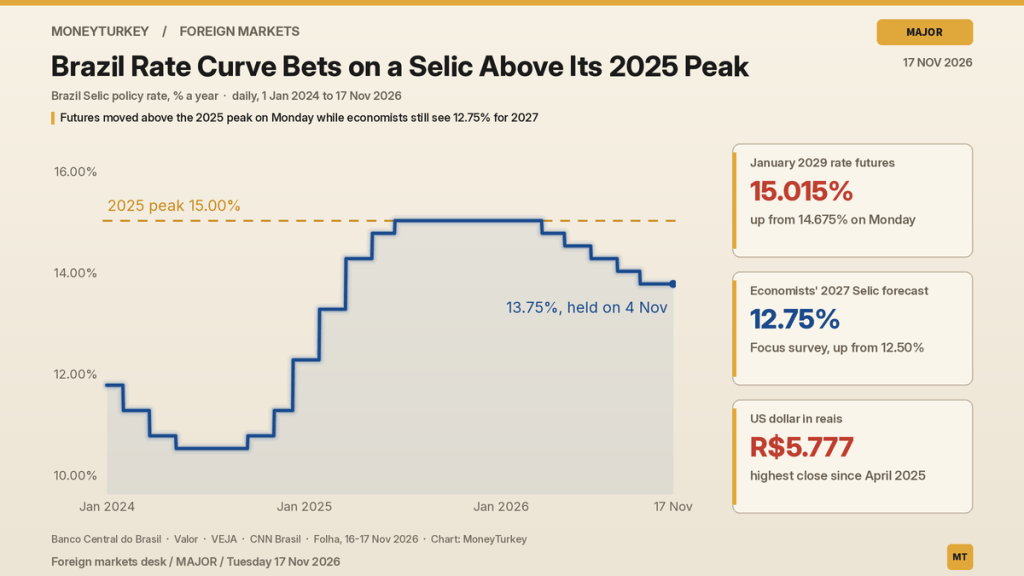
Brazil’s central bank only stopped cutting rates two weeks ago. By Monday’s close, traders were betting that the next big move is up, and that the Selic will end 2027 higher than it was at the top of the last tightening cycle.
MoneyTurkey Foreign Markets Desk | 17 November 2026
Key points
- Brazil’s interest-rate futures curve now prices about 1.7 percentage points of increases in 2027, which would take the Selic to almost 15.50%, above the 15% peak of 2025, Valor Econômico and brapi reported.
- The dollar closed up more than 2% at about R$5.777, its highest close since April 2025, and the Ibovespa fell 1.83% to 169,295, CNN Brasil, UOL and VEJA reported.
- Economists in the central bank’s weekly Focus survey see a far gentler path: a 2027 Selic of 12.75%, up from 12.50%, Reuters and Folha reported.
A pause the market no longer trusts
The Copom, the central bank’s rate committee, held the Selic at 13.75% on 4 November, ending a run of cuts that began in March from 15%, Suno and Bloomberg Línea reported. It gave no guidance on how long the pause would last.
On Monday the futures market began to price a small chance of a December increase. The curve implies about 0.1 percentage point of tightening at the 9 December meeting, a real but minority chance of a quarter-point rise to 14.00%, market participants told Valor. In Copom digital options, the odds of a hold fell to 73% from 82% on Friday, and the odds of a quarter-point rise climbed to 8.5% from 4%, according to Valor and brapi.
Interbank deposit futures, known as DIs, jumped more than 30 basis points at the most stressed points of the curve. The January 2029 contract closed at 15.015%, up from 14.675%, and the January 2031 contract at 15.255%, up from 14.975%, Valor and VEJA reported. The January 2028 rate rose to 14.555% from 14.27%.
Why investors took fright
The pressure was mainly domestic. Investors doubt that President Luiz Inácio Lula da Silva’s fiscal package, after his surprise re-election in October, does enough to stabilise the public debt, and are waiting to learn who will run the Finance Ministry, VEJA and Bloomberg Línea reported. Market participants also pointed to Workers’ Party bills in the lower house to tax profits and dividends and to tax LCA and LCI bonds that are now exempt, Valor and VEJA reported.
“The dollar today reflects much more the increase in Brazil’s risk premium,” Bruno Perri, chief economist at Forum Investimentos, told CNN Brasil. “The market doesn’t want to pay to see.” Abroad, caution over artificial-intelligence stocks and a firm dollar added to the selling, VEJA reported, on the day the Nasdaq entered a correction.
Economists and traders part ways
The Focus survey published on Monday kept the 2026 year-end Selic at 13.75% and raised the 2027 forecast to 12.75%, Reuters, Folha and Exame reported. Economists lifted 2027 inflation to 5.0% from 4.9%, above the 4.5% ceiling of the 3% target band, and cut 2027 growth to 1.02% from 1.15%. The gap between that 12.75% and the curve’s almost 15.50% is a measure of how much fiscal risk the market is charging for.
Activity is also cooling. The central bank’s IBC-Br activity index shrank about 0.9% in the third quarter, UOL and CNN Brasil reported.
What to watch
- Who Lula names to lead the Finance Ministry, and whether the fiscal package is strengthened.
- Copom digital-option odds and the DI curve ahead of the 9 December decision.
- Whether the real holds near R$5.78 per dollar, or tests its April 2025 levels around R$5.80.
Related on MoneyTurkey
- Quick wrap: Brazil sees stickier inflation as miners weigh on Jakarta
- Nasdaq Enters Correction as Wall Street Dumps Chipmakers
For information only. Not investment advice.
Sources
- Valor Econômico, curve pricing: https://valor.globo.com/financas/noticia/2026/11/16/mercado-precifica-possibilidade-de-alta-de-juros-em-dezembro-e-selic-de-1550-pontos-percentuais-em-2027.ghtml
- Valor Econômico, DI close: https://valor.globo.com/financas/noticia/2026/11/16/juros-futuros-disparam-em-meio-a-desconfianca-com-politica-economica-do-governo.ghtml
- brapi: https://brapi.dev/news/curva-de-juros-embute-selic-a-15-50-em-2027-e-risco-4c6b782b
- VEJA: https://veja.abril.com.br/coluna/macro-intelligence/dolar-dispara-e-juros-futuros-superam-15-com-incerteza-fiscal/
- CNN Brasil: https://www.cnnbrasil.com.br/economia/money/mercado/mercado-financeiro-ibovespa-dolar-16-novembro-2026/
- UOL: https://economia.uol.com.br/cotacoes/noticias/redacao/2026/11/16/dolar-sobe-a-r-577-maior-valor-desde-abril-de-2025-ibovespa-recua.ghtm
- Valor Investe: https://valorinveste.globo.com/mercados/renda-variavel/bolsas-e-indices/noticia/2026/11/16/ibovespa-cai-quase-2percent-e-dolar-vai-a-r-577-com-ruidos-sobre-lula-4-e-fuga-de-estrangeiros.ghtml
- Reuters via UOL: https://noticias.uol.com.br/ultimas-noticias/reuters/2026/11/16/analistas-reduzem-projecao-de-inflacao-este-ano-no-focus-mas-elevam-expectativas-para-ipca-e-selic-em-2027.htm
- Folha de S.Paulo: https://www1.folha.uol.com.br/mercado/2026/11/economistas-reduzem-previsao-da-inflacao-e-do-pib-neste-ano-e-elevam-a-selic-para-2027.shtml
- Exame: https://exame.com/economia/focus-mercado-eleva-previsao-de-inflacao-para-5-e-da-selic-para-1275-em-2027/
- Bloomberg Línea: https://www.bloomberglinea.com/latinoamerica/brasil/los-analistas-brasilenos-revisan-al-alza-sus-previsiones-sobre-el-tipo-de-interes-de-referencia-y-la-inflacion-debido-al-riesgo-fiscal/
- Suno: https://www.suno.com.br/noticias/boletim-focus-projecoes-sobem-16112026-go/

