
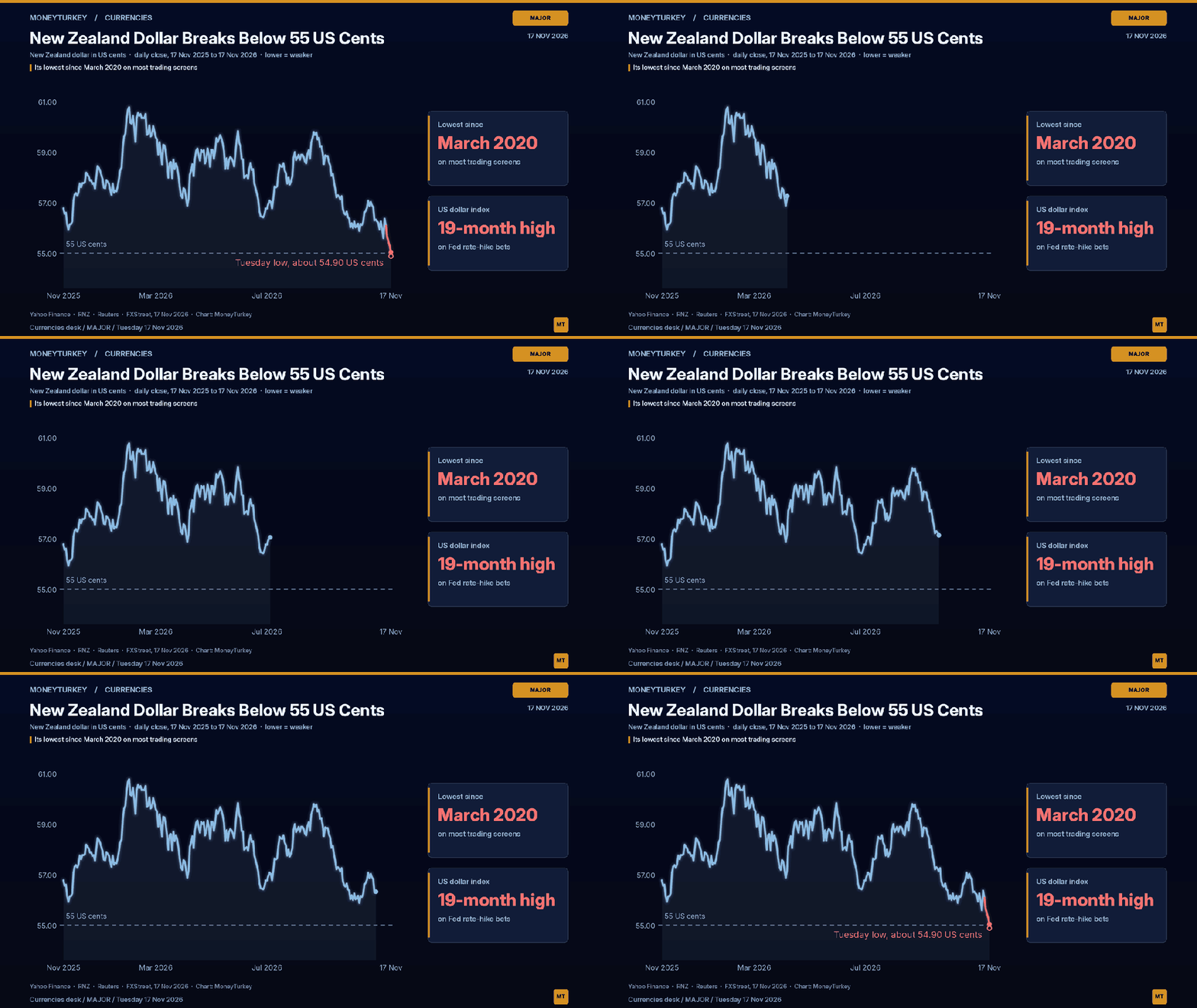
The New Zealand dollar fell through 55 US cents on Tuesday to its lowest since the pandemic panic of March 2020 on most trading screens, as bets on higher US interest rates and a sell-off in AI stocks pulled money towards the US dollar.
MoneyTurkey Currencies Desk | 17 November 2026
Key points
- The New Zealand dollar traded at about 54.9 US cents (around $0.549), its lowest since March 2020, RNZ and Reuters reported. Reuters put the low at $0.54845.
- The US dollar index reached a 19-month high on bets that the Federal Reserve will tighten policy further after last week’s hot US inflation data, Reuters and FXStreet reported.
- Westpac strategist Imre Speizer told RNZ the line to watch is 54.70 US cents, the 2020 low. A sustained break would take the currency back to levels last seen in 2009.
What happened
The New Zealand dollar broke through the 55 US cent mark around midday in Wellington and was trading at 54.9 US cents, RNZ reported. Reuters said it sank as low as $0.54845, the weakest since March 2020, and FXStreet had it at about 0.5490 in Asian hours, down for a sixth straight session. The Wall Street Journal and Bloomberg also called it a six-year low.
Platforms differ on the exact record. Speizer told RNZ the currency briefly dipped marginally lower, to 54.86 US cents, in April 2025, and said it was important not to get too hung up on the different figures.
What is driving it
The main force is the US dollar. A sharper-than-expected rise in US consumer inflation last week revived bets that the Federal Reserve will raise rates again, and that has made US dollar assets more attractive than New Zealand ones, Reuters and RNZ reported. Monday’s global sell-off in AI and chip stocks added to the pressure, because investors tend to run to the US dollar when shares wobble. “An equity market wobble is effectively the same as a fall in risk sentiment and the US dollar is a defensive currency,” Speizer told RNZ. Wall Street’s slide is covered in Nasdaq Enters Correction as Wall Street Dumps Chipmakers.
At home, the Reserve Bank of New Zealand surprised markets by holding rates in late October when a hike had been close to fully priced, and uncertainty over the formation of a new government is weighing too, The Wall Street Journal reported. The central bank’s own survey of business leaders and forecasters, published on Tuesday, showed two-year inflation expectations edging up to 2.36% from 2.34%, and one-year expectations rising to 2.92% from 2.60%, according to the RBNZ and Trading Economics. The figures did little to support the currency, FXStreet said.
Why it matters
A weaker currency helps New Zealand’s exporters but makes imports dearer, adding to already high imported fuel costs, RNZ reported. That lands on an economy where the Reserve Bank is expected to start raising its 2.75% official cash rate in December: ASB and Westpac both forecast a hike next month, NZ Adviser reported, and respondents to the RBNZ survey expect the rate at 3.05% by the end of December, according to the RBNZ and Trading Economics.
Speizer sees the risk of further falls. “I think momentum in the US dollar is pretty bullish and that is a thing that might put Kiwi/US lower over the week or two,” he told RNZ.
What to watch
- Whether the currency holds above the 2020 low of 54.70 US cents flagged by Westpac.
- US October retail sales on Tuesday and the Federal Reserve’s minutes on Wednesday.
- The Reserve Bank of New Zealand’s December policy decision.
Related on MoneyTurkey
- Dollar Rally Leaves Loonie, Kiwi and Aussie Trailing
- BHP Tumbles 5% as ASX Retreats for a Fourth Day
- The Commoditisation of High Tech
For information only. Not investment advice.
Sources
- RNZ: https://www.rnz.co.nz/news/personal-finance/2635442/under-pressure-kiwi-dollar-at-risk-of-falling-further-against-us-dollar
- Reuters via Euronext: https://live.euronext.com/en/financial-news/us-dollar-hits-19-month-peak-fed-hike-bets-while-nz-dollar-slumps
- FXStreet: https://www.fxstreet.com/news/new-zealand-dollar-falls-toward-18-month-lows-following-rbnz-q4-inflation-expectations-qoq-202611170244
- The Wall Street Journal: https://www.wsj.com/economy/central-banking/new-zealand-dollar-slumps-to-a-six-year-low-e13ed4c2
- Bloomberg: https://www.bloomberg.com/news/articles/2026-11-17/new-zealand-dollar-drops-to-six-year-low-against-greenback
- Reserve Bank of New Zealand, Survey of Expectations November 2026: https://www.rbnz.govt.nz/-/media/project/sites/rbnz/files/statistics/series/m/m14/insights/2026/survey-of-expectations-november-2026.pdf
- Trading Economics: https://tradingeconomics.com/new-zealand/inflation-expectations/news/601736
- NZ Adviser: https://www.mpamag.com/nz/specialty/residential/long-term-inflation-expectations-ease-as-cash-rate-hikes-loom/597649

