
Mexico’s peso has gone from the darling of carry traders to one of the year’s laggards. A growing number of investors think the central bank is happy to see it fall.
• Peso down nearly 9% since its early-September peak
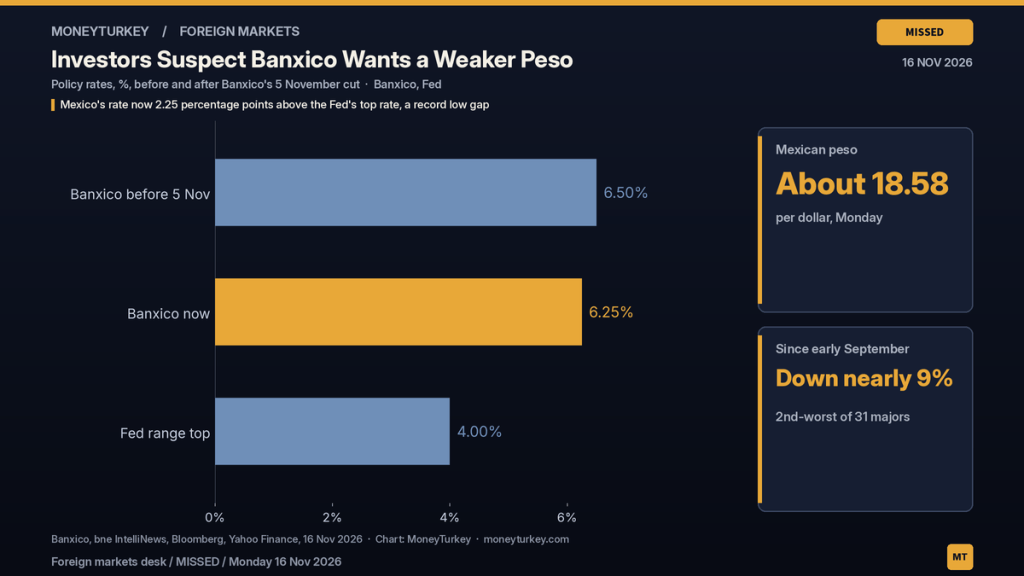
• Banxico cut to 6.25% on 5 November as the Fed leans towards hikes
Investors increasingly suspect the Bank of Mexico wants a weaker peso after a surprise rate cut narrowed Mexico’s yield advantage over the US to a record low.
MoneyTurkey Foreign Markets Desk | 16 November 2026
Key points
- Banxico cut its overnight rate by a quarter point to 6.25% on 5 November in a 3-2 vote, surprising economists who expected a hold.
- The peso has fallen nearly 9% since a two-year high in early September, the second-worst performance among 31 major currencies tracked by Bloomberg.
- Bank of America says many investors see motives beyond the 3% inflation target: a weaker peso to support growth, cheaper government borrowing, or both.
- Governor Victoria Rodríguez denies the bank targets any level for the currency.
What happened
Banxico’s governing board lowered its target for the overnight interbank rate by 25 basis points to 6.25%, effective 6 November, calling it a “one-time adjustment” and saying it expects to hold the rate there for an extended period. Deputy Governors Galia Borja and Jonathan Heath voted to keep it at 6.50%, FXStreet reported. bne IntelliNews said the rate is now the lowest since February 2022.
The peso fell as much as 1.1% to about 18.83 per dollar on the day of the decision, Bloomberg Línea reported. It was quoted near 18.58 early on Monday, after closing at about 18.53 on Friday, according to N+. Banxico’s official fixing data show the dollar at about 16.87 pesos in early September, which puts the peso’s slide since then at roughly 9%.
The cut came just before data showed Mexican inflation speeding up. Consumer prices rose 3.75% in the year to October, up from 3.45% in September, with core inflation at 3.80%, the national statistics agency INEGI said on 9 November. Electricity bills jumped as summer power subsidies ended.
Why traders suspect a weaker-peso push
Banxico is easing while the Federal Reserve is moving the other way. With US inflation running hot and markets betting on a Fed rise in December, the gap between Mexico’s 6.25% and the top of the Fed’s 3.75% to 4% range has shrunk to 2.25 percentage points, a record low according to bne IntelliNews. That erodes the carry trade, in which investors borrow cheaply in dollars to buy high-yielding pesos.
“In conversations with investors, many feel the cut was not necessarily aimed at the 3% inflation target,” Carlos Capistrán, head of Latin America and Canada economics at Bank of America, told Bloomberg. He said the talk has turned to “other possible motivations: a weaker peso to boost growth, lower financing costs for the government, or both”. The bank expects the peso to weaken to 19 per dollar next year.
Álvaro Vivanco, a strategist at Wells Fargo Securities, called the cut “tactical” in a 6 November note. “The strength of the currency was both a reason and a justification for Banxico to adopt a dovish stance,” he wrote. A strong peso had weighed on exports and tourism even as Mexico’s economy grew at its fastest pace since 2023 in the third quarter.
Positioning has turned with it. Asset managers have built their largest bearish position against the peso in two decades, according to Commodity Futures Trading Commission data cited by Bloomberg, and JPMorgan and Citigroup have dropped long-standing overweight calls on the currency.
The other side
Governor Rodríguez has denied that policymakers are aiming for a particular exchange rate. She told Bloomberg News the peso “remains below its 2025 average, and the recent adjustment came after a period of significant appreciation. So far, the move has been orderly, and we will keep monitoring it.”
São Paulo-based economist Marco Oviedo said the bank is not necessarily trying to weaken the peso but to avoid excessive overvaluation, and that for now it is getting rid of the “super peso”. Banxico has also signalled it is in no hurry to cut again. AI-related risk aversion and US politics have moved Latin American currencies too, so the peso’s slide is not down to Banxico alone.
What to watch
- Mexican markets are shut on Monday for Revolution Day, so Banxico publishes no fixing
- Whether the peso breaks through 19 per dollar, the level Bank of America expects next year
- The Fed’s 9 December decision and Banxico’s next statement on the exchange rate
- INEGI’s November inflation figures on 9 December
Related on MoneyTurkey
- Treasury Rout Leaves Bond Buyers Bracing for More Hikes
- Yen Pinned Near 160 as Japan’s Economy Shrinks
For information only. Not investment advice.
Sources
- Bloomberg via Bloomberg Línea (13 Nov): https://www.bloomberglinea.com/latinoamerica/mexico/recorte-de-la-tasa-en-mexico-alimenta-especulaciones-de-que-autoridades-desean-un-peso-mas-debil/
- Banco de México monetary policy statement: https://www.banxico.org.mx/publications-and-press/announcements-of-monetary-policy-decisions/%7B2E04D4F1-397A-2B77-F666-252D80D8EC69%7D.pdf
- FXStreet: https://www.fxstreet.com/news/mexican-peso-reels-as-banxicos-surprise-rate-cut-fuels-easing-bets-202611052216
- bne IntelliNews: https://www.intellinews.com/mexico-s-central-bank-surprises-markets-with-rate-cut-as-peso-weakens-482687/
- Bloomberg Línea (peso on decision day): https://www.bloomberglinea.com/latinoamerica/mexico/peso-mexicano-cede-terreno-tras-recorte-sorpresivo-de-banxico/
- N+ (peso on 16 Nov): https://www.nmas.com.mx/economia/dolar/precio-del-dolar-hoy-lunes-16-de-noviembre-de-2026-como-esta-el-tipo-de-cambio/
- Banco de México exchange rate data: https://www.banxico.org.mx/tipcamb/tipCamMIAction.do?idioma=en
- INEGI consumer prices, October 2026: https://www.inegi.org.mx/contenidos/saladeprensa/boletines/2026/inpc/inpc_2q2026_11.pdf
- El Economista: https://www.eleconomista.com.mx/economia/inflacion-mexico-acelera-tercer-mes-llega-3-75-anual-octubre-20261109-842900.html

