
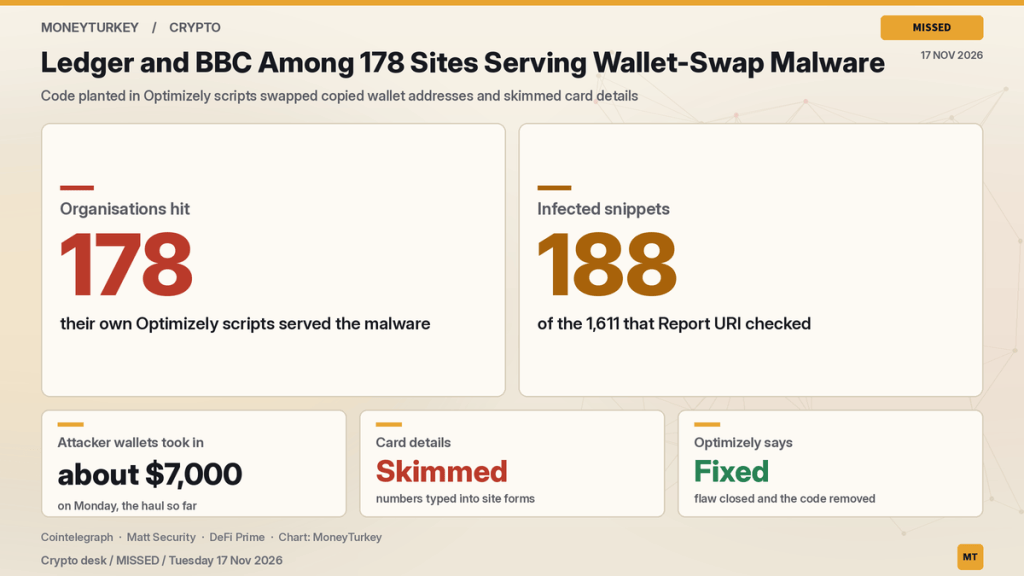
Attackers planted code in Optimizely scripts used by at least 178 organisations, so that sites including Ledger, the BBC and Salesforce served visitors malware that swapped crypto wallet addresses and skimmed card details.
MoneyTurkey Crypto Desk | 17 November 2026
Key points
- Report URI found malicious code in 188 of the 1,611 Optimizely snippets it checked, belonging to 178 organisations.
- The script replaced copied wallet addresses with the attacker’s and captured card numbers typed into site forms.
- The attacker’s wallets took in only about $7,000 on Monday. Optimizely says it has fixed the flaw and removed the code.
What happened
On Monday an attacker wrote malicious JavaScript into customer projects on Optimizely, a platform companies use to run website experiments, security researcher Scott Helme of Report URI found, according to BleepingComputer and Cointelegraph. Because the code sat inside each customer’s own project, the trusted Optimizely snippet loaded it for every visitor. Report URI found it in 188 of the 1,611 snippets it could check, belonging to 178 organisations, and says the real number is likely higher.
The list includes hardware wallet maker Ledger, trading platforms IG, Interactive Investor, TMS Brokers and OANDA, and big brands such as Zoom, the BBC, CNN, Salesforce, IKEA and HSBC, according to Cointelegraph and Matt Security’s summary of Report URI’s findings. Researcher Amirul Iman dubbed the campaign “Optimjack”, Cointelegraph reported.
How the malware worked
The script looked for valid Bitcoin, Ethereum, Solana, TRON and other wallet addresses on a page, in form fields and on the clipboard, and replaced them with the attacker’s own, Report URI found. A visitor who copied an address could paste the attacker’s without noticing. It also watched for card numbers, expiry dates and security codes typed into site forms and sent them to an attacker-controlled server, BleepingComputer and Cointelegraph reported, citing Report URI and security firm StepSecurity, though cards entered in payment providers’ own hosted fields were out of its reach. On iPhones and iPads it loaded known iOS exploit kits, according to BleepingComputer and Matt Security.
A small haul, so far
Wallets linked to the malware received only about $7,000 on Monday, according to Cointelegraph’s check of blockchain records and Report URI’s count. Report URI cannot see how many card details reached the attacker’s server. Optimizely said it had fixed a vulnerability in its Experimentation platform and removed the code, Cointelegraph and DeFi Prime reported. Most of the malicious code was gone from affected sites by late Monday, Cointelegraph said.
Why it matters
The attack did not need to break into Ledger or the BBC directly: one compromised third-party tool was enough to reach their visitors. Report URI advises anyone who sent crypto after visiting an affected site to check the receiving address against the one they meant to use. Crypto security has been under pressure this week, with miner rewards diverted in the Luxor attack.
Related on MoneyTurkey
- Luxor Blames AI-Enabled Hack for Diverted Miner Rewards
- Crypto movers: Lighter halts withdrawals after $15.5M drain
- Korea’s Upbit and Bithumb Freeze Lighter Token Transfers
For information only. Not investment advice.
Sources
- Cointelegraph: https://cointelegraph.com/news/hackers-inject-malware-into-178-major-websites
- BleepingComputer: https://www.bleepingcomputer.com/news/security/optimizely-supply-chain-attack-infects-major-brands-sites-with-malware/
- Matt Security: https://www.matt.security/blog/optimjack-optimizely-supply-chain-attack
- DeFi Prime: https://defiprime.com/optimizely-malware-ledger-website
- Cynet: https://www.cynet.com/blog/optimjack-malicious-web-injection-across-cnn-zoom-salesforce-fox-and-more/

