
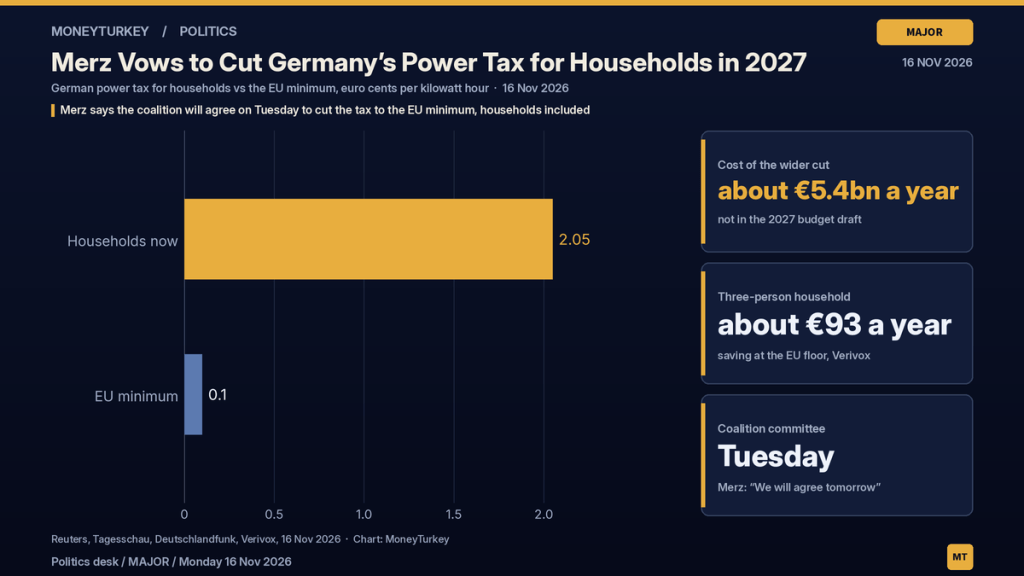
Merz says coalition leaders will agree on Tuesday to cut Germany’s power tax for households in 2027. His finance ministry still wants to know who pays.
MoneyTurkey Politics Desk | 16 November 2026
Key points
- Chancellor Friedrich Merz said the coalition committee of the CDU, CSU and SPD will decide on Tuesday to cut the electricity tax to the EU minimum for 2027, including for households
- Households now pay 2.05 euro cents per kilowatt hour; the EU floor is 0.1 cents
- The wider cut would cost about €5.4 billion (about $5.9 billion) a year, money missing from the 2027 budget draft
- The finance ministry said funding is still being discussed and rejected “fiscal experiments”, Reuters reported
What Merz said
“We will agree tomorrow,” Merz said in Munich on Monday at a joint appearance with CSU leader Markus Söder, according to Reuters and Tagesschau. He said the parties had checked the numbers again over the weekend and that the 2027 budget allows the tax to fall “completely to the European minimum, also for private households”, and that he expected Tuesday’s talks on the issue to be “relatively short”.
Merz said he had spoken to SPD leader and Finance Minister Lars Klingbeil over the weekend. “He knows that this decision is necessary,” the chancellor said.
A promise that slipped last week
The coalition agreement already promised a cut to the EU minimum for everyone, but so far the tax has been lowered only for industry, manufacturing and agriculture, according to Der Spiegel and Deutschlandfunk. When coalition leaders settled the 2027 budget last week, they could not agree how to pay for extending it to households, Die Zeit and Deutschlandfunk reported, and Union parliamentary group leader Frei said they would aim for 2028 instead, according to Deutschlandfunk. That left considerable anger inside the CDU, Reuters said.
Klingbeil has warned that the government cannot simply widen the gaps in coming years’ budgets “by five billion”, Tagesschau reported, though he said he had ideas for solid funding that would be discussed on Tuesday. The ministry’s response to Merz on Monday was cool: the relief must be “seriously and permanently” funded, it said, according to Reuters.
Who gives what
Söder called the power tax cut a question of credibility, and Reuters reported he also insists on relief from bracket creep. He said the CSU will not unwind the already legislated rise in the “mothers’ pension” to pay for it, Reuters and Tagesschau reported. Merz floated revisiting how much income is exempted from tax as the basic subsistence minimum, saying it is currently set somewhat higher than required, but gave no details, according to Reuters.
What it means for bills
A three-person household could save about €93 (about $102) a year if the tax falls to the EU floor, according to calculations by comparison portal Verivox cited by Deutschlandfunk and t-online. The cut would also end a quirk in which electricity is taxed more heavily than natural gas for heating, t-online noted.
The bigger test is fiscal. The fight is over whether a coalition already stretched by its 2027 budget can fund a promise worth billions a year without opening a new gap elsewhere, weeks before the Bundestag is due to vote on that budget at the end of November.
What to watch
- Tuesday’s coalition committee and whether the household cut is agreed with a named source of funding
- Whether the cut is full, to 0.1 cents, or partial
- The Bundestag’s vote on the 2027 budget at the end of November
Related on MoneyTurkey
- ECB’s Vujcic Signals Tightening May Outlast December
- Energy Bills Sap Japanese Spending as GDP Slips
- Latvia’s Kulbergs Picks Nationalists for One-Seat Majority
For information only. Not investment advice.
Sources
- Reuters: German coalition to cut electricity tax rate, Merz says
- Reuters via onvista: Merz: Koalition wird Stromsteuer senken
- Tagesschau: Merz erwartet Einigung zur Stromsteuer im Koalitionsausschuss
- Der Spiegel: Stromsteuer: Friedrich Merz erwartet Einigung im Koalitionsausschuss
- Deutschlandfunk: Merz: Stromsteuersenkung wird morgen beschlossen
- Die Zeit: Haushalt 2027: Stromsteuer wird nicht gesenkt
- n-tv: Merz beharrt auf Senkung der Stromsteuer ab 2027
- t-online: Senkung der Stromsteuer: Geld ist da

