
Hong Kong’s offshore yuan bond market has grown fast without a yardstick investors could track. On Monday the city’s exchange gave it one, and a dozen fund houses are already lining up products.
• 305 bonds in the first HKEX Offshore RMB Bond Index
• Twelve asset managers plan index-linked funds
Hong Kong Exchanges and Clearing has launched its first index of offshore yuan “Dim Sum” bonds, run by Bloomberg, as the city pushes to turn record issuance into a market investors can buy through funds.
MoneyTurkey Bonds Desk | 16 November 2026
Key points
- HKEX launched the HKEX Offshore RMB Bond Index on Monday 16 November, Hong Kong time, its first bond index. Bloomberg Index Services administers and calculates it.
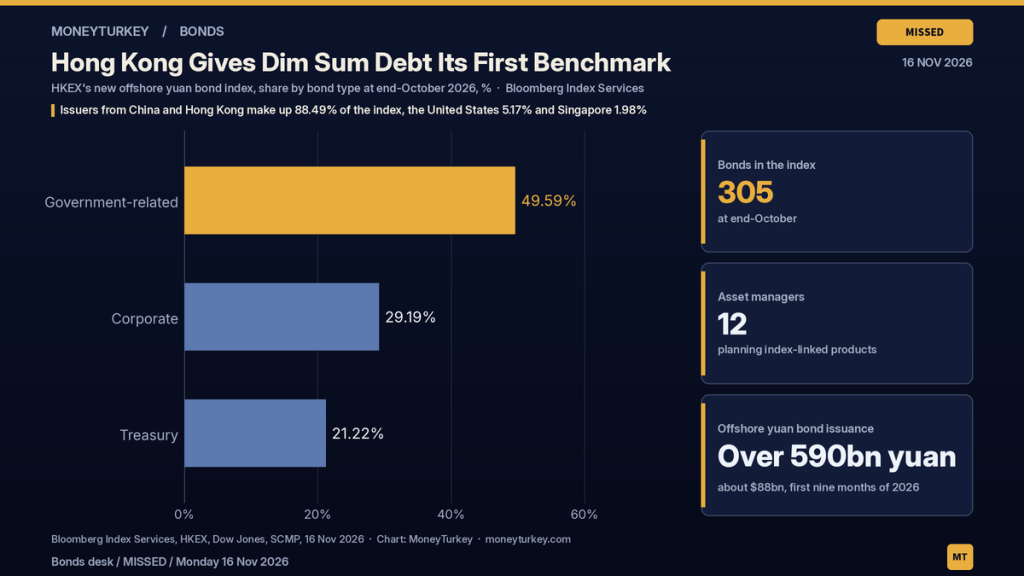
- The index would have held 305 bonds at the end of October, according to Bloomberg and the South China Morning Post.
- Twelve asset managers, including China Asset Management, CSOP Asset Management and Harvest Global Investments, are working with Bloomberg on products based on the indices, HKEX said.
- Offshore yuan bond issuance passed 590 billion yuan ($88 billion) in the first nine months of 2026, according to HKEX.
What happened
Dim Sum bonds are yuan-denominated debt issued outside mainland China, mostly in Hong Kong. Until now the market had no dedicated benchmark from the exchange where much of it is listed. The new index takes bonds from Bloomberg’s existing Offshore Renminbi (CNH) Index and keeps only those listed on the Stock Exchange of Hong Kong or lodged with the Central Moneymarkets Unit, the city’s bond settlement system.
It is the parent of a family of eight co-branded Bloomberg HKEX indices, which split the market by maturity (1-3, 3-5, 1-5 and 5+ years) and by credit quality, including investment-grade-only versions. Bloomberg said it may build customised indices on the same rules for individual asset managers.
Using end-October data, government-related bonds made up 49.59% of the index, corporate bonds 29.19% and Treasury securities 21.22%, Bloomberg’s announcement said. Issuers from China and Hong Kong accounted for 88.49%, the United States 5.17% and Singapore 1.98%.
Why it matters
A benchmark is what turns a list of bonds into something a fund can track. Without one, an exchange-traded fund has nothing to follow and a portfolio manager has nothing to be measured against. “This index delivers the first transparent, trackable and product-ready benchmark for the offshore RMB bond market,” said Xinrong Wu, general manager of E Fund, one of the first authorised managers for the index.
Beijing wants the yuan used more widely abroad, and Hong Kong wants to be where that happens. HKEX chief executive Bonnie Y Chan called the index “a significant step forward” in moving the city’s fixed-income market “from an issuance centre towards an ecosystem with greater depth, liquidity and investability”. Financial Secretary Paul Chan said at the launch that it could help attract more investors to offshore yuan bonds, according to Dow Jones.
The launch does not move prices by itself. Any effect on demand for Dim Sum bonds depends on whether the planned funds launch and draw money.
What to watch
- The first exchange-traded funds that track the Bloomberg HKEX indices, and how much money they draw
- Whether more of the twelve asset managers commit to products
- Offshore yuan bond issuance for the full year, after more than 590 billion yuan in nine months
Related on MoneyTurkey
- Treasury Rout Leaves Bond Buyers Bracing for More Hikes
- South Korea Fines 15 Bond Dealers Record $1.2 Billion
For information only. Not investment advice.
Sources
- Bloomberg Index Services announcement via PR Newswire / Yahoo Finance (15 Nov, US time): https://finance.yahoo.com/markets/world-indices/articles/bloomberg-indices-hkex-launch-co-010000946.html
- Bloomberg press release: https://www.bloomberg.com/company/press/bloomberg-indices-and-hkex-launch-co-branded-offshore-rmb-bond-index-family-to-support-growing-investor-demand-in-the-dim-sum-bond-market/
- Dow Jones Newswires via MarketWatch: https://www.marketwatch.com/story/hkex-launches-first-ever-offshore-yuan-bond-index-dbc70832
- South China Morning Post: https://www.scmp.com/business/banking-finance/article/3374420/hkex-launches-first-dim-sum-bond-index-push-expand-global-use-yuan
- Bloomberg News: https://www.bloomberg.com/news/articles/2026-11-16/hkex-launches-first-dim-sum-bond-index-to-boost-yuan-debt-market

