
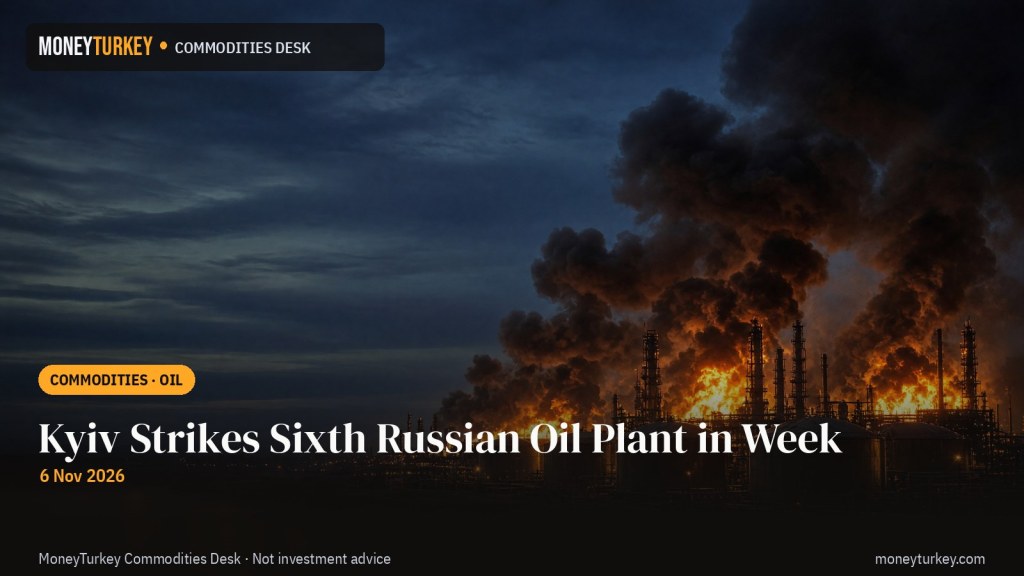
Ukraine hit a sixth Russian refinery in seven days, adding to damage that has already cut Russian crude processing to multi-year lows and prompted product-export curbs.
MoneyTurkey Commodities Desk | 6 November 2026
Key points
- Ukraine struck Afipsky (about 180,000 b/d) overnight and confirmed Yanos (about 300,000 b/d) had shut after a 3 November drone attack — the sixth plant hit since 30 October.
- Attacks this year have pushed Russian refining rates to multi-year lows; Moscow has restricted most diesel, gasoline and jet-fuel exports to protect domestic supply.
Ukraine struck its sixth Russian oil refinery in a week, hitting the roughly 180,000-barrel-a-day Afipsky plant overnight and confirming that the roughly 300,000-barrel-a-day Yanos facility near Moscow had already halted crude runs after a 3 November drone attack. The strikes resume a campaign that paused in mid-October after calls for calm from US President Donald Trump, who sought lower fuel prices ahead of the midterm elections. The renewed attacks come days before US-mediated talks between Russia and Ukraine scheduled for 10-11 November in Abu Dhabi.
What happened
Ukrainian forces targeted Afipsky, a medium-sized crude-processing plant in southern Russia owned by privately held ForteInvest. Regional emergency services reported a fire after drone debris fell on the site. The plant had already been hit several times, most recently in late August.
Separately, the Yanos refinery in Yaroslavl halted all crude runs after a 3 November drone strike. The facility supplies Moscow and surrounding regions — Russia’s largest fuel-consumption area — and has a design capacity of about 300,000 barrels a day.
There have now been six strikes on Russian oil-refining plants since 30 October. Bloomberg calculations based on public data put five of the hit facilities at a combined processing capacity of at least 1.3 million barrels a day, plus one unit at the Ufa group that can handle as much as 470,000 barrels a day.
What is driving prices
Attacks this year have already pushed Russian oil-processing rates to multi-year lows. Moscow responded by restricting exports of most diesel, gasoline and jet fuel to protect domestic supply. Before the ban, Russia supplied around 10 percent of global seaborne diesel.
The curbs aggravated an existing global shortage of diesel created by the war in the Middle East. Last month Trump and Russian President Vladimir Putin agreed to relax the ban in an attempt to lower US fuel prices, but no Russian cargoes have yet reached the US market.
The latest incidents are expected to put fresh pressure on Russian refining margins and could free up more crude for export while tightening product availability into winter demand.
Why it matters
Targeting energy infrastructure is aimed at cutting the oil revenues that finance Russia’s war in Ukraine and at carrying the conflict back onto Russian territory. Moscow has continued to strike Ukrainian ports, power plants, railroads and residential buildings.
Traders will watch whether the new damage forces Moscow to extend or tighten product export restrictions, and whether any additional supply reaches the global diesel market before winter demand peaks.
The 10-11 November talks in Abu Dhabi are the next scheduled diplomatic step; any agreement that alters the pace of strikes or sanctions could quickly change the supply outlook for Russian fuels.
What to watch
- Daily updates on Afipsky and Yanos restart timelines
- Moscow’s next move on diesel, gasoline and jet-fuel export quotas
- Any cargoes loaded under the relaxed export terms agreed with Washington
- Damage assessments from additional strikes reported overnight
Related on MoneyTurkey
For information only. Not investment advice.

