
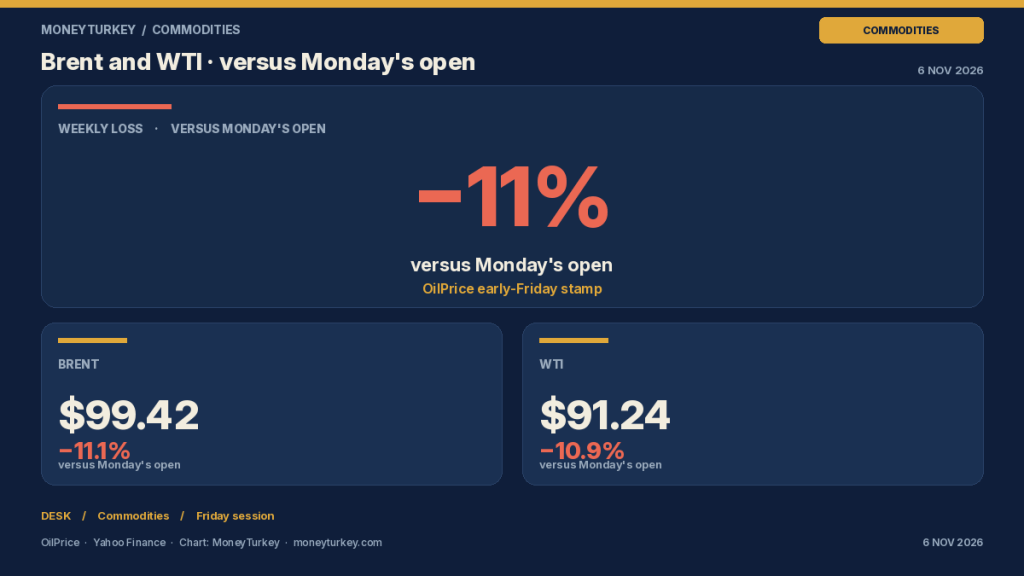
Brent and WTI are still down about 11% from Monday’s open at the OilPrice early-Friday stamp even after Friday prices sit above Thursday’s New York close on fresh Strait of Hormuz tanker reports — the week’s third chapter after Wednesday’s midterm collapse and Thursday’s Asia-then-tanker rebound.
MoneyTurkey Commodities Desk | 6 November 2026
Key points
- OilPrice early-Friday stamp: Brent $99.42 a barrel and WTI $91.24 a barrel, both above Thursday’s New York close, while both benchmarks remain down about 11% from Monday’s open (Brent −11.1%, WTI −10.9%).
- Reuters reported at least five vessel incidents in the Persian Gulf since Sunday; threats to commercial traffic persist even as crude shipments through the Strait of Hormuz have recovered.
Crude oil is on course for a sharp weekly drop after U.S. midterm results lifted market hopes that Middle East fighting could ease. That de-escalation bet drove Wednesday’s collapse; Thursday then split between an Asia slide and a New York tanker rebound; the OilPrice early-Friday stamp still shows Brent and WTI down about 11% from Monday’s open (Brent −11.1%, WTI −10.9%) even as both trade above Thursday’s close on fresh Hormuz attack reports. At that OilPrice early-Friday stamp, Brent stood at $99.42 a barrel and WTI at $91.24 a barrel.
What happened
The week’s oil tape needs three chapters, not one. On Wednesday, Livemint and Business Standard reported Brent down about 8.3% to below $100 and WTI near $88.12 as traders raised bets on an Iran-war exit (see MoneyTurkey’s earlier Friday piece). Thursday split again: Asia prints slid, then New York settled Brent at $98.29 and WTI at $90.52 after tanker-attack headlines (MoneyTurkey Derivatives desk). Friday morning CNBC had Brent +1.67% to $99.90 and WTI +1.43% to $91.69 — still only a bounce inside a deep weekly hole.
OilPrice’s early-Friday stamp put Brent at $99.42 and WTI at $91.24, both above Thursday’s New York close. OilPrice described a 12% weekly loss since Monday; our arithmetic at that stamp versus Monday’s open is about −11% (Brent −11.1%, WTI −10.9%). Reuters reported at least five vessel incidents in the Persian Gulf since Sunday. Threats to commercial traffic persisted despite a recovery in crude shipments through the Strait of Hormuz. The attacks, and skepticism that midterm politics alone end U.S.–Iran fighting, put a floor under prices.
What is driving prices
ING commodity analysts wrote that, in the absence of escalation, the oil market is likely to continue to slowly give back the risk premium it built in recent months, with oil flows from the Persian Gulf holding up well. KCM Trade’s chief analyst Tim Waterer said oil is likely to remain supported on dips and prone to sharp moves on any escalation headlines until there is a credible path to safer, cheaper transit through the Gulf (via Reuters, as quoted by OilPrice).
FXPro’s senior market analyst Alex Kuptsikevich noted that a Republican defeat in the midterms does not by itself mean the Middle East conflict will not escalate, pointing to 2006 and the Iraq war when Democrats took Congress but U.S. Middle East policy under President George W. Bush did not reverse — an attributed historical analogy, not a MoneyTurkey forecast.
Why it matters
Hindustan Petroleum Corporation Limited (HPCL), a major Indian state-owned refiner, is struggling to hire tankers to transit the Strait of Hormuz and pick up cargoes in the Gulf, chairman Vikas Kaushal told Bloomberg (via OilPrice). The main challenge has been hiring of ships, and sometimes the ship is contracted and then at the last minute the shipowner says it cannot do it.
Before the war, HPCL would usually pick up cargoes from inside the Gulf, but vessel scarcity, war premiums, and shipowners unwilling to risk transits have now forced it to pivot to the spot market and arrange for deliveries directly at its refineries. Increased flows of oil from the Strait of Hormuz — mostly via ship-to-ship transfers in the Gulf of Oman — are tying up supertankers for weeks waiting for transfers outside the Strait, limiting VLCC availability on other key crude routes.
Inefficient Middle East loadings and a tight supertanker market have also lifted demand and daily rates for smaller Aframax and Suezmax vessels. Elevated rates add millions of U.S. dollars to the cost of a single crude cargo, feeding through to oil and fuel prices.
What to watch
- Tanker availability and war premiums for Gulf loadings
- Ship-to-ship transfer volumes in the Gulf of Oman
- VLCC, Aframax and Suezmax daily rates
- Any escalation headlines from the Persian Gulf
Related on MoneyTurkey
For information only. Not investment advice.
Sources
- OilPrice: https://oilprice.com/Latest-Energy-News/World-News/Oil-Prices-Head-for-12-Weekly-Loss-Despite-Fresh-Tanker-Attacks.html
- OilPrice: https://oilprice.com/Latest-Energy-News/World-News/Indias-HPCL-Struggles-to-Secure-Oil-Tankers-as-Hormuz-Risks-Persist.html
- Yahoo Finance: https://finance.yahoo.com/energy/articles/oil-prices-head-12-weekly-060500517.html

