
Central bank sets licensing and reserve rules for stablecoin issuers and payment providers.
MoneyTurkey Crypto Desk | 6 November 2026
Key points
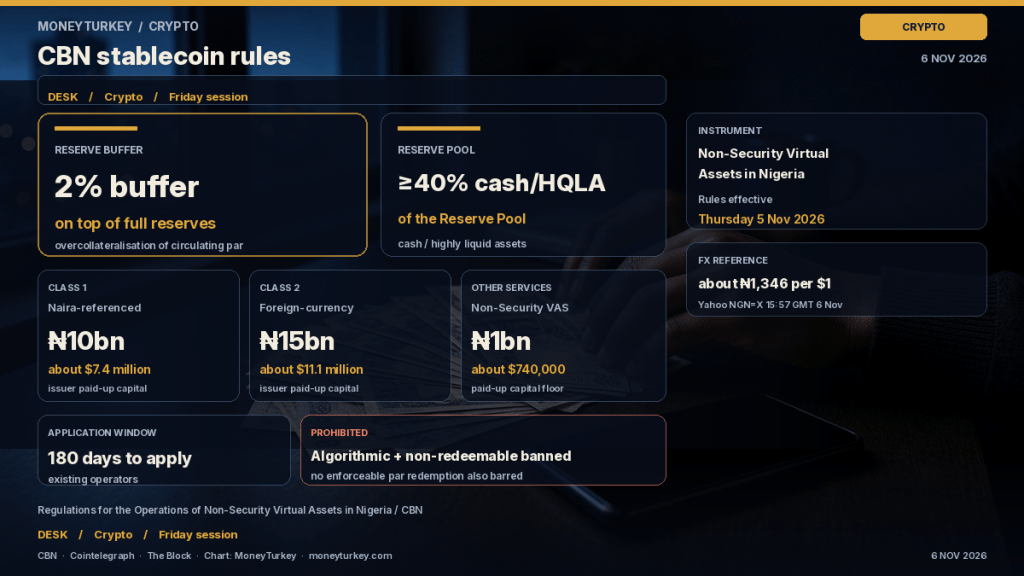
- Nigeria’s central bank requires stablecoin issuers to hold full reserves plus a 2% buffer, with at least 40% in cash or highly liquid assets.
- Issuers must obtain local licenses, meet minimum paid-up capital of 10 billion naira (about $7.4 million) for naira-backed tokens and 15 billion naira (about $11.1 million) for foreign-currency ones, and algorithmic stablecoins are banned.
Nigeria’s central bank has introduced licensing and reserve requirements for stablecoin issuers and other virtual-asset service providers. The rules ban algorithmic stablecoins and require issuers to back tokens with eligible assets plus a 2% buffer. The regulations took effect immediately and apply to exchanges, custodians and payment providers operating in one of Africa’s largest crypto markets.
What happened
The Central Bank of Nigeria issued the Regulations for the Operations of Non-Security Virtual Assets on Thursday. The framework sets licensing, capital and reserve standards for stablecoin issuers, crypto exchanges, custodians and payment-service providers. Existing operators have 180 days to apply for licenses or authorizations.
Under the rules, stablecoin issuers must maintain full reserves and an additional buffer equal to at least 2% of the token’s value. At least 40% of reserves must be cash or qualifying highly liquid assets. Naira-backed issuers face a minimum paid-up capital of 10 billion naira (about $7.4 million), while foreign-currency issuers must hold 15 billion naira (about $11.1 million). Payment-related service providers must maintain at least 1 billion naira (about $740,000) in paid-up capital. Dollar figures use about ₦1,346 per dollar (Yahoo Finance NGN=X as of 6 November 2026).
The regulations prohibit stablecoins that rely primarily on algorithms rather than eligible reserves to maintain value, as well as tokens that lack enforceable redemption rights. The Central Bank of Nigeria said the measures aim to support responsible innovation while protecting consumers and financial stability.
Why it matters
Nigeria has previously restricted crypto trading by limiting banking access for exchanges and seeking to curb peer-to-peer trading in local currency. The new rules expand central-bank oversight of crypto payment services and formalize reserve standards for stablecoins. According to Cointelegraph, the move follows President Bola Tinubu’s July executive order that sought to coordinate crypto oversight among Nigerian authorities.
The country has drawn attention in the crypto industry over its dispute with Binance. Binance discontinued its Nigerian naira services in March 2024 amid government scrutiny of crypto trading and allegations of currency manipulation. Nigerian authorities also detained a Binance executive for nearly eight months before dropping money-laundering charges in October 2024. Nigeria’s revenue agency introduced crypto tax collection rules for digital-asset platforms and peer-to-peer marketplaces in August 2026.
What to watch
- License applications from existing stablecoin issuers within the 180-day window
- Details on how the 2% buffer and 40% liquid-asset rule will be audited
- Any clarification on enforcement for foreign-currency-backed stablecoins
Related on MoneyTurkey
- Crypto movers: Bitcoin near $75,300 as blue chips slide
- Exchanges Tout Cold Storage After Binance’s $6.3B Hack
For information only. Not investment advice.

