
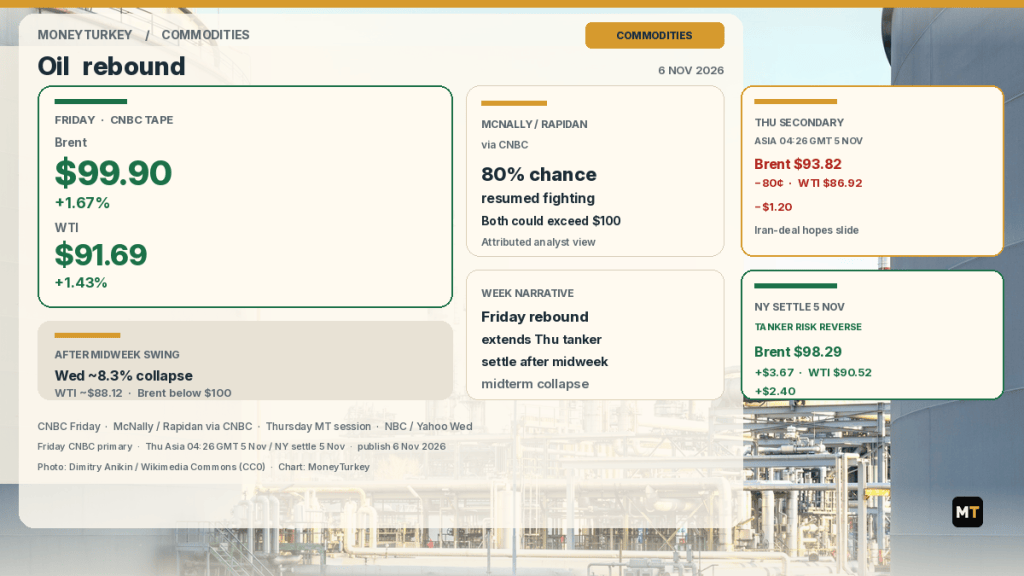
Brent and WTI futures climbed on Friday after a violent midweek swing — Wednesday’s midterm-driven collapse, Thursday’s Asia slide then tanker rebound — as investors reassessed U.S.-Iran supply risk through the Strait of Hormuz.
MoneyTurkey Commodities Desk | 6 November 2026
Key points
- Friday (CNBC tape): Brent futures climbed 1.67% to $99.90 a barrel; WTI gained 1.43% to $91.69.
- Thursday LOCK (MoneyTurkey Derivatives WP2296): Asia as-of 0426 GMT Brent $93.82 (−80¢) / WTI $86.92 (−$1.20); New York settle Brent $98.29 (+$3.67) / WTI $90.52 (+$2.40) after tanker attacks.
- Wednesday: Brent fell about 8.3% to below $100 and WTI to around $88.12 on midterm de-escalation hopes (Livemint / Business Standard), after a volatile Wednesday morning bounce that had Brent near $104.36 / WTI near $96.72 (TimesLIVE).
- Rapidan’s Bob McNally told CNBC he sees an 80% probability of resumed fighting and said both benchmarks could exceed $100 — attributed analyst view, not a MoneyTurkey forecast.
Oil prices rose Friday as investors weighed renewed U.S.-Iran conflict risks after the midterm elections, CNBC reported. Brent futures climbed 1.67% to $99.90 a barrel and WTI gained 1.43% to $91.69. That Friday print sits just above Thursday’s New York tanker-session settle ($98.29 / $90.52) published on MoneyTurkey’s Derivatives desk, and well above Thursday’s Asia lows.
What happened
The week’s oil tape needs three chapters, not one. On Wednesday, markets swung hard around the U.S. midterm outcome. TimesLIVE, citing Reuters, said Brent futures rose 76 cents, or 0.7%, to $104.36 a barrel on Wednesday morning while WTI gained 63 cents, or 0.7%, to $96.72, reversing earlier declines as Democrats captured control of Congress. Later Wednesday, Livemint and Business Standard reported a sharp collapse: Brent fell about 8.3% to below $100 a barrel and WTI declined by a similar margin to around $88.12 as traders raised bets on an Iran-war exit and fewer Strait of Hormuz disruptions.
Thursday split again. MoneyTurkey’s Derivatives desk (WP2296) locked an Asia-session print as of 0426 GMT with Brent down 80 cents, or 0.85%, to $93.82 and WTI down $1.20, or 1.36%, to $86.92 on Iran-deal / de-escalation hopes, then a New York settle reverse after tanker attacks: Brent up $3.67, or 3.88%, at $98.29 and WTI up $2.40, or 2.72%, at $90.52. CNBC separately said Iran reported three additional attacks on oil tankers in the Strait of Hormuz on Thursday, while UK Maritime Trade Operations data showed attacks on vessels continuing at a near-record rate — attributed shipping-risk context consistent with that settle rebound.
Friday’s CNBC session then extended the tanker-risk rebound: Brent +1.67% to $99.90 and WTI +1.43% to $91.69 as desks reassessed whether the election outcome would constrain further military action or leave physical Gulf risk intact. A WSJ headline in the same Mint cluster framed earlier peace-talk hopes as easing supply fears and weighing on prices — that fall narrative maps to the Wednesday/Thursday Asia chapters, not the Friday CNBC rebound, and is not treated here as a competing Friday settle.
What is driving prices
Bob McNally, Rapidan Energy Group founder, told CNBC he sees an 80% probability of military fighting resuming and forecasts both benchmarks could climb above $100 a barrel. He said President Trump is determined to prevent Iran from obtaining a nuclear weapon while the Iranian regime is unwilling to give up its nuclear capabilities. McNally’s view is shared by Lombard Odier’s chief economist Samy Chaar and head of investment strategy Luca Bindelli, CNBC reported. Those are attributed analyst probabilities — not verified market-implied odds.
A senior Iranian official said Iran sent a nuclear proposal to Washington through Qatar, Reuters reported — labelled here as an attributed claim. Another senior Iranian official said Iran and the U.S. remained far from a deal to end their war. Qatar stepped up mediation efforts to avert an escalation of attacks after the U.S. elections.
The U.S. carried out defensive strikes on Iran’s Qeshm Island targeting surface-to-air missiles used against U.S. assets, according to U.S. officials cited in TimesLIVE/Reuters copy. A U.S. official said the strikes appeared limited and did not signal a return to major combat operations. President Trump’s conflicting signals — military strikes continuing alongside statements downplaying further escalation — have made it difficult for traders to build strong directional conviction, said Priyanka Sachdeva of Phillip Nova.
Crude stocks fell by 5.27 million barrels in the week ended October 30, market sources said, citing American Petroleum Institute data. Gasoline stocks rose by 1.43 million barrels while distillate inventories fell by 1.19 million barrels. Diesel inventories remain tight while gasoline stocks rose more than expected, Haitong Futures said.
Why it matters
The Strait of Hormuz remains a major route for global oil trade. The conflict has disrupted energy shipments through the waterway, contributing to higher crude and fuel costs. Analysts note that underlying supply-disruption risks around the Strait have not disappeared even when midterm politics briefly priced a diplomatic off-ramp.
Higher fuel costs became a political liability for the Republican Party. President Trump acknowledged that the cost of gasoline had become a concern for voters. Vice-President JD Vance blamed the conflict for the party’s losses. The average U.S. gasoline price reached $4.13 per gallon on November 3, the highest average recorded for any U.S. election day, according to GasBuddy data cited by Bloomberg.
GasBuddy petroleum analyst Patrick De Haan said the drop in crude prices might bring the national average below $4 a gallon in the days ahead. The national average stood at $4.12 a gallon on Wednesday morning, about 39% above its level before the military campaign began, Livemint/NBC reporting said. That relief narrative was tied to Wednesday’s collapse; Friday’s rebound shows how quickly Gulf physical risk can reprice the same complex.
What to watch
- Progress in Qatar-mediated talks between Iran and the U.S. (attributed diplomacy chatter — verify before asserting price causality)
- Further attacks on vessels in the Strait of Hormuz / UKMTO reports
- Weekly U.S. crude inventory data from the EIA
- Any change in U.S. military posture after Democratic control of Congress
Related on MoneyTurkey
- Brent Futures Slide On Iran Deal Hopes
- Codelco Admits 42,100 Tonnes of Overstated Copper Output
- Soybeans Find Strength Late in Overnight Session
For information only. Not investment advice.
Sources
- CNBC (Friday prices / McNally): https://www.cnbc.com/2026/11/06/oil-price-today-brent-wti.html
- MoneyTurkey Derivatives WP2296 (Thursday Asia + NY settle LOCK): Brent Futures Slide On Iran Deal Hopes
- Livemint / Business Standard (Wednesday ~8.3% collapse): midterm de-escalation hopes
- TimesLIVE / Reuters (Wednesday morning bounce $104.36 / $96.72; API stocks; Qeshm strikes)
- WSJ (headline corroboration of peace-talk / supply-fear framing; paywalled): Oil prices fall as Iran peace talks ease supply fears

