
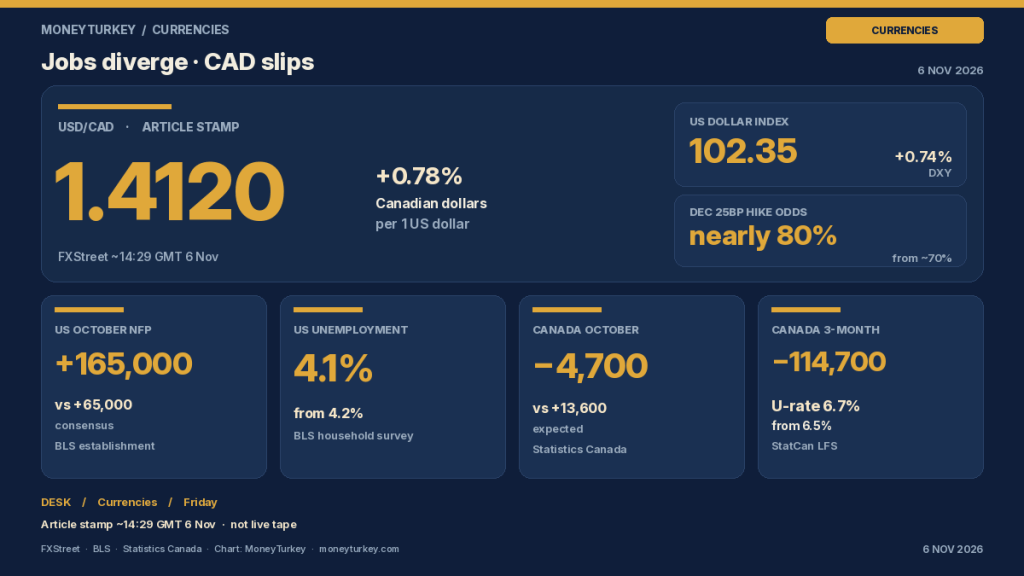
Stronger US payrolls and a Canadian jobs miss widen the policy gap between the Fed and the Bank of Canada.
MoneyTurkey Currencies Desk | 6 November 2026
Key points
- US Nonfarm Payrolls rose 165,000 in October, well above the 65,000 consensus, while Canada shed 4,700 jobs against a 13,600 expected gain.
- USD/CAD climbed 0.78% to 1.4120, the US Dollar Index rose 0.74% to 102.35, and FXStreet said markets priced nearly an 80% chance of a December Fed rate hike.
The Canadian dollar fell 0.78% on Friday, pushing USD/CAD to 1.4120, after the US Bureau of Labor Statistics reported a 165,000 October payroll gain and Statistics Canada showed a 4,700 job loss. The US unemployment rate fell to 4.1%, while Canada’s rose to 6.7%. The data widened the expected policy gap between the Federal Reserve and the Bank of Canada.
What happened
The US Bureau of Labor Statistics reported that Nonfarm Payrolls rose 165,000 in October, above the 65,000 consensus. September’s figure was revised up to 60,000 from 29,000 and August to 186,000 from 133,000, adding 84,000 jobs to prior estimates. The US unemployment rate fell to 4.1% from 4.2%.
Statistics Canada said the economy unexpectedly lost 4,700 jobs in October versus a 13,600 gain expected. The unemployment rate climbed to 6.7% from 6.5%. Canada has now shed 114,700 jobs over the past three months.
What is driving the currency
The stronger US labor report lifted market odds of a 25-basis-point Federal Reserve rate hike in December to nearly 80%, up from about 70% the previous day, according to FXStreet. The US Dollar Index rose 0.74% to 102.35. The Bank of Canada had raised its benchmark rate on 28 October for the first time in more than three years; the weak Canadian jobs data now complicate the case for further tightening.
The divergence in employment trends and policy expectations pushed USD/CAD higher. The pair traded at 1.4119 on the four-hour chart, capped by the 200-period SMA at 1.4120 and horizontal resistance at 1.4130 and 1.4150. Support lies near 1.4070 and the 100-period SMA at 1.4035.
Why it matters
The jobs divergence reinforces the rate differential between the Fed and the Bank of Canada. Traders now see a higher probability that the Fed will keep policy restrictive or even raise rates, while the Bank of Canada may pause or turn cautious. The resulting carry and flow pressure keeps USD/CAD bid.
For FX desks, the move widens the spread between US and Canadian yields and increases the risk of further CAD underperformance if US data continue to surprise to the upside and Canadian employment remains weak.
What to watch
- Next US CPI and Canadian CPI prints for rate-path signals
- Bank of Canada speakers for any shift in tightening bias
- US–Canada yield-spread moves and positioning data
Related on MoneyTurkey
- Taiwan Dollar Weakens Past 33 Per US Dollar
- Yen Climbs as Tech Rout and BoJ Minutes Squeeze USD/JPY Toward 157.40
For information only. Not investment advice.
Sources
- FXStreet: Canadian dollar suffers double blow as US jobs boom, domestic employment shrinks
- US Bureau of Labor Statistics — October 2026 Employment Situation (as reported)
- Statistics Canada — October 2026 Labour Force Survey (as reported)

