
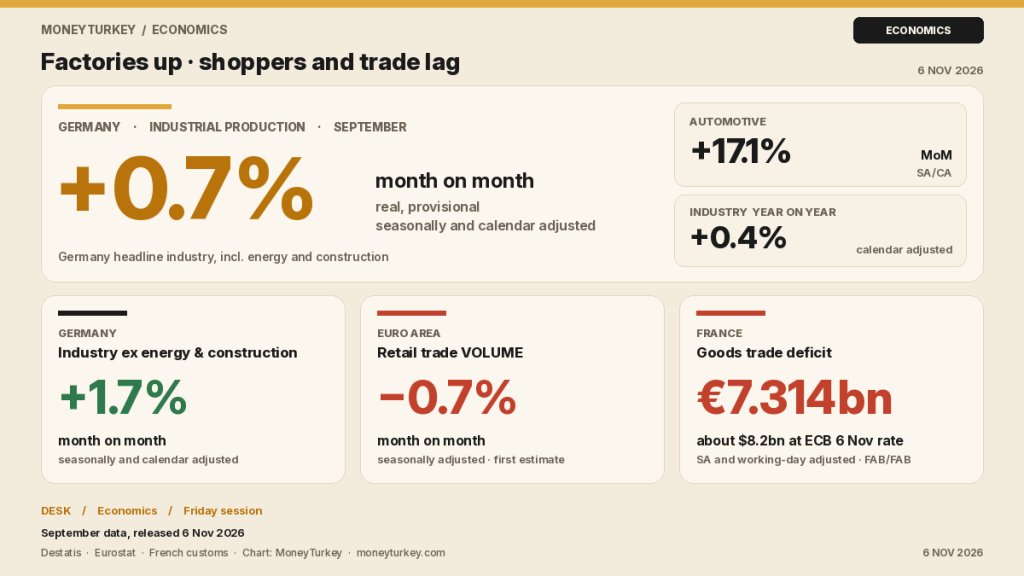
September industrial production beat forecasts on a sharp auto rebound, even as euro-area retail sales fell harder than expected and France’s trade gap hit its widest since May on revised data.
MoneyTurkey Economics Desk | 6 November 2026
Key points
- German industrial production rose 0.7% month-on-month in September, beating expectations of no change (Destatis via Anadolu / FXStreet).
- Euro-area retail sales volume fell 0.7% in September, versus a 0.1% drop forecast; France’s trade deficit widened to €7.314 billion (about $8.2 billion at the ECB’s 6 November reference rate), its widest since May on the revised French customs series (Anadolu; French customs).
German industrial production rose 0.7% in September from the prior month, beating market expectations of stagnation, according to Destatis data reported by Anadolu and corroborated on FXStreet. The gain followed a downwardly revised 1% increase in August and was led by a 17.1% surge in automotive manufacturing. The print adds to evidence of a factory rebound in the euro zone’s largest economy, even as currency-bloc retail sales fell and France’s trade deficit widened.
What happened
Germany’s Federal Statistical Office said industrial output climbed 0.7% month-on-month in September after markets had expected no change. Automotive production jumped 17.1%, reversing two months of subdued activity tied to plant overhauls and summer breaks. Pharmaceutical manufacturing also rose 8%, while construction contracted 2.6% and machinery and equipment production fell 6.5%. Production in industry excluding energy and construction increased 1.7% month-on-month, seasonally and calendar adjusted. On an annual basis, industrial production rose 0.4%.
France’s trade deficit widened to €7.314 billion (about $8.2 billion at the ECB’s 6 November reference rate) in September, its widest since May on the revised French customs series (May revised to €7.671 billion), according to official data reported by Anadolu. The gap increased by about €1.3 billion (about $1.5 billion) from August as higher energy imports outweighed gains in aircraft exports. Imports climbed about €2.4 billion to €62.7 billion (about $70 billion), while exports rose about €1 billion to €55.3 billion (about $62 billion). Energy imports increased about €0.9 billion, driven by refined petroleum products and natural hydrocarbons. Transport-equipment exports grew about €0.6 billion, supported by aircraft deliveries to the Near and Middle East and Africa.
What the numbers say
Euro-area retail sales volume fell 0.7% month-on-month in September, exceeding expectations of a 0.1% decline, according to Eurostat data reported by Anadolu. The drop followed a 0.4% rise in August. Sales of non-food products, excluding automotive fuel, dropped 1.2%, while food, drinks and tobacco sales decreased 0.3%. Automotive fuel sales at specialised stores rose 1%. Across the EU, retail trade volume declined 0.6% after increasing 0.4% the previous month.
On an annual basis, euro-area retail sales volume increased 0.4%, slowing from 1.3% growth in August. Food, drinks and tobacco sales rose 1.1% from a year earlier, while non-food sales increased 0.7%. Automotive fuel sales fell 3%. Among member states with available data, Germany posted the steepest monthly decline at 2%, followed by Romania at 1.3% and Portugal at 0.9%. Luxembourg recorded the strongest increase at 5.3%.
Why it matters
The German industrial rebound is fresh evidence that Europe’s largest economy is moving past a soft patch. The 0.7% gain and the 17.1% surge in automotive output suggest factories are clearing summer disruptions. Production in industry excluding energy and construction rose 1.7%, reinforcing the upturn. The annual 0.4% increase is modest but marks a second consecutive month of positive growth.
At the same time, the euro-area retail sales decline and France’s widening trade deficit show uneven momentum. The 0.7% drop in euro-area sales volume exceeded forecasts and was led by non-food products. France’s trade gap reached its widest since May on the revised French customs series as energy imports rose. Consumer demand and external balances remain under pressure even as factory output improves.
What to watch
- October German industrial production and factory orders
- Euro-area retail sales for October
- France trade balance for October
- Euro-zone PMI and GDP revisions
Related on MoneyTurkey
- UK House Prices Fall 0.6% in October, Steepest Drop Since August 2023
- Lagarde: December ECB Hike Hinges on Data
- Eurozone Inflation Hits 4.0% as German HICP Stays at 2.8%
For information only. Not investment advice.

