
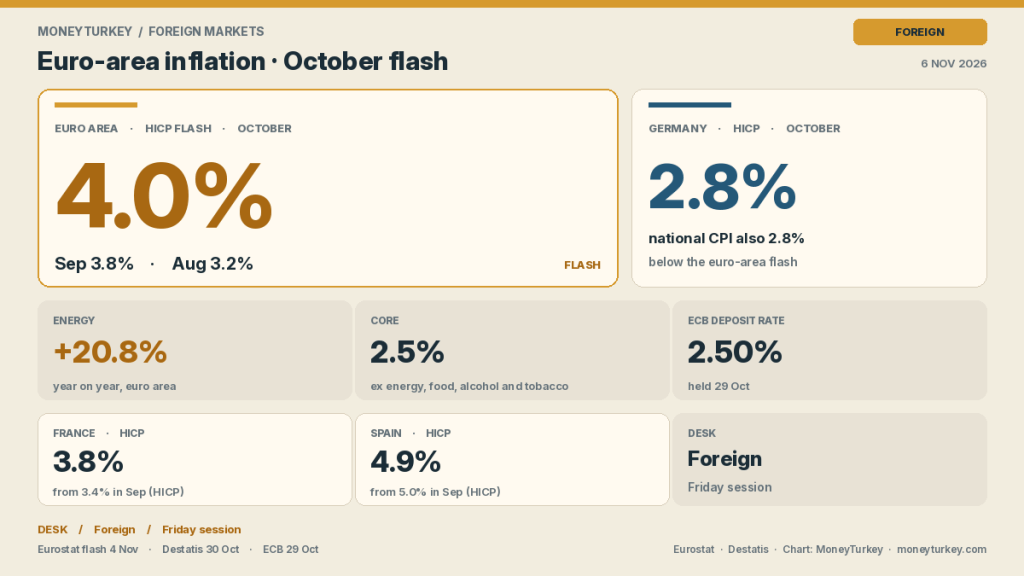
Euro-area consumer prices rose to 4.0% in October, the highest in three years, while German HICP was held at 2.8% by the fuel rebate — and markets are pricing a December ECB hike.
MoneyTurkey Foreign Markets Desk | 6 November 2026
Key points
- Eurostat’s flash estimate put euro-area inflation at 4.0% in October, up from 3.8% in September and 3.2% in August, FAZ reported.
- German HICP was 2.8% in October after the fuel rebate that began on 1 October; Berenberg’s Holger Schmieding estimates the rebate cut the German rate by about 0.3 percentage points, FAZ said.
- Bundesbank President Joachim Nagel called a December ECB hike “very likely necessary”; FAZ said markets expect a 25 bp rise in the deposit rate to 2.75% at the 17 December meeting.
Euro-area inflation printed at a three-year high in October, firming the case for another European Central Bank rate increase in December even as Germany’s own harmonised reading stayed softer under a temporary fuel rebate. The split between the bloc print and the German number is the local market story: euro rate-path repricing, not a German CPI spike to 4%.
What happened
Eurostat’s first estimate put euro-area inflation at 4.0% in October, FAZ reported on 4 November. Energy prices rose 20.8% year on year; services rose 3.3%; food, alcohol and tobacco rose 1.6%. Core inflation, excluding energy, food, alcohol and tobacco, held at 2.5%.
Germany was the outlier on the downside. Harmonised German inflation was 2.8% in October after the Tankrabatt that started on 1 October. Schmieding estimates that rebate shaved about 0.3 percentage points off the German rate, FAZ said. France rose to 3.8% from 3.4%; Spain eased to 4.9% from 5.0%; Austria was 3.5%. Lithuania led the bloc at 6.1%; Malta was lowest at 2.3%.
The ECB left the deposit rate at 2.5% at its October meeting. President Christine Lagarde indicated that, if nothing unexpected happened, the direction for December was clear — a 25 bp rise to 2.75% on the deposit rate, FAZ reported. Nagel said on Tuesday evening in Berlin that a December hike was “very likely necessary” from today’s vantage point, even after the October pause, because the inflation outlook had worsened.
Why markets care
A higher euro-area print with energy still the main driver keeps December firmly in play for the ECB after the October hold. Bund yields and the euro tend to reprice when hike odds firm. German HICP at 2.8% does not cancel that path: the Governing Council targets the euro-area aggregate, and FAZ notes the German rebate is a temporary fiscal distortion.
For equities, higher discount-rate odds weigh on rate-sensitive names. FAZ coverage said the data would likely pressure DAX valuations; it did not quantify the expected move in yields or the index.
Local context
The FAZ coverage is the primary German-language read on the Eurostat flash and the Nagel comments. Lagarde’s December steer came from the October ECB press conference, not from a separate German CPI release. Do not confuse the 4.0% euro-area figure with Germany’s 2.8% HICP.
What to watch
- ECB decision on 17 December and any updated staff projections
- Whether energy inflation stays elevated if Iran-war oil risk persists
- Next German CPI / HICP prints once the fuel rebate effect rolls
- Bund 10-year yield and EUR reaction into the December meeting
Related on MoneyTurkey
- Indonesia: MSCI Warning Sparks Rp16.9T October Sell-Off
- KOSPI Ends Down 6% After Circuit Breaker
- Brent Heads for ~12% Weekly Loss Despite Tanker Attacks
For information only. Not investment advice.
Sources
- FAZ — Euro-area inflation 4.0% / German HICP 2.8% / December ECB hike framing: faz.net
- FAZ / dpa — Nagel: December hike “very likely necessary”: faz.net
- Reuters via Investing.com — Euro-zone inflation three-year high; core 2.5%: investing.com

