
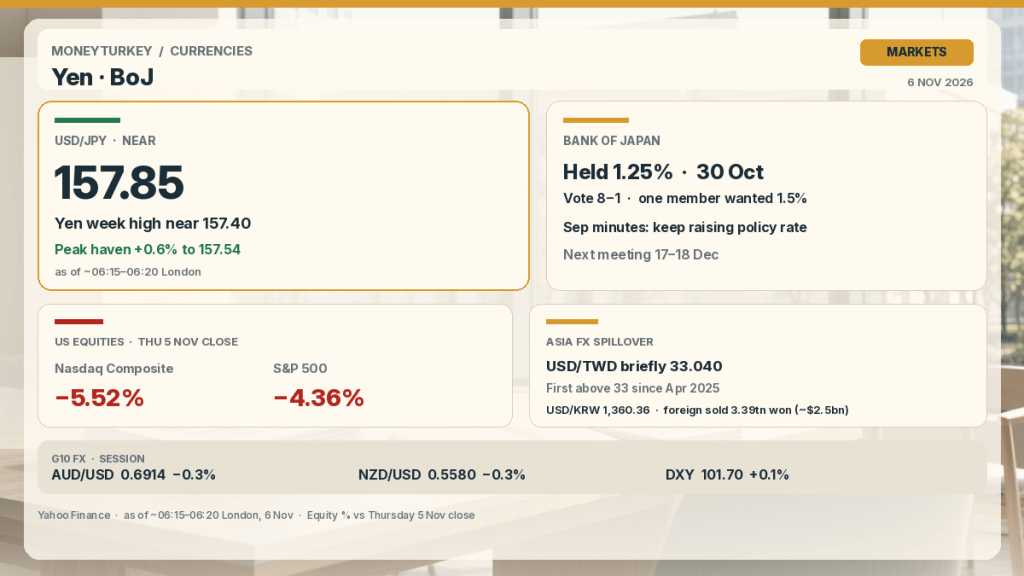
Yen haven demand met a hawkish BoJ minutes read, pulling USD/JPY toward a one-week high near 157.40 while Taiwan and Korea FX absorbed the equity shock.
MoneyTurkey Currencies Desk | 6 November 2026
Key points
- USD/JPY traded near 157.85 after the yen reached a one-week high near 157.40; the yen briefly gained as much as 0.6% to 157.54 per dollar.
- September BoJ minutes showed policymakers agreed it was appropriate to keep raising the policy rate, reinforcing December hike bets.
- Asia FX spillover: Taiwan dollar briefly weakened past 33 per dollar; dollar-won rose to 1,360.36 after foreign investors sold 3.39 trillion won (~$2.5bn) of Korean shares.
The yen strengthened into Thursday’s US equity selloff and a hawkish read of Bank of Japan September minutes, outperforming G10 peers as traders rotated into haven assets. The move is not only a Wall Street story: Taiwan’s dollar briefly broke a level not seen since April 2025, and the won faced pressure after heavy foreign equity selling — the Asia FX book that sat under the same risk-off pulse.
What happened
USD/JPY climbed the yen to a one-week high near 157.40 before the pair eased back toward 157.85. Earlier in the Asian session the dollar had traded near a weekly high around 157.25 before recovering toward 158.00; the yen later gave back some of its gains but remained stronger on the day. The yen strengthened as much as 0.6% to 157.54 per dollar at the peak of the haven bid.
Asian currencies traded mixed into the same risk-off wave. The Taiwan dollar weakened past 33 per dollar for the first time since April 2025, falling as much as 0.5% to 33.040 before recovering below the level. The Korean won also faced pressure, with the dollar-won rate rising to 1,360.36 after foreign investors sold 3.39 trillion won (about $2.5bn at ~1,360) of shares on Thursday.
The Australian dollar fell 0.3% to 0.6914 and the New Zealand dollar dropped 0.3% to 0.5580. The Singapore dollar weakened 0.2%. The US dollar index rose 0.1% to 101.70 ahead of the October nonfarm payrolls report.
What is driving the currency
Two forces drove the yen: risk aversion and BoJ policy signals. A 5.52% drop in the Nasdaq Composite and a 4.36% fall in the S&P 500 — verified against Thursday closes — triggered a shift into bonds and haven currencies. Market chatter linked the equity slide to fears of tighter scrutiny of artificial-intelligence investment after a Democratic sweep in US midterm elections; those midterm causality claims remain unverified claims as market attribution, not established fact.
BoJ minutes released on Thursday showed policymakers concurred it was appropriate to keep increasing the policy interest rate and modify the level of monetary easing. The bank held its policy rate at 1.25% on October 30 by an 8-1 vote, with one member wanting a 1.5% rate. The next meeting is set for December 17-18.
The rate gap between the BoJ at 1.25% and the Fed at 3.75%-4.00% remains wide. Markets price about a 70% chance of a Fed cut on December 9. A BoJ hike in December would narrow the gap by a quarter-point if the Fed stands still. Cleveland Fed President Hammack said on Thursday that policy has to become restrictive.
Why it matters
The yen’s safe-haven bid matters for USD/JPY positioning. The pair is back inside the 156.00-159.00 range it has held since late September. The 50-day and 200-day exponential moving averages sit within a quarter-yen of 158.00, and USD/JPY is trading just below both.
For Asia desks, the same risk-off pulse that lifted the yen also broke Taiwan’s 33 handle and lifted dollar-won — a regional FX footprint that majors often underweight versus the G10 haven headline.
Traders will watch Governor Ueda’s speech at 16:00 GMT on Friday and the October nonfarm payrolls release at 13:30 GMT. The payrolls report is forecast to show a 65,000 rise after 29,000 in September. October CPI data due on November 10 will feed the Fed’s December 8-9 meeting.
What to watch
- October nonfarm payrolls at 13:30 GMT on Friday, forecast at +65,000.
- BoJ Governor Ueda speech at 16:00 GMT on Friday.
- October CPI release on November 10 at 13:30 GMT.
- BoJ December 17-18 policy meeting.
Related on MoneyTurkey
- Rupee Hits Strongest Since 21 October as Oil Slide Eases Inflation Risks
- Sterling Holds Near $1.35 as BoE Hike to 4% Proves Largely Priced
- Asia open: KOSPI halted as Nikkei, Taiwan plunge
For information only. Not investment advice.
Sources
- Yahoo Finance / Investing.com Asian FX wrap: https://sg.finance.yahoo.com/news/asian-fx-mixed-yen-gains-043840964.html
- FXStreet: https://www.fxstreet.com/news/japanese-yen-outperforms-as-us-tech-rout-and-hawkish-boj-minutes-lift-demand-202611051749
- FXStreet: https://www.fxstreet.com/news/the-yen-rises-on-boj-minutes-with-ueda-and-us-nfp-on-the-friday-docket-202611052245
- BoJ September minutes (official PDF): https://www.boj.or.jp/en/mopo/mpmsche_minu/minu_2026/g260918.pdf
- Yahoo Finance chart locks (Nasdaq Composite −5.52%, S&P 500 −4.36% Thu 5 Nov closes; USD/JPY session low ~157.41)

