
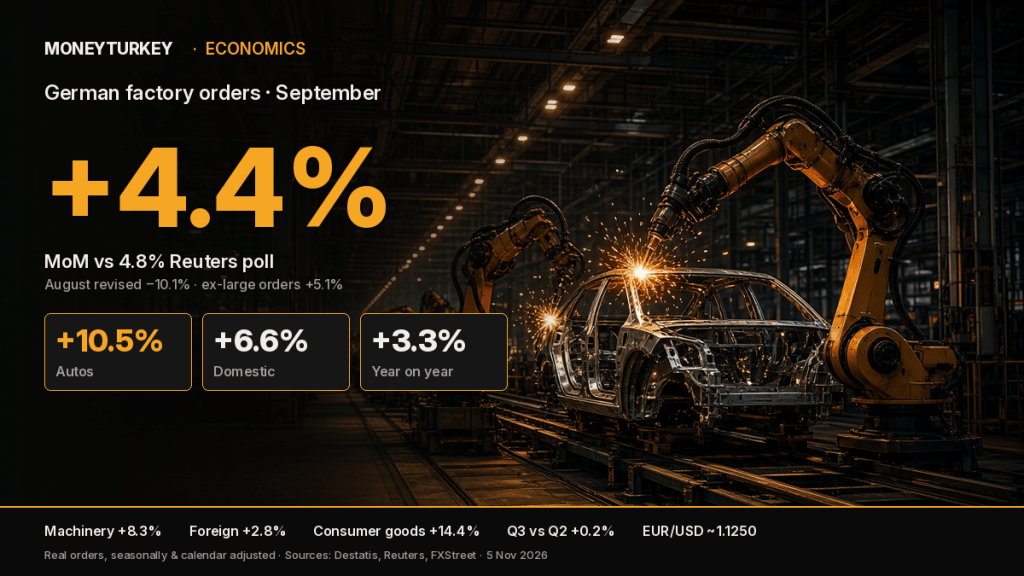
September orders rose after August’s sharp drop, led by autos, but missed the Reuters 4.8% consensus.
MoneyTurkey Economics Desk | 5 November 2026, ~13:25 London
Key points
- Real new orders in manufacturing rose 4.4% month-on-month in September (Destatis, seasonally and calendar adjusted), below a Reuters poll forecast of 4.8% (some desks had ~4.6%), after an upwardly revised 10.1% decline in August.
- Excluding large-scale orders, new orders rose 5.1% month-on-month; domestic orders increased 6.6%, foreign orders 2.8%; euro-area demand rose 4.5% and non-euro-area demand 1.6%.
German factory orders rebounded in September after August’s steep fall, but the gain was smaller than expected. Real new orders in manufacturing rose 4.4% from the previous month, Destatis reported, compared with a Reuters poll forecast of 4.8%. The automotive sector led the recovery with a 10.5% increase, while machinery and equipment orders rose 8.3%.
What happened
The Federal Statistical Office released provisional data showing that new orders in manufacturing increased 4.4% month-on-month in September after seasonal and calendar adjustment. The figure followed an upwardly revised 10.1% decline in August (provisional: −10.6%). The automotive sector posted a 10.5% rise in new orders — Destatis noted prior months were soft in part because of production changeovers and factory holidays — and machinery and equipment orders increased 8.3%, helped by a large-scale order in engines and turbines. Orders in other transport equipment, including aircraft, ships, trains and military vehicles, fell 10.4%.
Domestic orders rose 6.6% and foreign orders 2.8%. Demand from the euro area increased 4.5%, while orders from outside the euro area grew 1.6%. On an annual basis, factory orders rose 3.3% after calendar adjustment, compared with a 3.2% gain in August. Excluding large-scale orders, September new orders were 5.1% higher than in August. The less volatile three-month comparison showed total new orders 0.2% higher in the third quarter of 2026 than in the second.
What the numbers say
The 4.4% monthly increase was below the Reuters consensus of 4.8% (Anadolu and some other desks cited ~4.6%). The rebound was concentrated in autos and machinery, while other transport equipment orders declined. Domestic demand outpaced foreign demand, with euro-area orders growing faster than those from outside the bloc. Year-on-year growth edged up to 3.3% from 3.2% in August. Capital goods orders rose 5.3%, intermediate goods 0.5%, and consumer goods 14.4%.
FXStreet notes that factory-order readings can signal expansion and may act as an inflationary factor, but the German print has limited direct influence on total euro-area GDP. Real manufacturing turnover rose 0.2% month-on-month in September, Destatis said.
Why it matters
EUR/USD trimmed session gains after the data, pulling back from highs near 1.1270 to trade just below 1.1250 while still holding mild daily gains, FXStreet reported. The common currency had been supported earlier by a sharp decline in oil prices — Brent near about $93 after a ~$20 two-day drop — and by euro-area flash inflation rising to 4% year-on-year in October. The factory-orders miss adds to evidence on the pace of German industrial recovery and its implications for euro-area growth and ECB policy.
Separately on Thursday, the German Chamber of Commerce and Industry (DIHK) raised its 2026 growth outlook to 1% from 0.3%, Reuters reported, while cautioning that debt-financed public spending on infrastructure and defence — plus some export tailwind — is driving much of the expansion rather than self-sustaining private demand. The orders data provide an early industrial signal for that outlook, though the miss relative to consensus suggests the rebound remains uneven across sectors.
What to watch
- October industrial production figures for Germany
- Eurozone flash PMI data for November
- Next Destatis factory orders release for October
Related on MoneyTurkey
- Russia Services PMI Slips to 50.1 as New Orders Fall
- Bank of England Raises Bank Rate to 4% in First Hike Since 2023
For information only. Not investment advice.
Sources
- Destatis: https://www.destatis.de/EN/Press/2026/11/PE26_385_421.html
- Reuters via StreetInsider / Investing: German industrial orders +4.4% vs 4.8% poll; DIHK growth outlook to 1%
- Anadolu: https://aa.com.tr/en/economy/germanys-factory-orders-rebound-44-in-september-miss-estimates/4112264
- FXStreet: https://www.fxstreet.com/news/euro-trims-gains-as-german-factory-orders-miss-expectations-202611050742
- DIHK Fall 2026 survey / statement (growth forecast 1.0% for 2026 and 2027)

