
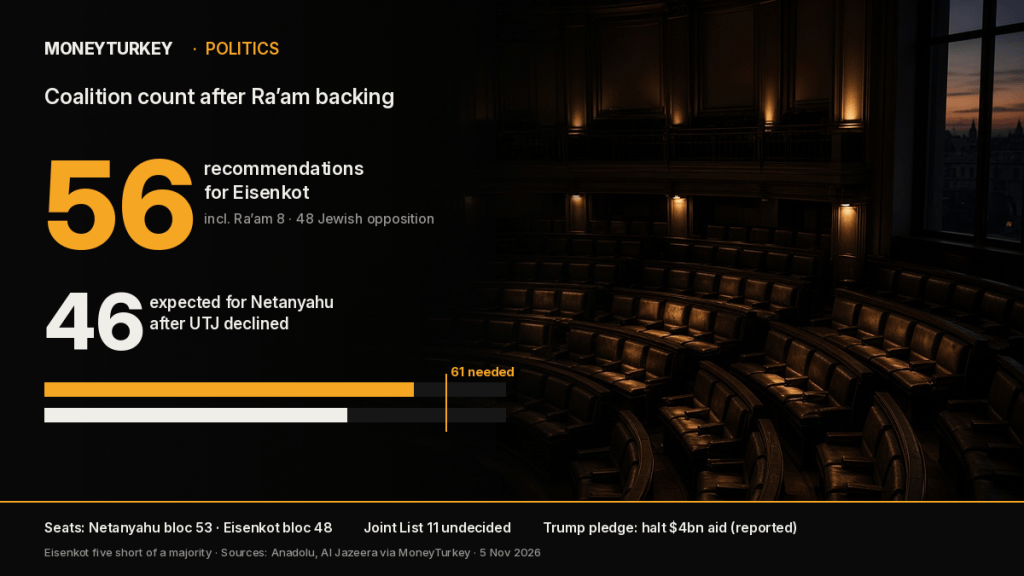
Ra’am’s eight lawmakers recommend Eisenkot, lifting his tally to 56 and leaving Netanyahu at 46, but a 61-seat majority is still required.
MoneyTurkey Politics Desk | 5 November 2026, ~13:00 London
Key points
- Ra’am’s eight lawmakers recommended opposition leader Gadi Eisenkot to form the next Israeli government, bringing his confirmed recommendations to 56.
- Netanyahu’s expected recommendations fell to 46 after United Torah Judaism declined to endorse him; both sides remain short of the 61-seat majority.
- Coalition uncertainty keeps a risk premium on Israeli assets and regional oil/defense names, with US military-aid bipartisanship also in play after the Democratic midterm sweep.
Ra’am, an Arab party with eight seats in Israel’s 120-member Knesset, recommended opposition leader Gadi Eisenkot to form the next government on Thursday, Anadolu Agency reported. The move brings Eisenkot’s formal recommendations to 56, including 48 from Jewish opposition parties. Netanyahu’s tally stands at 46 after his ally United Torah Judaism declined to endorse him. A candidate needs 61 votes to secure a parliamentary majority.
What happened
Ra’am’s chairman Mansour Abbas and two other lawmakers conveyed the recommendation to President Isaac Herzog, Yedioth Ahronoth reported via Anadolu Agency. The party won eight seats in last week’s election. Herzog is expected to task a lawmaker with forming a government in the coming days; the designated lawmaker will have 28 days, with a possible 14-day extension.
The Arab-led Joint List, which won 11 seats, has not announced its position, Anadolu Agency reported. The Seattle Times noted that the Joint List could support an anti-Netanyahu bloc by voting for it or by abstaining to lower the threshold for a majority.
United Torah Judaism, which holds seven seats, said it would not recommend any candidate, Anadolu Agency reported. Netanyahu’s coalition lost its parliamentary majority in the election but still holds 53 seats compared with 48 for Eisenkot’s bloc.
What is at stake for markets
Prolonged coalition talks leave policy continuity unsettled for investors watching the shekel, Israeli government bonds, and defense and energy names tied to Middle East risk. Without a 61-seat majority locked in, markets will price the path of any new government — and any return of Netanyahu — against regional oil and security premia rather than a settled political baseline.
Al Jazeera reported that opposition leaders Yair Lapid and Eisenkot linked Netanyahu’s US alignment to a Democratic congressional victory and warned that continued rule under Netanyahu risks Israel’s bipartisan support in Washington. Lapid said the outcome “endangers our security” and “jeopardizes our democracy.”
Eisenkot pledged to “renew and deepen” the US partnership and to work with allies “to advance a Middle East defined not simply by the absence of conflict, but by the presence of opportunity and cooperation,” Al Jazeera reported. That framing matters for desks that treat annual US military aid and the bipartisan backing behind it as a core input for Israeli credit and defense contractors.
Al Jazeera also reported that some Democratic candidates made criticism of US military aid to Israel a campaign theme, and that Trump pledged to halt $4 billion in annual funding, calling it a way to remove a “bad talking point” for Democrats. Lapid said Israel must return to the bipartisan approach that “worked for us for seventy years.” Any sustained shift in that aid channel would reprice defense supply chains and Israel-linked risk assets; for now the figure is a political signal, not a settled budget cut.
Why it matters
The Seattle Times reported that Arab parties now hold a record share of seats after high turnout, and that only one Arab party has ever served in an Israeli government, in 2021. Ra’am is willing to join an anti-Netanyahu government as a partner, but any such arrangement would still need the Joint List’s support. The Joint List has said it is willing to back a government without joining it, provided the arrangement advances Palestinian statehood goals.
The Seattle Times quoted Joint List lawmaker Ahmad Tibi saying the bloc wants “to do things that we did not do in the past in order to remove this criminal government.” He warned that rejection of Arab partnership would prove Israel is “an ethnocracy, not an absolute democracy for all citizens.” Coalition arithmetic that depends on those parties raises the odds of a longer formation clock — and a longer window of policy uncertainty for FX and equity desks.
What to watch
- Herzog’s decision on which lawmaker to task with forming a government
- Joint List announcement on whether it will vote for or abstain on an Eisenkot-led coalition
- Any public statements from US lawmakers on future military aid levels
- Reactions from Israeli bond and currency markets to coalition signals
Related on MoneyTurkey
- Erdogan Seeks Putin Talks on Ending Russia-Ukraine War
- North Korea Fires Missiles, Rules Out US Talks Over Binance Hack Charge
For information only. Not investment advice.
Sources
- Anadolu: https://www.aa.com.tr/en/middle-east/arab-party-recommends-opposition-leader-eisenkot-to-form-israeli-government/4112840
- Al Jazeera: https://www.aljazeera.com/news/2026/11/5/israels-opposition-slams-toxic-netanyahu-after-democrats-win-us-congress
- The Seattle Times: https://www.seattletimes.com/nation-world/arab-parties-extend-a-hand-to-try-and-topple-netanyahu-but-challenges-remain/

