
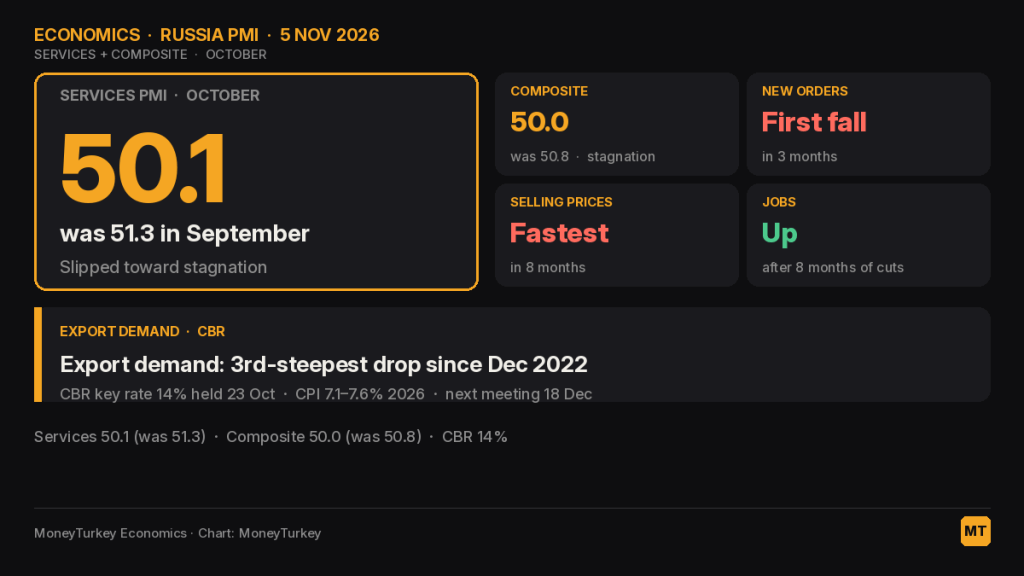
The October services PMI slipped to 50.1 from 51.3 as new orders fell for the first time in three months, leaving the Bank of Russia with a cooling economy and still-rising prices.
MoneyTurkey Economics Desk | 5 November 2026
Key points
- S&P Global’s Russia Services PMI fell to 50.1 in October from 51.3 in September, only just above the 50 line that separates growth from contraction.
- The composite output index, covering services and manufacturing, dropped to 50.0 from 50.8, meaning private-sector activity stalled overall.
- New business fell for the first time in three months, while firms raised selling prices at the fastest rate in eight months.
Russia’s services sector came close to stalling in October. The S&P Global Russia Services PMI fell to 50.1 from 51.3 in September, which points to only a fractional rise in output after modest gains in August and September. With manufacturing included, the composite output index fell to exactly 50.0 from 50.8. In other words, private-sector activity across Russia was flat on the month.
What happened
Survey respondents put the slowdown down to fewer orders from clients than they had expected. Total new business fell for the first time in three months. The drop was modest, but it went against the survey’s long-run pattern of strong growth. Firms reporting lower sales cited softer demand, fewer clients and pressure on customer budgets. Export orders fell faster: S&P Global said the decline in international demand was the third-steepest since December 2022.
Staffing rose for the first time after eight months of job cuts, though only marginally. Some firms hired to fill vacancies and finish existing projects. With less new work coming in, outstanding business fell again, its sixth decline in seven months.
Prices are moving the wrong way
Input cost inflation picked up for the first time in three months. Firms reported higher costs for utilities, raw materials, staff and fuel. They passed part of that on: selling charges rose at the fastest rate in eight months, faster than the survey’s historical average. Business confidence about the year ahead softened for a second month and stayed below its 2026 average and well below its long-run trend.
Why it matters
The survey leaves the Bank of Russia in an awkward spot. On 23 October it held its key rate at 14% for a second straight meeting. It also raised its end-2026 inflation forecast to 7.1–7.6% and said it expects the key rate to average 12.5–13.5% in 2027. Demand is now softening faster than prices, so the central bank faces a stalling economy that it still cannot ease into quickly.
For markets, the rouble has been supported more by oil prices and Ukraine-settlement headlines than by domestic growth. Weaker services momentum and falling export orders make the currency more exposed if either support fades. The central bank publishes its summary of the October key-rate discussion today. Its next rate decision is due on 18 December.
What to watch
- Bank of Russia key-rate discussion summary, out 5 November, for how policymakers weigh weaker demand against sticky prices
- Weekly CPI prints for signs that faster pass-through of selling prices is feeding into inflation
- November PMIs, to see whether new orders keep falling
- Bank of Russia decision on 18 December
Related on MoneyTurkey
- BoE Poised to Hike to 4% as Iran Oil Pushes UK Inflation to 3.5%
- Indonesia Q3 GDP Beats Forecast at 5.47% as Rupiah Firms
- Turkey December Rate Cut Splits Analysts After CPI Ticks to 29.77%
For information only. Not investment advice.

