
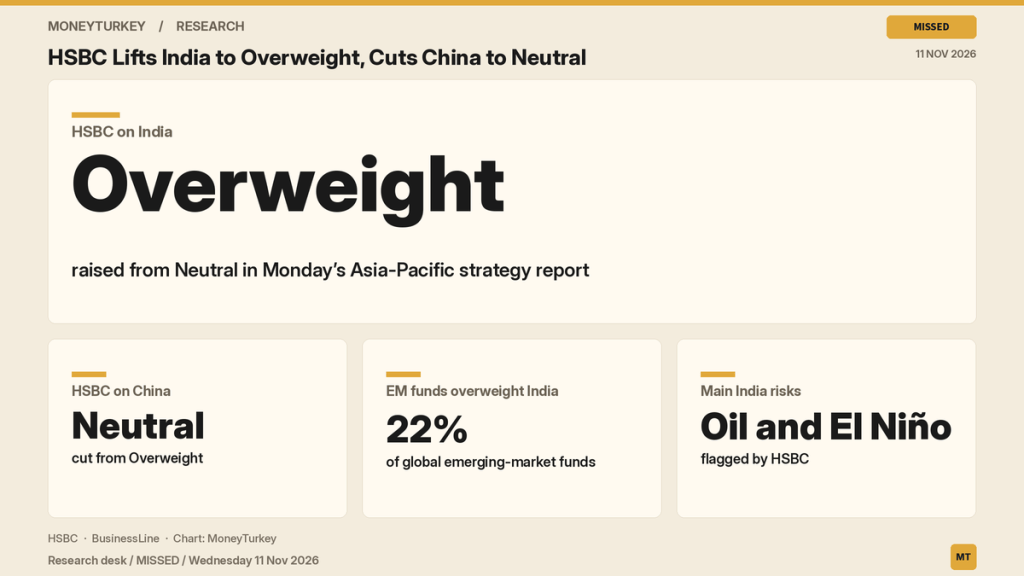
HSBC has raised Indian equities to Overweight and cut mainland Chinese equities to Neutral, betting that India’s long valuation reset has run its course while China lacks the catalysts for a lasting re-rating.
MoneyTurkey Research Desk | 11 November 2026
Key points
- HSBC upgraded India to Overweight from Neutral in an Asia-Pacific equity strategy report published on Monday.
- It cut mainland China to Neutral from Overweight, saying policy support may limit losses but is unlikely to drive a sustained re-rating.
- Only 22% of global emerging-market funds are overweight India, which HSBC sees as room for foreign buying.
- High oil prices and El Niño are the main risks it flags for India.
The call
“Following a multi-year valuation re-set and significant underperformance to EM, we now raise Indian equities to overweight,” HSBC said in the note, according to Business Standard. The team led by Herald van der Linde, HSBC’s head of Asia-Pacific equity strategy, pointed to resilient corporate earnings, strong credit growth and policy measures supporting growth and the rupee, according to The Times of India, BusinessLine and India Business Trade.
HSBC said large-cap valuations now look more reasonable, and that only 22% of global emerging-market funds hold an overweight position in India, according to The Times of India and BusinessLine. It also pitched India as a diversifier: “India offers diversification and low volatility in Asian markets dominated by AI stocks,” the bank said, according to Business Standard and Business Today.
Why China lost its Overweight
“Our downgrade reflects our belief that there are limited catalysts that can drive a sustained re-rating,” HSBC said, according to The Times of India and Business Standard. The bank acknowledged that Chinese stocks are cheap and offer high shareholder yields, but said weak consumer confidence, property-market stress and softer domestic investment still weigh on growth, while subdued southbound flows from mainland investors into Hong Kong and falling margin financing point to weaker investor appetite.
Within China, HSBC still prefers banks, consumer stocks with attractive dividend yields, biotech and technology hardware makers exposed to artificial intelligence, according to The Times of India, Business Today and BusinessLine.
Where HSBC sees opportunity in India
HSBC is most positive on banks, citing a better growth outlook. Among industrials it likes capital goods, cement, ports and electronics manufacturing services, and in consumption it prefers discretionary names such as retailers and carmakers over staples. It remains positive on insurers and hospitals despite recent regulatory uncertainty, according to The Times of India, Business Standard and India Business Trade.
Risks
HSBC said persistently high energy prices could trigger modest earnings downgrades, weigh on domestic demand and pressure the rupee, and that higher inflation would hit consumption, especially in rural areas. It also flagged a possible El Niño. The bank said it does not expect those risks to be large enough to derail overall market sentiment, according to The Times of India and Business Standard.
Why it matters
The switch flips HSBC’s ranking of Asia’s two largest equity markets after a year in which global money chased AI-heavy North Asian stocks and left India behind. It follows Citi’s higher Nifty 50 target earlier this week, adding to a run of big-bank calls for foreign investors to rebuild Indian positions.
What to watch
- Foreign portfolio flows into Indian equities in the coming weeks
- Whether the pace of Indian earnings downgrades keeps slowing
- Chinese consumer confidence, property data and southbound flows
- Oil prices and the rupee
Related on MoneyTurkey
- Citi lifts Nifty 50 target to 28,000 for end-2027, sees room for $12 billion of foreign inflows
- UOB Kay Hian Upgrades Singapore Banks to Overweight
For information only. Not investment advice.
Sources
- The Times of India: https://timesofindia.indiatimes.com/business/india-business/hsbc-upgrades-indian-equities-to-overweight-downgrades-chinese-stocks-to-neutral/articleshow/135677830.cms
- Business Standard: https://www.business-standard.com/markets/news/hsbc-upgrades-indian-equities-to-overweight-cuts-china-to-neutral-126110901244_1.html
- BusinessLine: https://www.thehindubusinessline.com/markets/hsbc-upgrades-india-to-overweight-cuts-china-to-neutral-in-asia-strategy-shift/article71682343.ece
- Business Today: https://www.businesstoday.in/markets/stocks/story/stock-market-hsbc-upgrades-india-to-overweight-cuts-china-rating-to-neutral-heres-why-566395-2026-11-09
- India Business Trade: https://indiabusinesstrade.in/hsbc-upgrades-indian-equities-to-overweight-downgrades-china-to-neutral.htm

