
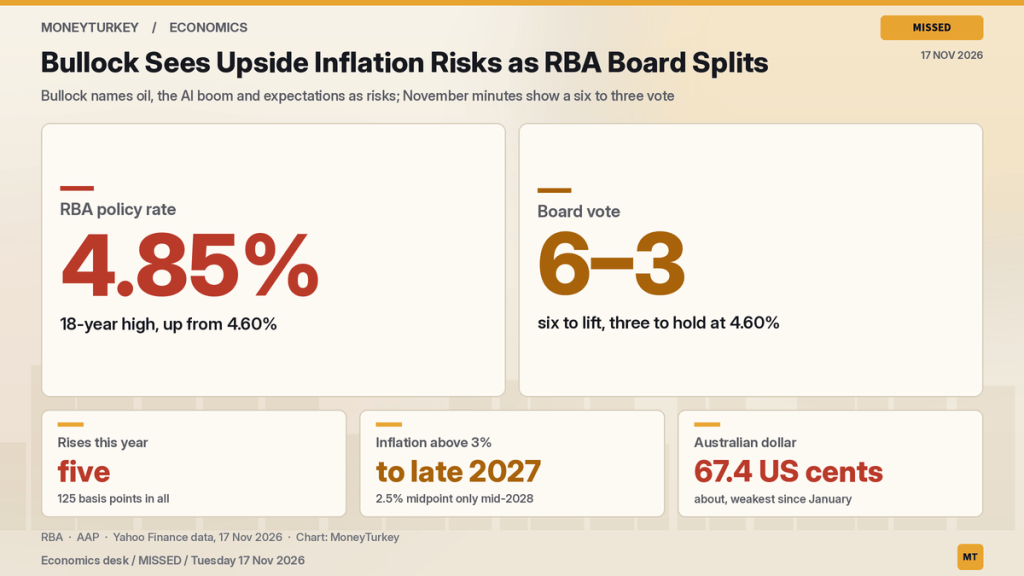
Australia’s central bank chief says oil, the AI boom and creeping expectations could push inflation higher. Minutes out the same day show a board split six to three.
MoneyTurkey Economics Desk | 17 November 2026
Key points
- Reserve Bank of Australia governor Michele Bullock said on Tuesday that inflation risks are “still skewed to the upside”, naming oil prices, AI and data-centre spending, and inflation expectations
- Minutes of the 2-3 November meeting show six board members voted to lift the policy rate to 4.85%, an 18-year high, while three wanted to hold at 4.60%
- The majority judged 4.60% “not clearly sufficient” to bring inflation back to target
- The Australian dollar traded around 67.4 US cents, its weakest since January
Speaking at the ASIC Annual Forum in Sydney, Bullock said the RBA’s five rate rises this year, 125 basis points in all, were not just a response to oil. “We already had inflation above target in the latter half of last year and early this year, and we’d already started raising interest rates before the Middle East conflict started,” she said, according to the RBA’s transcript and AAP. “They’ve made it worse.”
Three risks pointing up
The first is oil. The RBA’s forecasts take market pricing for oil, which sees prices easing, but Bullock said those expectations have repeatedly gone unfulfilled. The minutes put a number on it: the forecasts assume oil falls by around US$30 a barrel over two years, an assumption that needs some resolution of the Middle East conflict, according to the RBA minutes and InvestingLive.
The second is the AI boom. Bullock said spending on data centres is “adding to demand and pressure on resources at a time that we don’t really have space to absorb it”. It is a rare case of a central banker naming AI investment as an inflation risk rather than a productivity hope, the question our Blindspot piece on the AI boom puts at the centre.
The third is expectations. Bullock said the bank’s business liaison is picking up “little inklings” that firms see 3% to 3.5% inflation as “the new normal”, which would make the return to the 2.5% midpoint of the 2-3% target band much harder.
A divided board
The minutes, released on Tuesday, show why the vote split. The six-member majority said forward-looking price pressures had risen and that the risk of leaving policy too loose outweighed the risk of going too far. The three dissenters wanted to wait for the 100 basis points of tightening already delivered earlier in the year to work through, pointing to the housing downturn and the risk of a sharper slowdown, according to the minutes, AAP, InvestingLive and The Australian Financial Review.
Staff now expect both headline and underlying inflation to stay above 3% until late 2027 and to reach the midpoint of the target only in mid-2028, later than they forecast in August, the minutes and Vantage Markets showed. Headline inflation is expected to jump in October as last year’s energy subsidies drop out, according to the minutes and InvestingLive.
Bullock also flagged a downside risk: the housing market has declined further than higher rates alone would explain, partly because of tax changes and general uncertainty.
Market reaction
The hawkish tone did not lift the Australian dollar. It traded around 67.4 US cents, down about 0.6% on the day, according to FXStreet, Vantage Markets and Yahoo Finance data, with Vantage putting it at its weakest since January as the US dollar strengthened. Across the Tasman, the New Zealand dollar has also slipped below 55 US cents.
What to watch
- Australian wage data on Wednesday and October jobs figures on Thursday (InvestingLive)
- The October inflation print, where staff expect a jump as energy subsidies roll off
- The RBA’s final meeting of the year in early December (AAP)
- Oil prices, the swing factor in the bank’s forecasts
Related on MoneyTurkey
- The Commoditisation of High Tech
- New Zealand Dollar Breaks Below 55 US Cents
- BHP Tumbles 5% as ASX Retreats for a Fourth Day
For information only. Not investment advice.
Sources
- Reserve Bank of Australia: Panel Participation at the ASIC Annual Forum, 17 November 2026
- Reserve Bank of Australia: Minutes of the Monetary Policy Board Meeting, 2 and 3 November 2026
- AAP: ‘Made it worse’: Iran war not only cause of rate rises
- The Australian Financial Review: RBA board minutes reveal why it raised interest rates to an 18-year high
- InvestingLive: RBA minutes: 6 members saw rates “not clearly sufficient”, 3 warned of sharper downturn
- Vantage Markets: AUDUSD Falls to Lowest Since January After Reserve Bank Minutes
- FXStreet: RBA’s Bullock: Inflation risks remain tilted to the upside
- Central Banking: RBA governor says inflation risks remain skewed to upside
- Yahoo Finance market data, as of 11:30 London

