
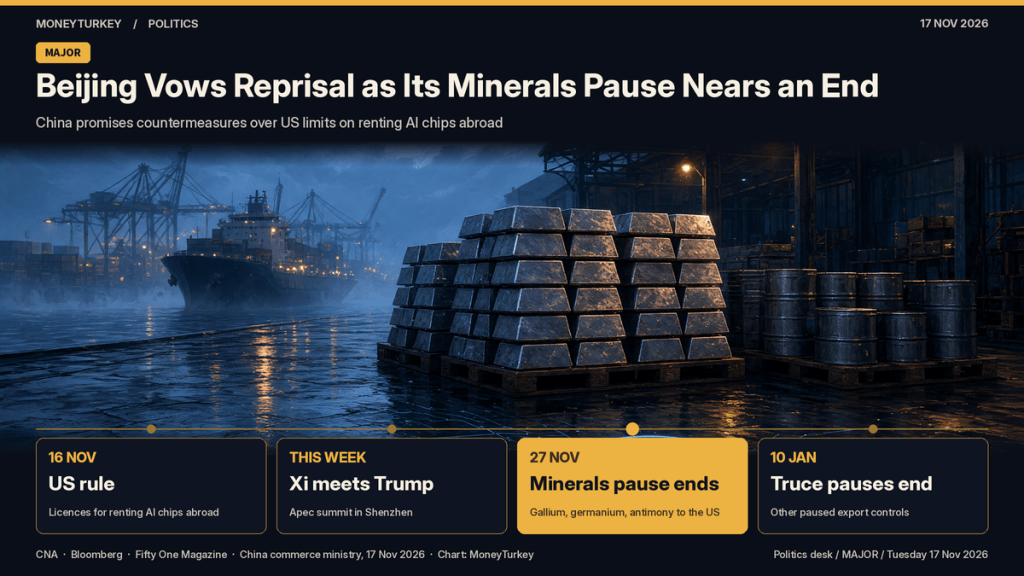
China has promised countermeasures over Washington’s new limits on renting AI chips abroad. Its sharpest lever may be a minerals pause that lapses on 27 November, days after Xi Jinping meets Donald Trump.
MoneyTurkey Politics Desk | 17 November 2026
Key points
- China’s foreign and commerce ministries both condemned the US rule on Tuesday; the commerce ministry said China will take countermeasures “if the US persists”, according to The Edge, CNA and ANI
- China’s suspension of its ban in principle on licences for US-bound gallium, germanium and antimony ends on 27 November, and no extension had been published, according to Global Trade Alert and China Prospect
- Hong Kong-listed AI developers MiniMax and Z.AI each fell more than 6% on Tuesday, according to Bloomberg and The Inference
- Xi and Trump meet this week on the sidelines of the Apec summit in Shenzhen, their third meeting this year, according to The Edge and The Next Web
What Beijing said
The US Commerce Department’s interim rule, released on Monday, requires a US licence for data centres anywhere in the world that supply large amounts of computing power from advanced chips to companies headquartered in China, and for shipments of advanced chips to Singapore, Malaysia, Thailand, Indonesia and Brazil, according to CNA and Lianhe Zaobao. Operators already serving Chinese clients have 90 days to get a licence, Lianhe Zaobao reported.
“The US repeatedly overstretches the concept of national security, abusing export control measures,” foreign ministry spokesman Guo Jiakun told a briefing in Beijing on Tuesday, according to CNA. He called the rule economic coercion that “runs counter to the consensus reached between the two sides” and said China would take necessary measures to safeguard its rights and interests, according to Lianhe Zaobao and The Next Web.
The commerce ministry went further later in the day. It expressed “strong dissatisfaction and firm opposition” and said: “If the US persists, China will take countermeasures to firmly safeguard its sovereignty, security and development interests,” according to The Edge and ANI. It also urged Washington to return to resolving differences through consultation. Neither ministry named a specific step.
The lever on the calendar
Beijing may not need to announce anything. After Xi and Trump met in South Korea in late 2025, China suspended its rule that licences for gallium, germanium and antimony bound for the United States would in principle not be granted, Reuters reported at the time. That suspension runs until 27 November 2026, according to Global Trade Alert and China Prospect.
When China’s commerce ministry extended its other paused export controls to 10 January on 9 November, it left that notice out, according to China Prospect and Fifty One Magazine. If the pause simply lapses, the default for US-bound shipments returns to refusal from 28 November, according to Fifty One Magazine, about a week after the Shenzhen summit. The metals go into semiconductors, fibre-optic cables and ammunition, Reuters reported.
That is the bargain now under strain. Washington has held off new technology restrictions while China keeps critical minerals flowing, and US officials have complained that Chinese rare-earth magnet shipments are arriving too slowly, Bloomberg reported. Brian Wong, an assistant professor at the University of Hong Kong, expects a targeted response rather than an end to the truce, according to The Next Web.
What the rule costs China’s AI firms
Renting computing power in data centres abroad had been forecast to supply nearly a third of China’s advanced computing by the end of 2027, according to the Institute for Progress, a Washington think tank, as reported by Bloomberg and The Next Web.
Investors priced that in on Tuesday. MiniMax and Z.AI, the two Hong Kong-listed AI model developers, each fell more than 6% during the session, according to Bloomberg and The Inference, and Z.AI closed 5.26% lower at HK$335 (about $43), according to Tiger Brokers and The Inference. China’s contract chipmakers went the other way, as our Foreign Markets Desk reported.
Why it matters
Export controls upset China more than almost anything else right now other than Taiwan, Dexter Roberts, a nonresident senior fellow at the Atlantic Council’s Global China Hub, told Bloomberg. Xi’s choice is between hitting back hard enough to risk the trade truce, which now runs to January, and waiting. The two governments are also due to hold their first dialogue on AI safety at Apec, according to The Edge and The Next Web, and the chip dispute will sit at the same table.
What to watch
- Any read-out on chips or minerals from the Xi-Trump meeting in Shenzhen this week
- Whether China’s commerce ministry extends or lets lapse the 27 November pause on gallium, germanium and antimony licences
- Licence guidance from the US Commerce Department before the 90-day deadline
- Further moves in MiniMax, Z.AI and other Chinese AI developers in Hong Kong
Related on MoneyTurkey
- US Licence Rule Rattles Southeast Asia’s Data Centre Boom
- Huang Lost the Chip Curb Fight. Hong Kong Made His Case.
- SMIC rises 6.6% as chip shares diverge
- Kremlin Hails First Putin-Xi-Trump Meeting in Shenzhen
For information only. Not investment advice.
Sources
- CNA: China slams new US chip curbs, vows ‘necessary measures’
- Lianhe Zaobao: Beijing condemns tighter US chip export controls as ‘long-arm jurisdiction’
- The Edge Malaysia: China warns US of retaliation over chip curbs, urges dialogue
- The Tribune (ANI): China threatens countermeasures against US restrictions on advanced semiconductor access
- The Next Web: China weighs response to US chip curbs before Trump summit
- Bloomberg: US chip curbs force Xi to weigh response before Trump summit
- Bloomberg via Yahoo Finance: China AI stocks sink as US chip curbs hit labs and hyperscalers
- The Inference: Z.ai falls to HK$335
- Tiger Brokers: Z.AI loses HK$1 trillion in market value over five months
- Global Trade Alert: China: temporary suspension of stricter export controls on certain dual-use items to the US
- China Prospect: US-China November 10 deadline extended to January 2027
- Fifty One Magazine: China extends one export-control pause to January, but antimony’s 27 November date still stands
- Reuters: China halts ban on gallium, germanium, antimony exports to US

