
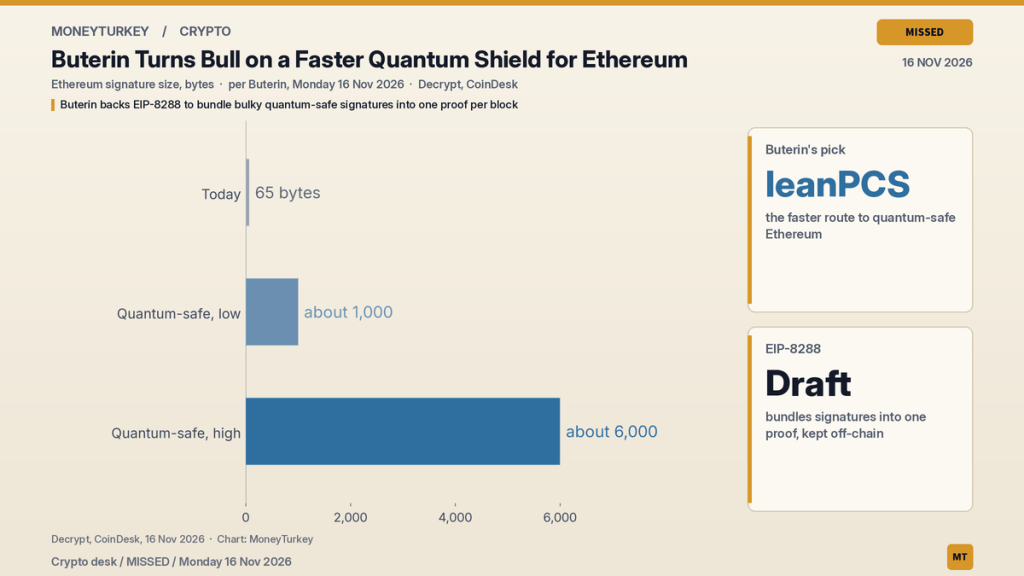
Ethereum has a quantum problem that is really a storage problem: the signatures that would survive a quantum computer are many times larger than today’s. Vitalik Buterin says he has found the faster way around it, and he has changed his mind to get there.
MoneyTurkey Crypto Desk | 16 November 2026
Key points
- Buterin said a standard Ethereum signature of 65 bytes would grow to between 1 and 6 kilobytes under quantum-resistant schemes, Decrypt and CoinDesk reported.
- His draft proposal, EIP-8288, would bundle those signatures and proofs into a single compact proof per block, so the full data never has to be stored on-chain.
- Of three ways to build it, he now favours leanPCS because it “could potentially be implemented very quickly.” The proposal is still a draft with no launch date.
What happened
“Over the past few weeks I’ve gone from thinking leanPCS is total bull to being a total bull,” Buterin wrote on X on Monday, in a long thread explaining how Ethereum could absorb the much larger signatures and proofs that quantum-resistant cryptography needs.
The scale of the jump is the problem. Zero-knowledge proofs used by privacy applications would balloon from a few hundred bytes to around 128 kilobytes, Buterin said, according to Decrypt. “This is unsustainable to put on chain,” he wrote. More data in each block eats into Ethereum’s limited block space, which could push up the fees users pay, CoinDesk noted.
His answer is EIP-8288, a draft he co-authored with developer Thomas Coratger in June. Users would still publish their signatures or proofs, but network nodes would repeatedly bundle everything they have seen into a single STARK, a type of zero-knowledge proof, until one “master proof” verifies everything in a block. Only short claims, not the bulky signatures themselves, would be kept on-chain.
Three routes, one favourite
Buterin set out three ways to build the system. The simplest, leanSPHINCS, would support a single type of hash-based signature cheaply but could do nothing else. The most ambitious, leanSTARK, would accept any signature scheme or privacy protocol, but Ethereum would first have to agree on a new programming language for users’ programs, which he called “the first big case of ‘Ethereum moving beyond the EVM.’” That decision would take time and be hard to reverse, CoinDesk reported.
leanPCS sits between the two. It standardises a smaller mathematical checking tool, the polynomial commitment scheme at the core of STARK proofs, that different proof systems can share, giving much of leanSTARK’s flexibility with far fewer design choices. The trade-off is that it needs more information on-chain than the broader option, according to CoinDesk. leanSTARK could be layered on later.
“So there is a route to getting ‘the cryptographic proof singularity’ much faster than any of us expected,” Buterin wrote, “and that route runs through 8288 with leanPCS.”
Why it matters
Quantum computers are expected eventually to break the elliptic-curve cryptography that secures Ethereum and Bitcoin accounts today. Swapping in quantum-safe signatures without a way to compress them would make every transaction heavier and costlier. Buterin’s shift gives developers a shorter path, and it follows calls from researchers last week to put quantum defences ahead of faster blocks in Ethereum’s planned 2027 upgrade, CoinDesk reported.
The caveat is timing. EIP-8288 is still a draft, its published specification lists the reference implementation as unfinished, and Buterin’s endorsement sets no launch date.
What to watch
- Whether core developers take up EIP-8288 in planning for the 2027 upgrade
- Progress on the unfinished reference implementation and any testnet work on leanPCS
- Further comments from Buterin or Ethereum Foundation cryptographers on a timeline
Related on MoneyTurkey
- DBS and JPMorgan Open Round-the-Clock Tokenized Deposits
- Bitcoin Traders Stack $900 Million of Insurance at $60,000
For information only. Not investment advice.

