
Gate and peers are racing to show cold-wallet cover after Binance’s record Oct. 29 theft; Bitcoin slipped below $76,000 on Thursday’s risk unwind.
MoneyTurkey Crypto Desk | 6 November 2026
Key points
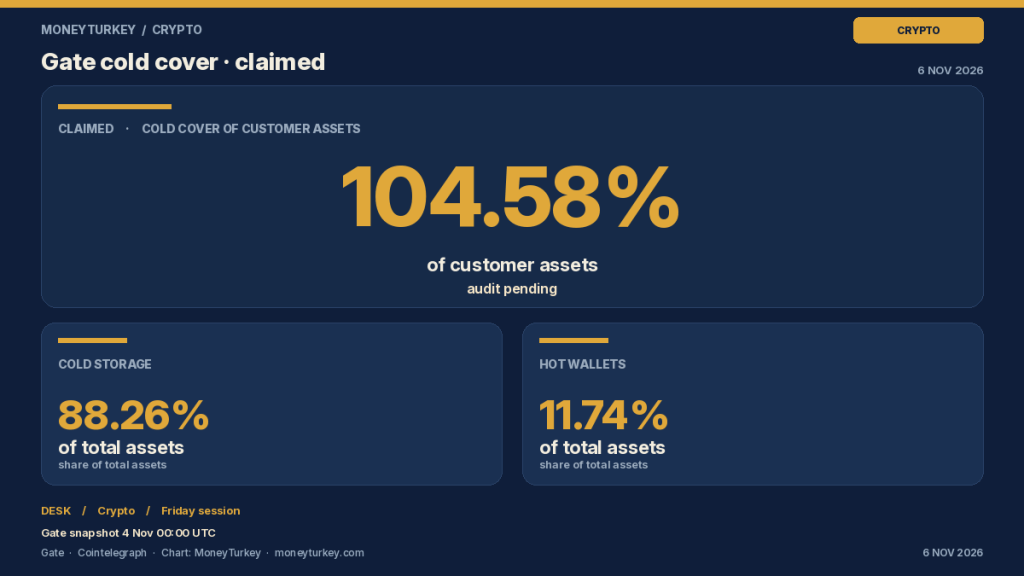
- Gate launched a “Proof of Security” framework on Thursday, reporting 88.26% of total assets in cold storage and 11.74% in hot wallets, with claimed cold coverage of 104.58% of customer assets — still under third-party audit.
- Binance’s Oct. 29 hot-wallet breach drained about $6.3 billion in roughly 20 minutes, according to TRM Labs; the exchange has not published a precise cold-hot split.
- Bitcoin fell below $76,000 on Thursday as crypto liquidations neared $500 million in the first hour of the US session and about $850 million over 24 hours, per CoinGlass via Cointelegraph.
A week after the largest crypto theft on record, the market story has shifted from the drain itself to how other venues prove they could survive one. Gate on Thursday unveiled Proof of Security (PoSEC), putting cold-storage ratios under the spotlight as Bitcoin erased post-midterm gains. MoneyTurkey first covered the Binance loss on 1 November; subsequent desks tracked the refill and crime-unit fallout. Today’s wire is the industry response plus Thursday’s risk unwind — not a fresh drain.
Gate’s Proof of Security
Crypto exchange Gate launched a “Proof of Security” framework on Thursday, reporting that 88.26% of its total assets were in cold storage and 11.74% in hot wallets. It claims cold storage could cover 104.58% of customer assets even if its hot wallets were fully drained. Gate said the snapshot data is still undergoing independent review by a third-party audit firm. Coinbase separately says it keeps more than 99% of customer assets offline, Cointelegraph reported.
What Binance has and has not said
Attackers emptied about $6.3 billion from Binance hot-wallet infrastructure on 29 October, most of it in about 20 minutes, according to TRM Labs. Binance co-CEO Richard Teng said the attack affected the exchange’s own hot wallet and that the vast majority of user assets sit in cold wallets, but the firm has not released an exact split. Binance said attackers used an internal wallet-signing service to move funds outside normal withdrawal channels and that some technical details will stay confidential to limit copycats. Public blockchain records show fund movement but not internal controls, CertiK analyst Jonathan Riss told Cointelegraph.
Thursday’s market reaction
Bitcoin dropped below $76,000 on Thursday after US stocks reversed gains made after the midterm elections. Crypto markets liquidated nearly $500 million in the first hour of the US session, according to CoinGlass data cited by Cointelegraph, with 24-hour total liquidations nearing $850 million. Ether, Solana and XRP also posted sharp declines in the same risk-off move.
Unanswered questions
Wallet balances offer only a partial picture of an exchange’s exposure, Riss noted. Cold-storage ratios are not always comparable across venues because reporting periods and asset bases differ. Offline wallets can still be hit through compromised signing systems or weak access controls — the same class of weakness that featured in the Binance case.
What to watch
- Gate third-party audit results on PoSEC figures
- Any Binance disclosure of a precise cold-hot split
- Further CoinGlass liquidation prints if risk assets keep sliding
Related on MoneyTurkey
- Binance Loses $6.3 Billion in Record Crypto Theft; FBI Blames North Korea
- Binance Says It Has Refilled 98% of Hacked Assets as Bitcoin Retakes $80,000
- Bitcoin, Ether ETFs Lose $530M
- Greece Sets 10% Crypto Tax From 2027
For information only. Not investment advice.
Sources
- Cointelegraph: Here’s what happened in crypto today
- Cointelegraph: Crypto exchanges tout cold storage ratios after Binance attack
- Gate announcement: Proof of Security (PoSEC) — 104.58% cold storage coverage

