
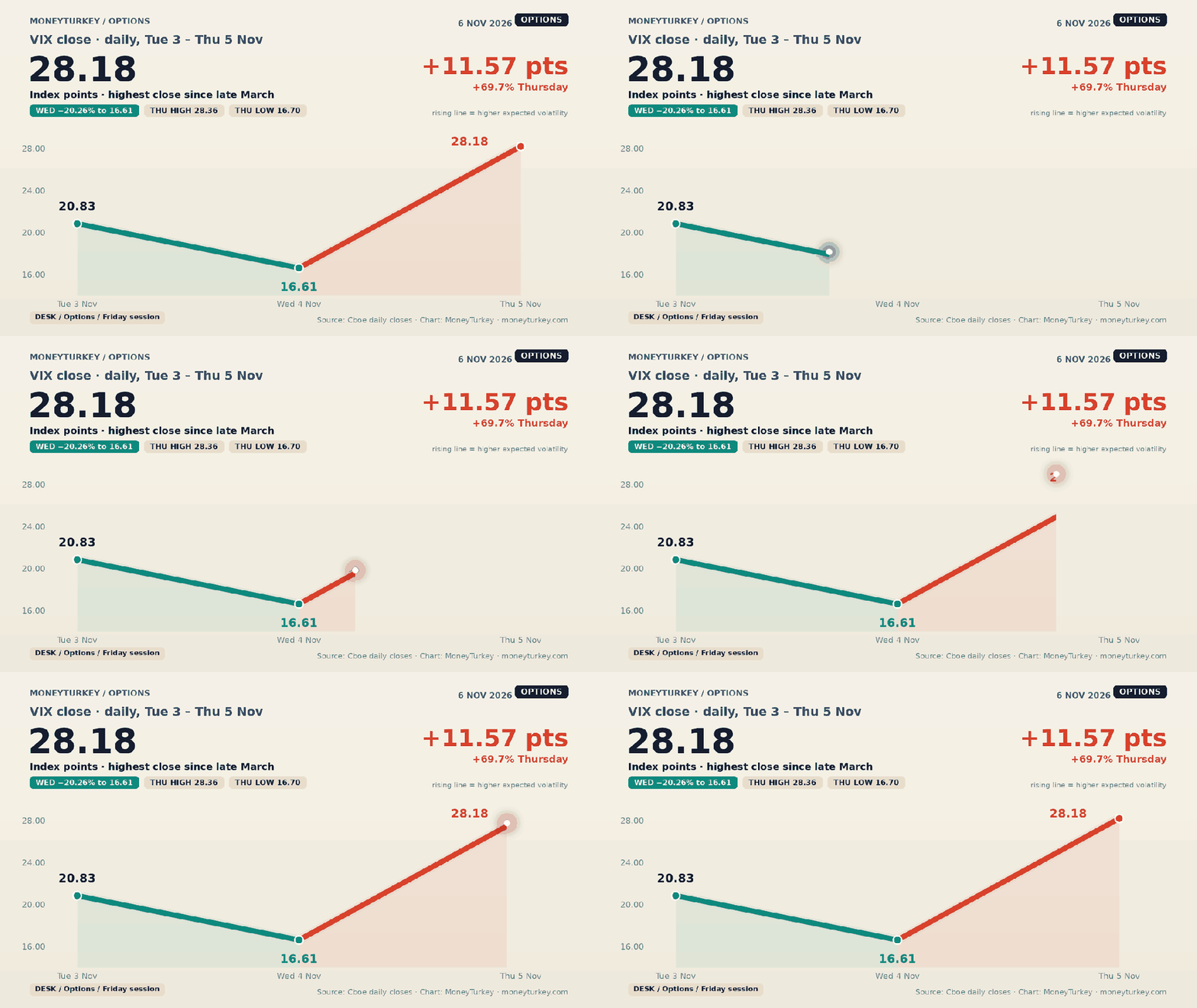
The fear gauge posted its sharpest one-day drop in more than a year, then jumped 11.57 points the next session to close at 28.18, leaving traders watching for further volatility-driven rebalancing.
MoneyTurkey Options Desk | 6 November 2026
Key points
- The VIX plunged 20.26% to 16.61 on Wednesday, its biggest one-day percentage decline since April 2025, after Democrats won control of both chambers of Congress.
- On Thursday the index closed 11.57 points higher at 28.18, after touching 28.36 intraday — its largest one-day point gain since the post-Liberation Day tariff shock in April 2025 and its highest close since late March.
Wall Street’s fear gauge swung violently this week, first collapsing on post-election relief and then spiking as the AI trade came under pressure. The Cboe Volatility Index fell 20.26% to 16.61 on Wednesday after Democrats took both chambers of Congress, removing a major political uncertainty premium. The next day the index closed 11.57 points higher at 28.18, its biggest one-day point gain in more than 18 months, as chip and data-center stocks sold off sharply.
What happened
Wednesday’s rally followed the election result. The S&P 500 rose 1.6%, the Nasdaq gained 1.4% and the Dow surged roughly 3%. Crude fell as investors bet that the election result would pressure the White House to de-escalate the Iran conflict, pushing Treasury yields lower and supporting equities.
Thursday’s reversal was sharp. The Nasdaq Composite closed down 5.52% at 24,315.00 as investors fretted that Democratic control could slow AI infrastructure development. Reuters reported the VIX up 11.5 points at 28.09 during the session; it went on to touch 28.36 and close at 28.18, according to Cboe daily data. Analysts cited by Reuters said the move reflected an unwind of the previous session’s rally and of the crowded AI trade that had driven markets for months.
Analysts also attributed some of the selling to investors getting ahead of volatility-driven rebalancing by leveraged and inverse ETFs and systematic strategies. These vehicles typically adjust exposure near the close, amplifying late-day moves in either direction.
How traders are positioned
A GuruFocus analysis published on Yahoo Finance said the sharp drop in the VIX on Wednesday showed that investors had been carrying a meaningful political uncertainty premium into the election. Once the result became clear, that premium disappeared quickly, leaving the index at levels closer to a normal risk environment.
Thursday’s surge indicated that protection demand returned fast. Interactive Brokers chief strategist Steve Sosnick told Reuters that the previous day’s rally had been partly predicated on the idea that volatility would be decreasing. “Yesterday there was the perception that no one needed protection and now it’s ‘Oh my god, we need it’,” he said.
Sosnick also flagged the risk that the re-evaluation of the AI investment theme could prove secular rather than a short-term trading rebalance. If sustained, that shift would keep implied volatility elevated even after the initial post-election relief trade fades.
Why it matters
A VIX reading of 16.61 is far below the elevated levels seen ahead of the vote, but the subsequent jump to 28.18 shows that volatility remains sensitive to shifts in sentiment around the AI trade and policy uncertainty. The market has moved from election risk to ongoing policy risk.
Democratic control could bring tougher scrutiny of AI data centers, energy companies, defense contractors and cryptocurrency. Debt-ceiling fights and government-shutdown risks remain potential sources of volatility. Large hyperscalers gained on Wednesday while data-center operators and semiconductor stocks came under pressure.
Traders will watch whether the VIX can stay below 20 once the initial relief trade fades. Key variables include Treasury yields, oil prices, AI regulation and fiscal negotiations. The fear gauge’s rapid round-trip this week underscores that the wild ride is not necessarily over.
What to watch
- VIX level relative to 20 after post-election relief fades
- Treasury yields and oil prices as policy uncertainty persists
- AI infrastructure stocks under Democratic regulatory scrutiny
- Volatility-driven ETF and systematic strategy rebalancing flows
Related on MoneyTurkey
- Delta and United Options Show Separate Bull Call Spreads
- Cboe-Backed Group Sues CFTC Over Stock Perps
For information only. Not investment advice.
Sources
- Yahoo Finance: https://sg.finance.yahoo.com/news/wall-streets-fear-gauge-just-172244609.html
- Kitco: https://www.kitco.com/news/off-the-wire/2026-11-05/wall-street-fear-gauge-jumps-most-liberation-day-ai-trade-stumbles
- Barron's: https://www.barrons.com/articles/stock-market-volatility-vix-fear-index-060f67db
- Barron's: https://www.barrons.com/livecoverage/stock-market-news-today-110626/card/wall-street-s-fear-gauge-suggests-the-wild-ride-ain-t-over-yet-t42kCuuZoh53BcqrMbDL?modCode=hp_LEDE_B_LC_1

