
Oil is still priced for a war in the Gulf. Goldman Sachs says the market is heading the other way, towards a surplus big enough to drag prices well below today’s levels by the end of next year.
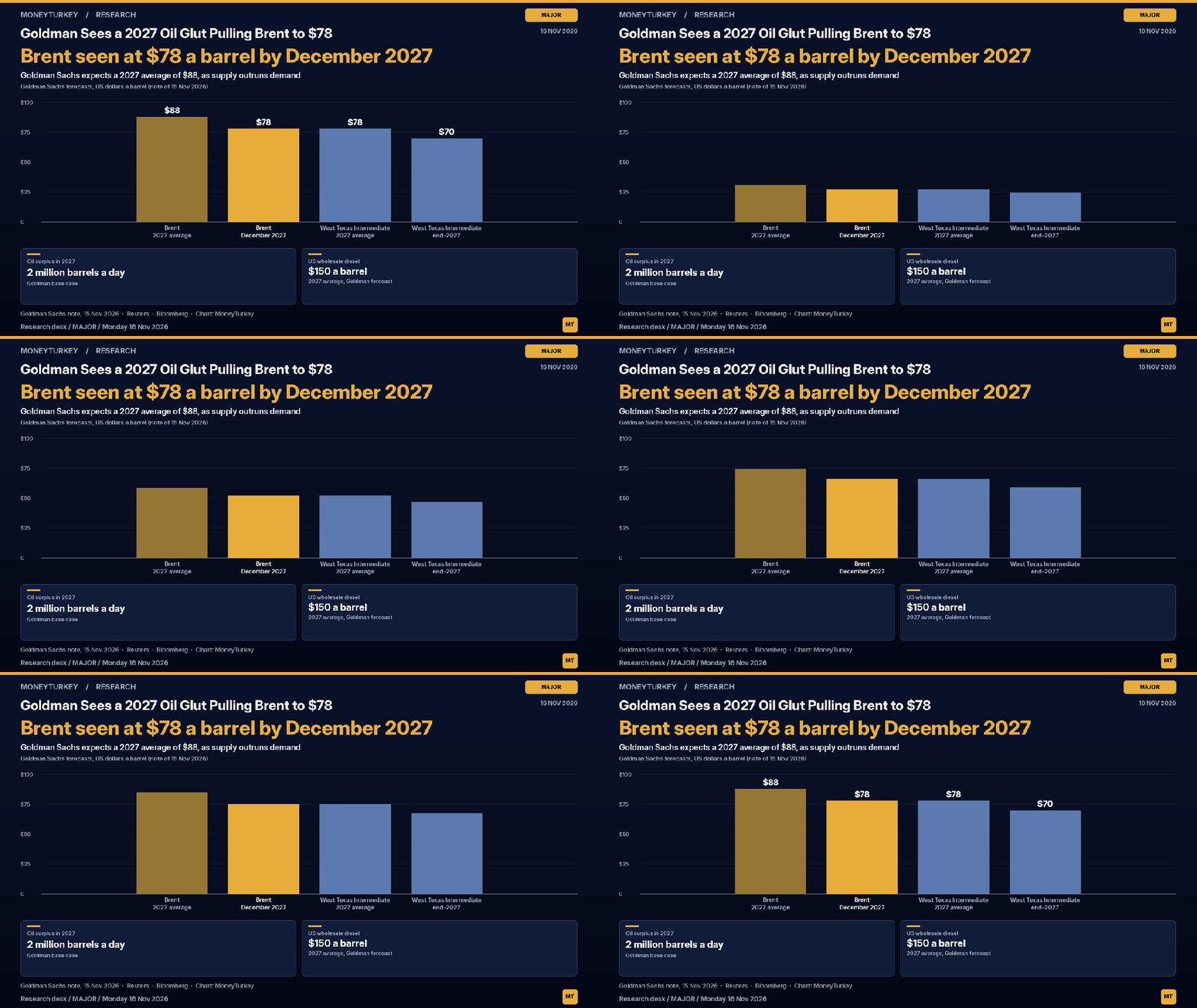
• Brent seen averaging $88 in 2027, $78 by December 2027
• 2 million barrels a day surplus in Goldman’s base case
Goldman Sachs expects a return to surplus to pull Brent crude lower over the next two years, while warning that attacks on shipping in the Middle East could still push prices up in the coming weeks.
MoneyTurkey Research Desk | 16 November 2026
Key points
- Goldman Sachs forecasts Brent to average $88 a barrel in 2027 and ease to $78 by December 2027, according to a note dated Sunday reported by Reuters and Bloomberg.
- It sees West Texas Intermediate averaging $78 a barrel next year and slipping to $70 by the end of 2027.
- In the bank’s base case, oil production exceeds end-use demand by 2 million barrels a day in 2027.
- Near-term risks still point up, from shipping attacks, damage to oil infrastructure and a rebuilding risk premium.
The call
Brent traded around $95 a barrel in Asia on Monday, according to Reuters and the Economic Times, so Goldman’s path implies a drop of roughly $17 a barrel by late 2027. The bank expects the war-driven risk premium to “gradually normalise” as supply catches up.
“We still see significant risks to oil prices with upside risk to market prices in the near-term from intensified shipping attacks and oil infrastructure damage and a recovery in the risk premium, but also medium-term price downside from stronger supply, weaker demand, or a lower risk premium than in our base case,” the bank said, according to Reuters.
The reasoning
The core of the call is supply. Goldman’s analysts, including Daan Struyven, said the 2 million barrel surplus already allows for supply disruptions of about half that size, Bloomberg reported. “For 2027, we again expect a contest between high supply disruption risk and increasing market adaptation,” they wrote. In their base case, Middle East supply rises above its 2025 average through ship-to-ship transfers and new pipelines, while supply growth elsewhere stalls.
China is unlikely to come to the rescue. The bank expects persistent weakness in road-fuel use to cut Chinese demand by about 400,000 barrels a day and estimates that China’s total oil demand peaked in 2025, according to Bloomberg and the Economic Times.
Refined products should ease too, but stay well above historical norms. Goldman sees US wholesale diesel averaging $150 a barrel in 2027, Reuters reported, which would keep fuel costs high even as crude falls.
How it compares
The International Energy Agency said on Friday that the oil market will return to surplus in the fourth quarter of this year, with supply of about 105 million barrels a day running 1.7 million above demand, and a larger surplus in 2027, according to the Economic Times and AGBI.
The risks
Oil slipped on Monday as shipments through the Strait of Hormuz were reported close to pre-war levels and Washington extended a waiver of the Jones Act shipping law for 90 days, freeing more tankers to move fuel between US ports, Reuters reported. But the danger at sea has not gone away. Iranian state media and the Revolutionary Guards reported tankers striking mines near Hormuz over the weekend. These are unverified claims, with no independent confirmation of how much damage was done.
What to watch
- Independent confirmation of the weekend tanker incidents near Hormuz
- Further attacks on shipping or Gulf oil infrastructure
- Signs of weaker Chinese road-fuel demand
Related on MoneyTurkey
- HSBC Lifts India to Overweight, Cuts China to Neutral
- UOB Kay Hian Upgrades Singapore Banks to Overweight
For information only. Not investment advice.
Sources
- Reuters via Zawya: https://www.zawya.com/en/business/goldman-sees-brent-easing-to-78-a-barrel-by-end-2027-as-markets-adapt-2277950
- Bloomberg via The Straits Times: https://www.straitstimes.com/business/goldman-sachs-predicts-sizeable-surplus-for-oil-market-in-2027
- investingLive: https://investinglive.com/commodities/goldman-sees-brent-at-78-by-end-2027-as-oil-surplus-returns-flags-near-term-upside-risk/
- The Economic Times (Goldman note): https://m.economictimes.com/industry/energy/oil-gas/goldman-sachs-sees-oil-losing-its-war-fuelled-price-premium-in-2027/amp_articleshow/135872353.cms
- The Economic Times (oil prices): https://economictimes.indiatimes.com/markets/commodities/news/oil-price-today-november-16-brent-crude-hovers-near-95-despite-hopes-of-middle-east-supply-surplus-why-caution-is-warranted/articleshow/135870098.cms
- Reuters via CNBC: https://www.cnbc.com/2026/11/16/oil-prices-fall-on-expectations-of-coming-supply-surplus.html
- AGBI: https://www.agbi.com/oil-and-gas/2026/11/oil-falls-on-potential-supply-surplus-from-middle-east/

