
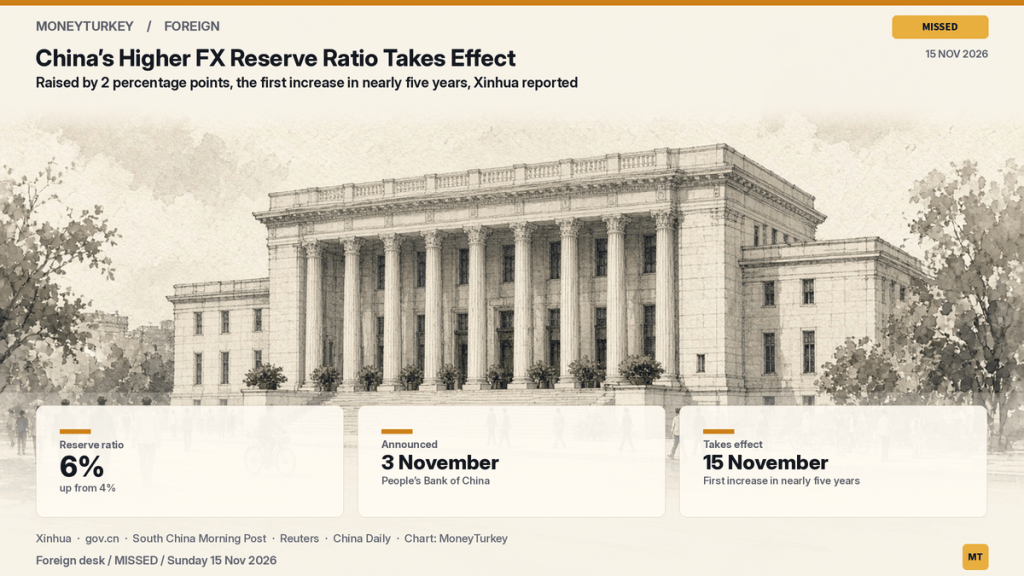
China’s higher foreign-exchange reserve requirement for banks took effect on Sunday, 15 November, lifting the ratio to 6% from 4%. The People’s Bank of China announced the change on 3 November, a move Xinhua and China Daily said is expected to ease upward pressure on the yuan.
MoneyTurkey | Foreign | 15 November 2026
Key points
- The foreign-exchange reserve requirement ratio for financial institutions rose by 2 percentage points to 6% from 4% on 15 November, as announced by the central bank on 3 November
- The ratio is the share of foreign-currency deposits that banks must hold at the central bank; raising it tightens dollar liquidity onshore, Xinhua reported
- Xinhua and China Daily said the move should ease appreciation pressure on the yuan; the central bank itself said it aims to strengthen banks’ foreign-exchange liquidity management
- Chinese markets were closed on Sunday, so Monday’s session is the first test of the higher ratio
What happened
The People’s Bank of China said on Tuesday, 3 November, that it would raise the foreign-exchange reserve requirement ratio by 2 percentage points, from 4% to 6%, starting on 15 November, according to Xinhua, the Chinese government’s website gov.cn, the South China Morning Post and Reuters. Xinhua described it as the first increase in nearly five years.
The central bank said the change was “aimed at strengthening the management of foreign exchange liquidity in financial institutions,” Reuters reported. China Daily said on Sunday the higher ratio is expected to reduce the foreign currency available to financial institutions, “helping ease appreciation pressure on the renminbi” and curb self-reinforcing expectations of further gains.
Reuters calculated that the change would withdraw an extra $24 billion from the financial system, based on official deposit data. Ming Ming, chief economist at CITIC Securities, told Xinhua it would freeze about $20 billion to $25 billion of foreign-currency liquidity at banks.
Why markets care
The move reverses the direction of the last adjustments. The central bank lowered the ratio three times in 2022 and 2023 to 4%, Xinhua reported, and Reuters noted that the September 2023 cut was meant to stem the yuan’s losses and capital outflows. This time the target is a currency that has been rising: Reuters said the yuan had gained more than 5% against the dollar this year by early November, and both Reuters and the South China Morning Post said it had reached its strongest level since 2022.
Not everyone expects a lasting effect. Zhaopeng Xing, senior China strategist at ANZ, told Reuters the step was likely to “carry greater symbolic significance” and would not be enough to ease the oversupply of dollars created by companies converting foreign-currency earnings into yuan.
Where the yuan stands
On the day of the announcement, the onshore yuan closed at 6.6765 per dollar, 307 pips weaker than the previous session, Xinhua reported, citing the China Foreign Exchange Trade System. On Friday, 13 November, it closed at 6.6707 per dollar, down 18 pips on the day, according to RTHK and the Economic Observer, while the central bank’s daily midpoint was set at 6.7152 per dollar, RTHK and Xinhua Finance reported.
What to watch
- The central bank’s daily yuan midpoint on Monday morning, published at 09:15 Beijing time (01:15 UK time), after Friday’s 6.7152
- How the onshore yuan opens against Friday’s 6.6707 close, the first session with the 6% ratio in force
- Any comment from the central bank on foreign-exchange liquidity or further use of the ratio
- Whether companies’ conversion of dollars into yuan keeps supporting the currency, the imbalance ANZ said the ratio change may not offset
Related on MoneyTurkey
- Chinese banks lift dollar deposit rates above US benchmarks to slow the yuan rally
- HSBC Jumps 3.7% in Hong Kong as China Opens Yuan FX Pilot
- Japan Warns on Yen at 160 as US Help Proves Small
For information only. Not investment advice.
Sources
- Xinhua, 3 Nov: https://english.news.cn/20261103/675daab9069d4063ab6569a54fd89292/c.html
- gov.cn (Xinhua graphic), 3 Nov: https://www.gov.cn/zhengce/jiedu/tujie/202611/content_7084887.htm
- South China Morning Post, 3 Nov: https://www.scmp.com/business/article/3373053/pboc-raise-reserve-requirement-ratio-foreign-exchange-deposits-2-percentage-points
- Reuters via Investing.com, 3 Nov: https://www.investing.com/news/economy-news/china-to-raise-forex-deposit-reserve-ratio-to-6-starting-november-15-4993312
- China Daily, 15 Nov: https://www.chinadaily.com.cn/a/202611/15/WS6af910d0e4b03ebf8519c6b6.html
- RTHK, 13 Nov: https://gbcode.rthk.hk/TuniS/news.rthk.hk/rthk/ch/component/k2/1877713-20261113.htm
- Economic Observer, 13 Nov: http://www.eeo.com.cn/2026/1113/1092212.shtml
- Xinhua Finance (cnfin.com), 13 Nov: https://www.cnfin.com/kx/detail/20261113/4495241_1.html

