
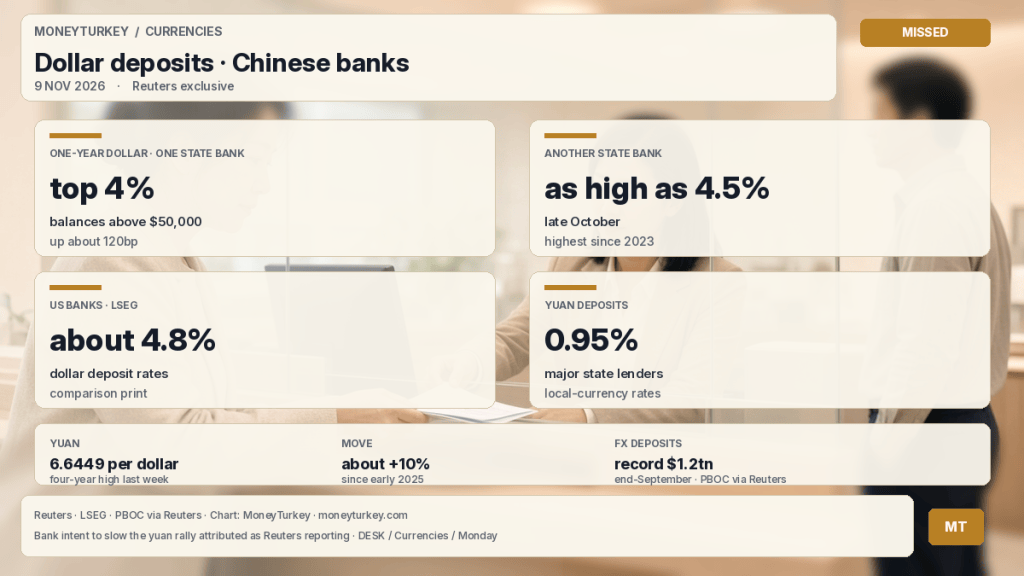
More than six Chinese banks have lifted dollar deposit rates to their highest since at least 2023, in some cases above US benchmarks such as the secured overnight financing rate (currently 3.97%), as Beijing tries to slow a yuan rally of about 10% since early 2025, Reuters reported.
MoneyTurkey Currencies Desk | 9 November 2026
Key points
- More than six Chinese banks have raised dollar deposit rates in recent weeks; at one state bank one-year rates now top 4% on balances above $50,000, about 120 basis points higher than a few months ago.
- The People’s Bank of China said last Tuesday that banks must hold more foreign-currency reserves, and the yuan hit a four-year high of 6.6449 per dollar last week.
Chinese banks have sharply raised dollar deposit rates in recent weeks, in some cases above US benchmarks such as the secured overnight financing rate (currently 3.97%), as Beijing tries to slow the yuan’s climb. The moves, reported by Reuters, have taken rates to levels not seen since at least 2023 and come after the currency strengthened about 10% against the dollar since early 2025. Exporters have complained that the stronger yuan is squeezing already thin margins, prompting banks to offer savers and companies higher returns for holding dollars instead of converting them into yuan.
What happened
More than six Chinese banks, including state-owned, joint-stock and foreign lenders, have lifted dollar deposit rates in the past few weeks, according to people at the banks who spoke to Reuters on condition of anonymity. At one state bank, rates rose about 80 basis points over recent months to as high as 4.5% in late October, the highest level since 2023 and close to the 4.8% offered at US banks. At another state bank, dollar deposit rates have been raised twice in two weeks; one-year rates now top 4% on balances above $50,000, some 120 basis points higher than a few months earlier when state lenders first pushed rates above the 2.8% cap imposed in 2023.
A third state bank offered to match the US secured overnight financing rate, currently 3.97%, for some of its most creditworthy clients, and several foreign banks are offering dollar deposits above 4%. Exporters and retail customers have begun to place dollars on deposit at the new rates, two bankers told Reuters. Chinese banks have continued to use some of those dollars to buy US Treasuries, a shift first reported by Reuters in September.
The People’s Bank of China did not respond to a faxed request for comment. Reuters could not determine whether policymakers had directed the rate increases. The PBOC typically issues informal guidance on such rates to state banks.
What is driving the currency
The yuan has risen about 10% against the dollar since early 2025, a move that has begun to hurt exporters’ competitiveness. One banker at a state lender said the current exchange rate is “not particularly favourable for exporters.” To avoid being forced to convert foreign exchange back into yuan, banks are using higher dollar deposit rates to absorb some of the pressure, the person said.
Over the same period, Chinese banks have repeatedly cut yuan deposit rates to ease pressure on margins and encourage spending. Major state lenders now offer local-currency deposit rates as low as 0.95%. The combination of higher dollar rates and lower yuan rates widens the incentive for savers and companies to keep funds in dollars rather than convert them into yuan.
Last Tuesday the PBOC announced it would raise the foreign-currency reserves banks must hold, the latest official step to rein in the yuan’s rally. The reserve requirement increase is separate from the deposit-rate moves but forms part of the same policy effort to slow the currency’s appreciation.
Why it matters
Higher dollar deposit rates reduce the need for exporters and other dollar holders to sell their foreign exchange into the local market, which would otherwise add to yuan strength. By offering rates that match or exceed US benchmarks such as the secured overnight financing rate (currently 3.97%), banks give clients an alternative to immediate conversion, potentially easing upward pressure on the currency without direct central-bank intervention in the spot market.
The moves also signal that Beijing is willing to use domestic interest-rate tools to manage exchange-rate outcomes. The end of the de-facto cap on state-bank dollar rates and the speed of the latest hikes suggest the authorities view the yuan’s recent gains as large enough to warrant stepped-up action.
“With higher dollar deposit rates, it may discourage some exporters to convert accumulated dollar balances into yuan, which could reduce some of the yuan appreciation pressure,” said Lynn Song, chief economist for Greater China at ING, according to Reuters. Foreign-currency deposits in China reached a record $1.2 trillion at the end of September, up 17.7% from a year earlier, PBOC data showed.
For FX traders, the development adds a new domestic channel through which Chinese policy can influence the yuan’s path. Sustained higher dollar deposit rates could slow the pace of yuan appreciation even if the PBOC does not intervene directly in the spot market or adjust its daily fixing.
What to watch
- Next PBOC reserve-requirement announcements for any further tightening
- Monthly trade data for signs exporters are retaining more dollar receipts
- US Treasury holdings reported by Chinese banks for evidence of continued dollar demand
- Any reversal or extension of the 2.8% cap on state-bank dollar rates
Related on MoneyTurkey
- Japan spent a record $50 billion in one day defending the yen in July, data show
- Rupee Hits Six-Month High at 93.91 on Oil Drop
For information only. Not investment advice.

