
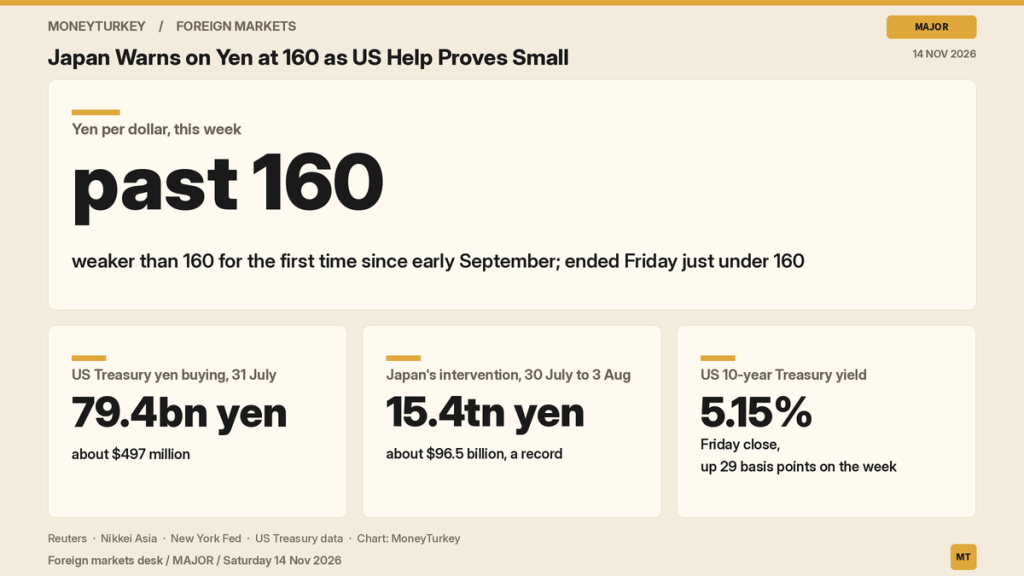
Japan’s Finance Minister Satsuki Katayama warned on Friday that yen moves had become “one-sided and rapid” after the currency weakened past 160 per dollar, just as a New York Fed report showed the US share of this summer’s joint intervention was far smaller than markets had assumed.
MoneyTurkey Foreign Markets Desk | 14 November 2026
Key points
- The yen weakened past 160 per dollar for the first time since early September
- Katayama said Tokyo will work closely with the US Treasury and respond appropriately
- The US bought only 79.4 billion yen (about $497 million) on 31 July, against Japan’s 15.4 trillion yen (about $96.5 billion)
- The 10-year US Treasury yield ended the week at 5.15%, keeping the gap with Japan wide
What happened
Katayama told a regular news conference that recent currency moves had been “one-sided and rapid” and that Tokyo would keep working closely with the US Treasury and respond appropriately, Reuters reported. Anadolu and FXStreet carried the same warning. She declined to comment on intervention records.
The yen briefly crossed the 160 line for the first time since early September after traders priced in more Federal Reserve rate rises, Reuters reported. Anadolu also put the move past 160, its weakest since early September. Japan’s top currency diplomat, Atsushi Mimura, said a day earlier it was “too early to forget” the summer intervention.
The yen steadied on Friday on intervention worries, ending the session just under 160 per dollar, according to Barchart and exchangerates.org.uk data.
The smaller US role
Japan spent a record 15.4 trillion yen (about $96.5 billion) to support its currency between 30 July and 3 August, after it slid to a four-decade low near 164 per dollar, Reuters and FXStreet reported.
A quarterly New York Fed report published on Thursday showed the US Treasury bought 79.4 billion yen (about $497 million) on 31 July, selling euros from its Exchange Stabilization Fund, Reuters and Nikkei Asia reported. It was the first US yen-buying intervention since 1998.
Analysts told Reuters the modest US contribution weakens the deterrent effect of any future joint action, and that the yen could retest its lows. “Even if the US doesn’t step in, Japan likely will,” said Akira Moroga, chief market strategist at Aozora Bank.
Why markets care
The pressure on the yen comes from the rate gap. The 10-year US Treasury yield closed Friday at 5.15%, up 29 basis points on the week, according to Treasury curve data reported by The Company Chronicle and The Economy Pulse. Markets fully price a quarter-point Fed rise at the 8-9 December meeting, Barchart reported.
In Tokyo, markets increasingly expect the Bank of Japan to raise rates in December, Reuters and investingLive reported. Until that gap narrows, officials are leaning on warnings. Tokyo is also bringing forward winter utility subsidies, as the weak yen and high oil prices raise import costs, Katayama said.
What to watch
- Any rate checks or intervention if the yen weakens back past 160 per dollar
- The Fed meeting on 8-9 December and the Bank of Japan meeting in December
- Further comments from Katayama or Mimura
Related on MoneyTurkey
- EU Parliament Sinks Retail Investment Overhaul by 14 Votes
- Indonesia Faces One-Way MSCI Review After Losing 30 Stocks
For information only. Not investment advice.

