
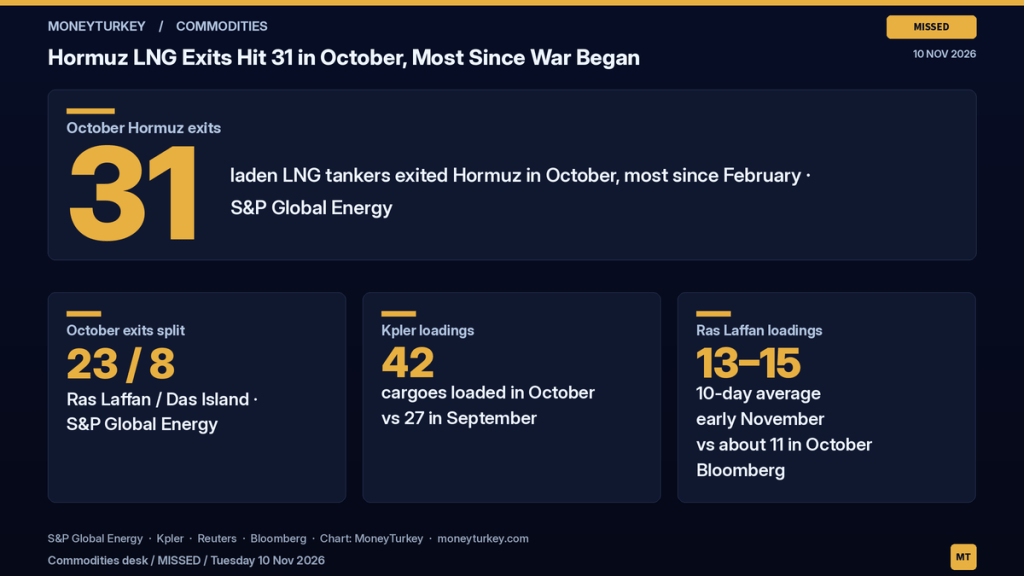
Thirty-one laden LNG tankers left the Strait of Hormuz in October, the most since the Iran war began in February, as Qatar squeezed more cargoes out of a Ras Laffan hub still under force majeure.
MoneyTurkey Commodities Desk | 10 November 2026
Key points
- 31 LNG tankers exited Hormuz in October, the highest since February, according to S&P Global Energy data cited by Reuters: 23 loaded at Qatar’s Ras Laffan and eight at the UAE’s Das Island.
- Kpler counted 42 LNG cargoes loaded in October, up from 27 in September; Ras Laffan’s 35 cargoes topped 2.7 million tons, against nearly 6.2 million tons of Qatari exports in February.
- Ras Laffan loadings ran at 13 to 15 on a 10-day moving average in early November, up from about 11 in October but still roughly half the pre-war pace, Bloomberg reported.
What happened
October’s 31 Hormuz exits were the highest monthly count since the US-Iran conflict disrupted shipping, S&P Global Energy data showed, according to Reuters. Kpler’s ship-tracking put October loadings at 42 cargoes, with Ras Laffan alone loading 35, its highest since the war started even though the hub remains under force majeure. QatarEnergy said in March that Iranian attacks had taken out 17% of Qatar’s export capacity.
Two Ras Laffan cargoes that cleared the strait were moved to other ships off Oman’s Sohar anchorage, Kpler data showed. One is now bound for South Korea; the other was delivered to Pakistan. Das Island held steady at seven loadings in October, in line with pre-war levels, per Kpler.
Loadings are not yet matched by exits. Eleven laden Qatari tankers left Hormuz in the 10 days through 8 November, according to Bloomberg and Kpler data, a pace broadly steady over the past month. Most ships loading at Ras Laffan or transiting the strait are not transmitting their locations, so both counts are hard to verify. QatarEnergy did not immediately respond to Bloomberg’s request for comment.
Why it matters
Hormuz is the route linking Qatari LNG with Asia and Europe. Any sustained rise in Qatari supply would ease winter competition between the two regions for scarce cargoes. European gas prices have retreated from late-October highs but remain more than twice their pre-war level, Bloomberg said, and Rystad Energy warned this week of a high likelihood of much higher gas prices this Northern Hemisphere winter because supply is tight.
Speculation that Washington may seek an end to the conflict after last week’s midterms has not stopped attacks on vessels in the waterway, Bloomberg reported. One Qatari LNG tanker was attacked late last month, but exports and Hormuz transits did not drop afterwards.
What to watch
- Whether Hormuz exits catch up with the higher Ras Laffan loading pace in November
- Ship-to-ship transfers off Oman feeding South Asian and North Asian buyers
- European gas prices as the heating season starts
Related on MoneyTurkey
- Singapore Opens 500-Tonne Gold Vault to Central Banks
- Funds Turn Net Short Corn Before Tuesday’s USDA Report
For information only. Not investment advice.
Sources
- Reuters via The Economic Times: Hormuz LNG traffic hits highest in October since Iran war began
- Bloomberg via Rigzone: Qatar LNG loadings gain pace
- OilPrice: LNG traffic through Hormuz hits highest level since Iran war began

