
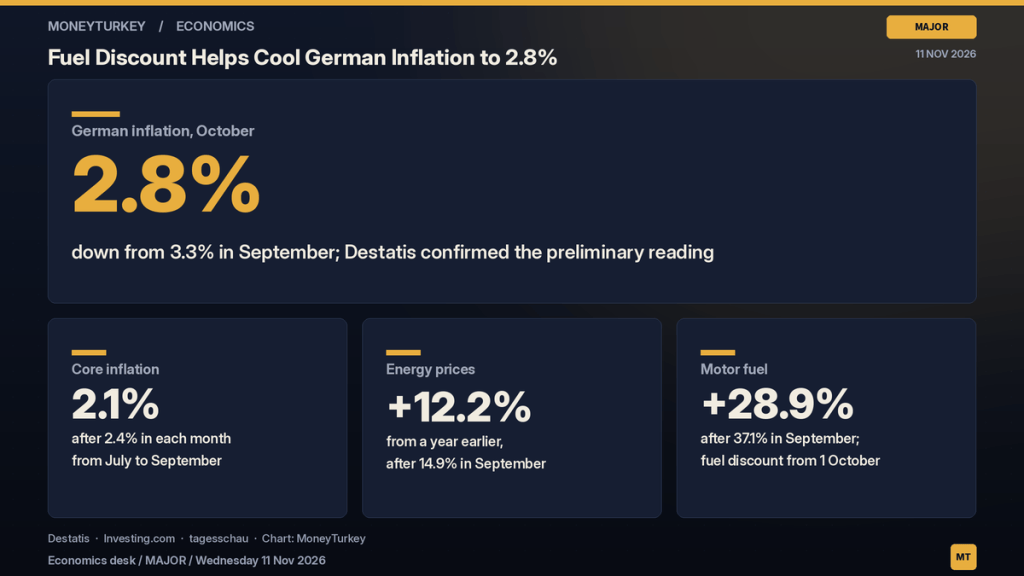
Germany’s final October figures confirmed inflation at 2.8%, down from 3.3% in September, as a new fuel discount dampened energy costs and core inflation slowed to 2.1%.
MoneyTurkey Economics Desk | 11 November 2026
Key points
- Annual inflation eased to 2.8% in October from 3.3% in September, confirming the preliminary reading, the Federal Statistical Office (Destatis) said on Wednesday.
- Core inflation, which excludes food and energy, slowed to 2.1% after three months at 2.4%.
- Energy prices rose 12.2% from a year earlier, down from 14.9%, after a fuel discount took effect on 1 October.
Consumer prices fell 0.2% from September. Germany’s harmonised index of consumer prices, used for comparisons across the European Union, also rose 2.8% from a year earlier and fell 0.1% on the month, both matching the preliminary estimates.
What happened
“The persistently high rate of inflation continued to be primarily driven by the development of energy prices, even though the new fuel discount introduced at the beginning of October is likely to have dampened inflation somewhat,” Destatis President Ruth Brand said.
Motor fuel prices were 28.9% higher than a year earlier, a smaller rise than September’s 37.1%. On the month, fuel prices fell 5.5% as the discount kicked in. Heating oil went the other way: it was up 84.5% from a year earlier, faster than 74.9% in September, and rose 4.6% on the month. Destatis said crude oil price moves since the start of the Iran war were still feeding through to consumers.
Electricity was 5.2% cheaper than a year earlier and natural gas, excluding operating costs, 1.2% cheaper.
What the numbers say
Food prices rose 0.4% from a year earlier, the same pace as in September. Eggs were up 15.4% and fresh vegetables, including potatoes, 11.5%, while butter fell 18.9%.
Services prices rose 2.5%, slower than 2.7% in September, and goods prices rose 3.0%. Net rents excluding heating were up 1.9%.
Why it matters
The fuel discount is doing visible work on the headline rate, but heating oil and the wider energy bill are still running hot. With inflation also elevated across the euro area, many economists expect the European Central Bank to raise rates again in December, Reuters reported. The cooler core reading gives policymakers a little more room, and how much of the drop survives once the fuel effect fades is the question for the coming months.
What to watch
- Germany’s flash November inflation estimate at the end of the month
- The ECB’s December policy meeting
- Whether heating oil keeps climbing into winter
Related on MoneyTurkey
- German exports jump 2% in September, beating forecasts
- German Factory Orders Rebound 4.4%
- BoE’s Lombardelli Flags Another Rate Rise
For information only. Not investment advice.
Sources
- Federal Statistical Office (Destatis): https://www.destatis.de/EN/Press/2026/11/PE26_392_611.html
- Reuters, via onvista: https://www.onvista.de/news/2026/11-11-tankrabatt-drueckt-deutsche-inflation-auf-2-8-prozent-0-20-26574946
- Investing.com: https://www.investing.com/news/economic-indicators/german-october-inflation-eases-to-28-as-expected-core-slows-to-21-5017981
- tagesschau: https://www.tagesschau.de/wirtschaft/konjunktur/inflation-tankrabatt-spritpreise-oktober-100.html
- Hurriyet Daily News (Anadolu Agency): https://www.hurriyetdailynews.com/amp/german-annual-inflation-eases-to-2-8-in-october-229260

