
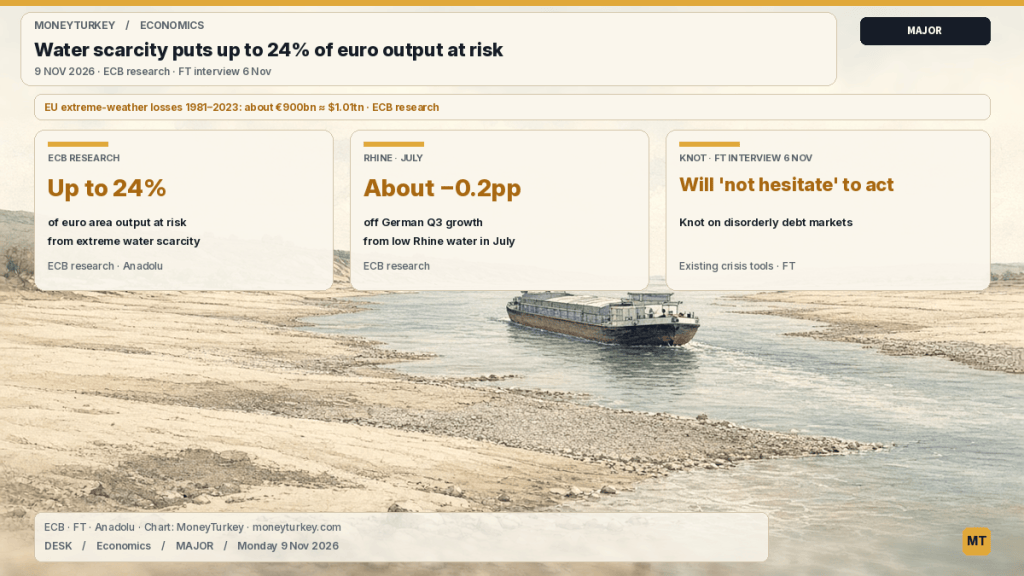
Klaas Knot, one of two candidates to succeed Christine Lagarde, says the ECB would “not hesitate” to act against disorderly bond-spread moves, as euro zone finance ministers took a first look at the race on Monday and new ECB research put up to 24% of euro area output at risk from extreme water scarcity.
MoneyTurkey Economics Desk | 9 November 2026
Key points
- Knot told the Financial Times he would use existing crisis tools, including asset purchases, and would not rule out a new, more tailored instrument.
- Euro zone finance ministers discussed Knot and Pablo Hernández de Cos on 9 November but were not expected to recommend a candidate yet.
- The ECB estimated an extreme water scarcity event could put up to 24% of euro area output at risk.
What Knot said
“If circumstances require it, we will not hesitate to take action,” Knot said in an interview with the Financial Times conducted on 6 November, according to the FT and Il Sole 24 Ore. The former Dutch central bank governor, who led De Nederlandsche Bank from 2011 to 2025, said the ECB must “certainly be there to contain spreads when they are driven by unjustified and disorderly market dynamics”.
He added that there is no single spread level that triggers intervention, and that a rise in public borrowing costs on its own does not justify bond buying. The bank’s existing tools, he said, pair a requirement for governments to fix their fiscal fundamentals with a temporary shield against disorderly markets.
The race to replace Lagarde
The Netherlands has nominated Knot and Spain has nominated Hernández de Cos, the general manager of the Bank for International Settlements and a former Bank of Spain governor, Reuters reported. Lagarde steps down on 7 February. Eurogroup president Kyriakos Pierrakakis said Monday’s meeting would be “primarily an information point and the discussion”, with EU leaders expected to steer the final choice.
Jefferies economist Modupe Adegbembo told Reuters that Knot is seen as slightly more hawkish and De Cos slightly more dovish, while cautioning against overplaying the difference.
ECB water-risk findings
Separately, ECB research reported by Anadolu found that 72% of euro area companies are highly dependent on ecosystem services, and nearly 75% of bank corporate lending goes to firms exposed to at least one of them. Low Rhine water levels in July shaved roughly 0.2 percentage points off German third-quarter real GDP growth, the bank said.
Extreme weather caused about €900 billion ($1.01 trillion) in direct losses across the EU between 1981 and 2023, more than a fifth of it in the last three years. Less than a quarter of natural catastrophe losses in the EU are insured, and cover is below 5% in several member states. Meeting EU green goals needs extra investment of about 3% of bloc GDP a year until 2030, with private capital expected to fund 75% to 80%.
Why it matters
With debt worries spreading in parts of the euro area, how far the next ECB president is willing to go to contain bond spreads matters for sovereign bond markets. The water-risk work adds a physical-shock variable to growth forecasts, after the Rhine episode already showed up in German GDP.
What to watch
- Any Eurogroup recommendation and a European Parliament hearing for the chosen candidate
- Further comments from Knot or De Cos on crisis tools
- Euro area bond spreads
Related on MoneyTurkey
- German exports jump 2% in September, beating forecasts
- China factory-gate inflation hits 5.7%, a post-Covid high, as coal and oil prices surge
For information only. Not investment advice.
Sources
- Financial Times: Transcript of an interview with Klaas Knot
- Il Sole 24 Ore: Knot says ECB will not hesitate to act against a debt crisis
- Reuters via Investing.com: Euro zone ministers to discuss ECB appointments
- Reuters via Investing.com: Knot and de Cos in race to replace Lagarde
- Anadolu: ECB warns extreme water scarcity puts up to 24% of eurozone output at risk

