
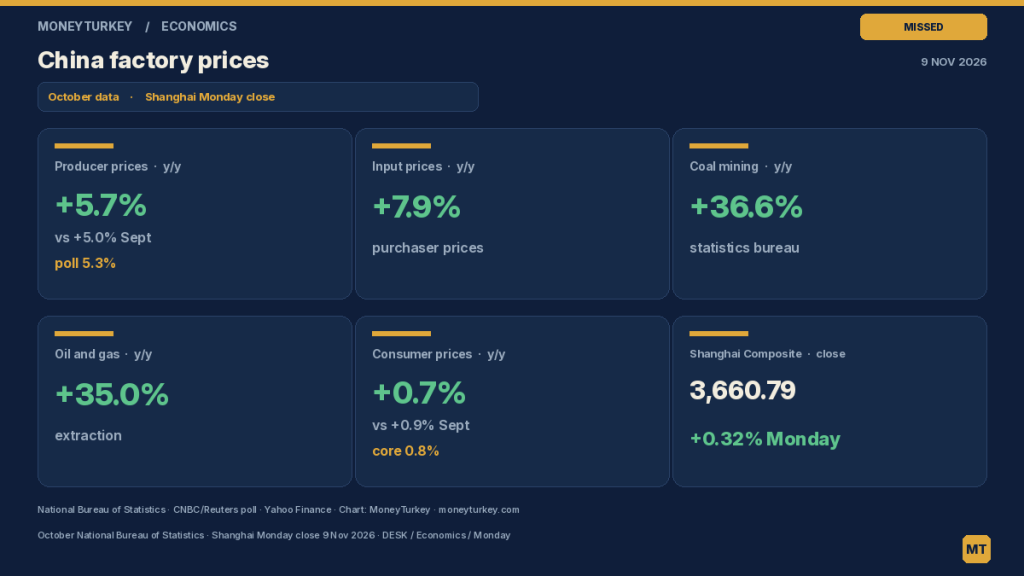
China’s producer prices rose 5.7% from a year earlier in October, the fastest pace since June 2022, as higher global energy prices fed through to coal, oil and chemicals. Consumer inflation went the other way, slowing to 0.7% as food prices fell.
MoneyTurkey Economics Desk | 9 November 2026
Key points
- The producer price index rose 5.7% year on year, up from 5.0% in September and above the 5.3% forecast in a Reuters poll, CNBC reported. It rose 0.7% from September.
- Prices that factories pay for inputs rose 7.9% from a year earlier, the National Bureau of Statistics said.
- Consumer prices rose 0.7% year on year, down from 0.9%, and core inflation, which excludes food and energy, slowed to 0.8% from 1.0%.
- The Shanghai Composite closed up 0.32% at 3,660.79, and the dollar was at 6.6737 yuan at about 7:25am London time.
What the Chinese release shows
The statistics bureau’s Chinese-language release shows how concentrated the jump was. Prices in coal mining and washing rose 36.6% from a year earlier and oil and gas extraction rose 35.0%, the bureau said. Petroleum and coal processing rose 29.9% and chemical materials 16.4%. Mining prices overall were up 27.9%.
Among the prices factories pay for inputs, fuel and power rose 18.6% and chemical raw materials 16.8%. Consumer goods prices at the factory gate slipped 0.1%, which shows that the cost pressure was building upstream, not in the shops.
Dong Lijuan, chief statistician of the bureau’s urban division, said rising international energy prices pushed up oil, gas and coal prices during the month. In the consumer basket, data storage devices rose 45.4% from a year earlier, tablets 29.3% and computers 23.0%, the bureau said.
Consumers
Petrol was the biggest upward driver of consumer prices, up 22.4% from a year earlier. Food fell 2.9%, with fresh vegetables down 16.9% and pork down 8.6%, the bureau said. Consumer prices were unchanged from September.
Zhang Zhiwei, president and chief economist at Pinpoint Asset Management, told CNBC that the rise in producer prices was driven by very strong external demand.
The market angle
Mainland shares edged higher after the data. The Shanghai Composite ended the day up 0.32% at 3,660.79. The yuan firmed slightly, with the dollar down 0.2% at 6.6737 yuan, according to Yahoo Finance data.
Weak consumer inflation still points to soft household demand.
What to watch
- Whether energy prices keep producer inflation rising in November
- China’s October credit and activity data for signs of weaker domestic demand
- Any stimulus signals from Beijing
For information only. Not investment advice.
Sources
- National Bureau of Statistics (producer price release, Chinese): https://www.stats.gov.cn/sj/zxfbhjd/202611/t20261109_1965794.html
- National Bureau of Statistics (consumer price release, Chinese): https://www.stats.gov.cn/sj/zxfb/202611/t20261109_1965795.html
- Xinhua (NBS statistician Dong Lijuan’s briefing, Chinese): https://www.news.cn/fortune/20261109/decb1630fe0f4b03b1eedaed46676cc1/c.html
- CNBC: https://www.cnbc.com/2026/11/09/china-wholesale-inflation-rises-consumer.html
- Yahoo Finance (Shanghai Composite, USD/CNY): https://finance.yahoo.com/quote/000001.SS/

